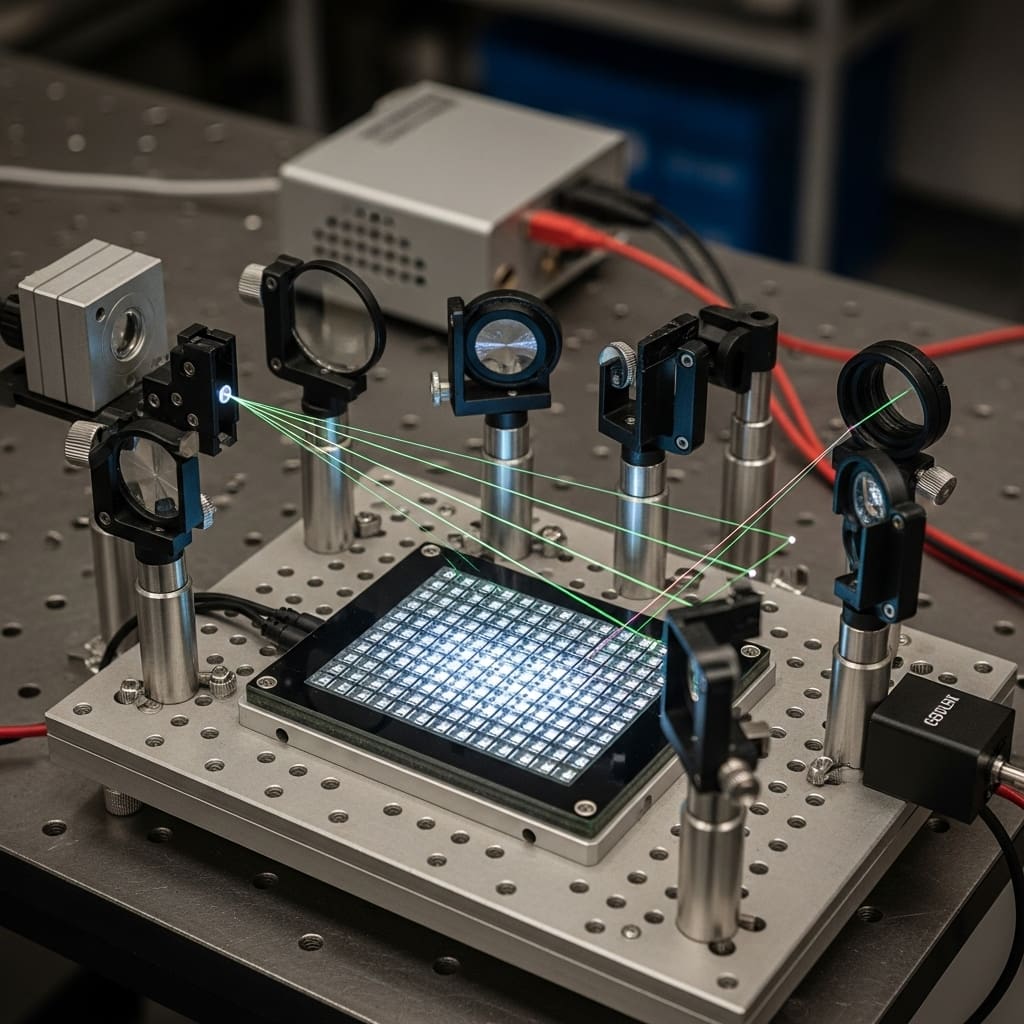
Tensor network methods represent a powerful new approach to computation, bridging the gap between the potential of quantum systems and the practicality of classical algorithms. Nicolas Allegra from Thales Alenia Space and colleagues demonstrate the application of these techniques to key challenges in image processing and classical optics, drawing direct parallels with principles from quantum mechanics. This research exploits the compressive power of tensor networks to accelerate complex operations such as wave-front propagation and image formation, offering the promise of significantly faster algorithms. The resulting advancements have broad implications for fields including astronomy, earth observation, microscopy, and a wide range of classical imaging applications, potentially revolutionising data processing in these areas.
These quantum-inspired methods promise faster algorithms with applications ranging from astronomy and earth observation to microscopy and classical imaging more broadly.
Pauli-Z Expansion and Unitary Time Evolution
This research presents a detailed and mathematically rigorous exploration of Pauli-Z expansions, unitary evolution, and coefficient analysis. The core idea involves representing operators, relevant to quantum many-body systems, as a sum of products of Pauli-Z operators acting on individual qubits. Scientists then investigate how to determine the time evolution of a quantum system, finding that because Pauli-Z operators commute, the calculation simplifies dramatically. The team analyzed the properties of these coefficients, deriving an exact formula and demonstrating that they decay rapidly as the number of qubits in a term increases.
This rapid decay is crucial because it enables the development of efficient approximations and facilitates a compact representation of quantum states and operators, connecting to matrix product operators. This research is highly relevant to the study of strongly correlated quantum systems, where traditional methods often fail. The Pauli-Z expansion and matrix product operator representation provide a way to approximate the ground state and dynamics of these systems, with applications in condensed matter physics, such as studying magnetism, superconductivity, and topological phases of matter. Future research directions include developing adaptive truncation schemes and performing a rigorous error analysis to quantify the accuracy of the approximations. This work represents a significant advancement in our ability to simulate and understand complex quantum systems.
Tensor Networks Achieve Scalable Image Compression
This research demonstrates a powerful application of tensor networks, originally developed for quantum physics, to significantly enhance classical image processing. Scientists achieved substantial compression improvements by applying quantics tensor trains and tree tensor networks to represent and manipulate image data. The team measured how the error scales with system size, revealing that quantics tensor trains exhibit an error rate independent of system size in an efficient regime, while simultaneously achieving a compression ratio that increases polynomially with system size. Further analysis revealed a crucial distinction between quantics tensor trains and matrix product states.
The research showed that the quantics tensor train approach reaches a lower error limit, particularly at high resolution where pixel noise dominates, and that tensor trees consistently act as compressors, maintaining a compression ratio even in the thermodynamic limit. Quantitative comparisons demonstrate this advantage, with tensor trees outperforming matrix product states and continuing to compress images even at reconstruction errors as low as 10 -5. Specifically, for an error of 10 -3, the compression ratio for quantics tensor trains was measured at 4. 2, while for an error of 10 -5, the ratio reached 2. 3. These findings suggest that tensor networks offer a significant advantage over standard image compression algorithms, particularly for large datasets and relatively high error tolerances, paving the way for faster and more efficient image processing techniques with potential applications in astronomy, earth observation, and microscopy.
Quantum Optics Solved with Tensor Networks
Researchers have demonstrated the effectiveness of tensor network methods for applications in image processing, building on their established success in simulating complex quantum systems. This work casts problems in Fourier optics as analogous to quantum mechanics, representing optical evolution using matrix product operators, a technique that enables efficient computation through data compression. The team successfully applied this quantum-inspired technique to problems involving wave-front propagation and image formation, demonstrating its potential for a range of optical applications. Future research will focus on solving inverse problems, such as phase retrieval, denoising, and deconvolution, with potential benefits for fields including astronomy, earth observation, and microscopy.
👉 More information
🗞 Tensor network methods for quantum-inspired image processing and classical optics
🧠 ArXiv: https://arxiv.org/abs/2510.23089