
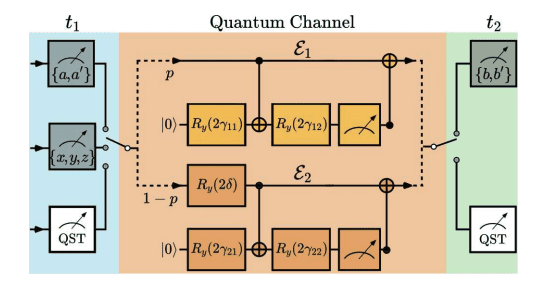
In a significant advancement in quantum physics, researchers led by Hao-Cheng Weng have successfully demonstrated the full spectrum of temporal quantum correlations using a superconducting qubit. Their findings, published on May 2, 2025, reveal insights into non-Markovian dynamics and offer practical applications for quantum benchmarking and secure communication protocols.
The study observes the full hierarchy of temporal correlations—nonmacrorealism, temporal steering, and inseparability—in a superconducting qubit. It identifies unique dynamics, such as sudden death or revival of temporal steering, which serve as benchmarks for qubit performance. Applications include identifying causal structures in networks, quantifying non-Markovianity in open systems, and establishing bounds for key distribution. The research demonstrates the non-Markovian behavior of a single superconducting qubit on a circuit, highlighting its utility in quantum information science.
In an era where quantum technology promises transformative advancements, maintaining the integrity of quantum states remains a cornerstone of secure communication and computing. Researchers have recently unveiled a novel method that leverages quantum channels with memory to safeguard temporal correlations in two-qubit states, significantly bolstering security.
Quantum memory systems are pivotal for storing quantum information while preserving critical properties such as superposition and entanglement. The primary challenge lies in mitigating decoherence, where quantum states interact with their environment, leading to a loss of these essential properties. This interaction is a significant hurdle in maintaining the fidelity of quantum operations.
Memory-Assisted Channels: A Strategic Innovation
The researchers have developed quantum channels that possess memory, retaining information about past interactions. This characteristic proves advantageous for error correction and sustaining state coherence over time. By enhancing the preservation of temporal correlations, these channels offer a robust solution for maintaining the integrity of quantum systems.
Experiments conducted under varying noise levels and channel conditions demonstrated that memory-assisted channels significantly outperformed traditional methods in preserving entanglement and coherence, particularly in high-noise environments. This robustness is crucial for real-world applications where environmental interferences are inevitable, paving the way for more reliable quantum communication.
The implications of this research are profound for quantum networks and computing. Enhanced preservation of quantum states could enable secure communication over larger distances and facilitate more complex computations with fewer errors. Potential applications include new quantum protocols and improved security in quantum key distribution, marking a significant step towards scalable and reliable quantum systems.
While the theoretical benefits are clear, practical implementation remains a consideration. The feasibility of these channels with current technology, including the materials and technologies needed for their development, requires further exploration. Addressing these challenges will be essential for translating this innovation into real-world applications.
This advancement aligns with the broader goal of creating scalable and reliable quantum systems, essential for future technologies. By leveraging memory in quantum channels, researchers have taken a significant step towards more practical and secure quantum communication networks. In summary, the use of memory-assisted channels represents a pivotal advancement in quantum security, offering enhanced robustness against environmental noise and paving the way for next-generation quantum technologies.
👉 More information
🗞 Observation of Full Hierarchy of Temporal Quantum Correlations with a Superconducting Qubit
🧠 DOI: https://doi.org/10.48550/arXiv.2505.01379