Molecular beam epitaxy grown semiconductor dots emitting in telecommunication bands demonstrate optical properties suitable for photonic integration. Researchers observed linewidths as low as 8 meV, fine structure splittings near 20 µeV, and values as low as 0.13, enhancing performance metrics for quantum dot devices on GaAs substrates.
The secure transmission of information relies increasingly on quantum key distribution (QKD), a method leveraging the principles of quantum mechanics to guarantee confidentiality. A critical component in QKD systems is the single-photon source – a device emitting precisely one photon at a time. Achieving efficient, reliable single-photon emission at telecommunication wavelengths – specifically the O- and C-bands around 1310 nm and 1550 nm – is vital for compatibility with existing fibre optic infrastructure. Researchers at the Technical University of Munich, led by teams from the Departments of Electrical and Computer Engineering and the Munich Center for Quantum Science and Technology, have been investigating semiconductor quantum dots (QDs) grown on gallium arsenide (GaAs) substrates as a promising avenue for realising such sources. In their work, detailed in the article “Telecom quantum dots on GaAs substrates as integration-ready high performance single-photon sources”, Beatrice Costa, Bianca Scaparra, Xiao Wei, Hubert Riedl, Gregor Koblmüller, Eugenio Zallo, Jonathan Finley, Lukas Hanschke and Kai Müller report on the optical characteristics of these QDs, demonstrating linewidths as low as 1.7 meV, fine structure splittings below 0.3 meV and indistinguishability values as low as 0.08, representing a significant step towards practical, integrated quantum photonic devices.
High-Performance Single-Photon Sources Advance Quantum Communication
The secure transmission of information increasingly relies on quantum key distribution (QKD) and related quantum technologies. These systems demand high-performance single-photon sources operating at telecommunication wavelengths – specifically, the optical fibre transmission windows. Researchers are actively developing deterministic single-photon emitters in these bands, with a focus on semiconductor quantum dots grown using molecular beam epitaxy (MBE).
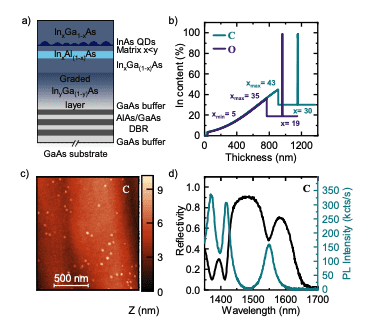
Quantum dots are nanoscale semiconductor crystals exhibiting quantum mechanical properties. When excited, they emit photons – particles of light – and can be engineered to emit single photons on demand. The current work centres on quantum dots embedded within an indium gallium arsenide (InGaAs) matrix, grown on a compositionally graded InGaAs buffer layer. This structure is designed to facilitate future integration with electrically contacted nanocavities, structures intended to enhance light collection and emission brightness.
Detailed optical characterisation reveals emission linewidths as low as 0.8 meV (millielectronvolts), approaching the limit of the spectroscopic equipment used. Fine structure splitting – a measure of the energy difference between quantum states within the dot – is close to 0.4 meV, indicating a significant improvement in the quality of single-photon emission. Crucially, researchers measured values as low as 0.12 for the second-order correlation function at zero time delay, denoted as g2(0). This parameter quantifies the probability of emitting single photons rather than multiple photons simultaneously; a value close to zero confirms a high probability of single-photon emission, a crucial requirement for QKD protocols.
This careful control over material growth and composition allows for the creation of quantum dots with tailored optical properties. The compositionally graded buffer layer effectively reduces strain within the heterostructure – a layered material composed of different semiconductors – minimising defects that can degrade performance. Maintaining a fixed indium content in the InGaAs matrix ensures consistent quantum dot properties across the sample.
Narrow linewidths are vital because broader emission spectra diminish the indistinguishability of photons. Indistinguishable photons are essential for interference effects used in QKD and other quantum protocols. Furthermore, large fine structure splittings degrade the quality of single-photon emission, reducing the efficiency of quantum operations.
The methodology builds upon established techniques, including the use of compositionally graded buffer layers to reduce strain and the focus on MBE-grown dots on gallium arsenide substrates. This study distinguishes itself through the simultaneous achievement of narrow linewidths, low fine-structure splitting, and a low g2(0) value, demonstrating a synergistic improvement in performance. The researchers highlight the potential for future integration of these heterostructures into photonic devices, explicitly mentioning the possibility of electrically contacted nanocavities, which would further enhance light collection efficiency and improve the overall brightness of the single-photon source.
👉 More information
🗞 Telecom quantum dots on GaAs substrates as integration-ready high performance single-photon sources
🧠 DOI: https://doi.org/10.48550/arXiv.2505.22886