Researchers from Tel Aviv University have demonstrated that inelastic decay can occur in integrable systems, which are typically characterized by purely elastic scattering. The team used circuit quantum electrodynamics (cQED) to simulate integrable boundary models, showing that microwave photons could undergo inelastic decay due to a nonlinear relationship with elastically scattered excitations. The study also developed a method for calculating exact expressions for response functions describing inelastic decay, which could have wider applications in integrable quantum field theories. The findings challenge traditional understanding of integrable systems and could enhance our understanding of many-body quantum models.
What is the Significance of Inelastic Decay in Integrable Systems?
Integrable systems are characterized by purely elastic scattering of their excitations, a feature that has drawn significant theoretical interest. These systems possess an extensive number of locally conserved charges, leading to the conservation of the number of scattered excitations as well as their set of individual momenta. In a recent study by Amir Burshtein and Moshe Goldstein from the Raymond and Beverly Sackler School of Physics and Astronomy at Tel Aviv University, it was shown that inelastic decay can nevertheless be observed in circuitQED realizations of integrable boundary models.
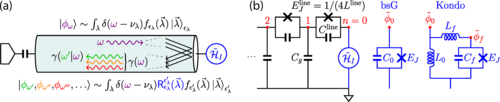
The researchers considered the scattering of microwave photons off impurities in superconducting circuits implementing the boundary sine-Gordon and Kondo models, both of which are integrable. They demonstrated that not only is inelastic decay possible for the microwave photons due to a nonlinear relation between them and the elastically scattered excitations, but also that integrability provides powerful analytical tools allowing for the calculation of exact expressions for response functions describing the inelastic decay.
Using the framework of form factors, the researchers calculated the total inelastic decay rate and elastic phase shift of the microwave photons extracted from a two-point response function. They then went beyond linear response and obtained the exact energy-resolved inelastic decay spectrum using a novel method to evaluate form factor expansions of three-point response functions. This method could prove useful in other applications of integrable quantum field theories.
How Does Integrability Impact Experimental Observations?
Integrability is not just a theoretical curiosity. Recent advances in the fabrication techniques of quantum simulators have enabled the experimental realization of integrable systems, leading to an interplay between experiment and theory. The past decade has seen several theoretical breakthroughs concerning the equilibrium and out-of-equilibrium dynamics of integrable systems that go hand in hand with surprising experimental observations.
Essentially, integrability gives rise to counterintuitive experimental measurements that push the boundaries of well-established theoretical frameworks and improve our understanding of the role of integrability in an ever-growing list of mechanisms. Experiments on the quantum simulation of many-body quantum models, both integrable and non-integrable, have been mostly restricted to the realm of cold-atom systems.
Another possible platform for quantum simulation is that of superconducting circuits. The rapidly evolving field of circuit quantum electrodynamics (cQED) deals with the simulation of interacting models by means of Josephson junctions or their flux-tunable counterparts, the superconducting quantum interference devices (SQUIDs).
What Role Does Circuit Quantum Electrodynamics Play?
The field of circuit quantum electrodynamics (cQED) reveals its true strength in the simulation of quantum impurity models. The intrinsically large kinetic inductance of Josephson junctions allows one to design transmission lines with impedances on the order of the resistance quantum, providing an environment for photons with an effective fine-structure constant of order unity.
Furthermore, the nonlinearity of the junctions provides the means to realize many types of quantum impurities that are strongly coupled to the photonic environment. Single-photon spectroscopy then provides highly sensitive tools to investigate the fine details of the boundary models of interest across a wide range of parameters and probe fundamental phenomena in those many-body systems.
The starting point of this work is an experimentally observed phenomenon that is seemingly at odds with integrability. Recent experiments have demonstrated that photons propagating in a high-impedance transmission line setting an environment with a large effective light-matter coupling scatter inelastically off a quantum impurity with a very high probability.
How Does Inelastic Decay Persist in Integrable Systems?
These observations have been reproduced in several studies. It appears that such photon splitting has nothing to do with integrability as scattering processes in integrable systems are highly restricted by the extensive number of local conservation laws forbidding particle production.
The flexibility of the circuit elements provides us with tools to check this assumption by tuning the impurity parameters to those of integrable boundary models. Strikingly, experiments show that inelastic decay persists even when the impurity parameters are pushed toward those of the boundary sine-Gordon (bsG) model, which is known to be integrable.
This study by Burshtein and Goldstein provides valuable insights into the behavior of integrable systems and the role of inelastic decay. It also offers a powerful analytical tool for calculating exact expressions for response functions describing inelastic decay, which could be useful in other applications of integrable quantum field theories.
Publication Date: 2024-04-29
Authors: Amir Burshtein and Moshe Goldstein
Source: PRX Quantum 5, 020323
DOI: https://doi.org/10.1103/PRXQuantum.5.020323