The term “Magnificent 7” tech stocks refers to seven leading technology companies that dominate the market and are considered key drivers of innovation and growth within the tech sector. These companies include Alphabet (Google), Amazon, Apple, Meta Platforms (Facebook), Microsoft, Nvidia, and Tesla.
The concept highlights their significant influence on the stock market and global economy due to their large market capitalizations, cutting-edge technologies, and dominant market positions in their respective industries. These tech giants have become benchmarks for performance in the tech industry, attracting substantial investment from institutional and retail investors. This article is not investment advice.
Grouping leading tech stocks began with the acronym FAANG, which initially stood for Facebook, Apple, Amazon, Netflix, and Google. Coined by Jim Cramer of CNBC, FAANG represented the most influential tech companies of the time, known for their rapid growth and innovation. Over time, as the market landscape evolved, additional influential tech companies like Microsoft and Nvidia were recognized for their substantial contributions to the tech sector, leading to the group’s expansion.
As a result, the Magnificent 7 (seven) emerged as a broader representation of the leading tech stocks, encompassing more companies that significantly impact the market. The tickers for each company are provided by Google Finance or Yahoo Finance. GOOGL: Yahoo Finance, AMZN: Yahoo Finance, AAPL: Yahoo Finance, META: Yahoo Finance, MSFT: Yahoo Finance, NVDA: Yahoo Finance, TSLA: Yahoo Finance
Besides FAANG, other variations such as FANG (excluding Apple), FAAMG (replacing Netflix with Microsoft), and now the Magnificent 7 reflect the dynamic nature of the tech industry and the shifts in market leadership. Each acronym highlights different combinations of companies based on their market performance, technological advancements, and strategic importance. Including companies like Tesla and Nvidia in the Magnificent 7 underscores the increasing importance of artificial intelligence, electric vehicles, and advanced hardware in the tech ecosystem. These variations serve as shorthand for investors to identify and track the leading players in the tech sector, reflecting their evolving roles in driving market trends and technological progress.
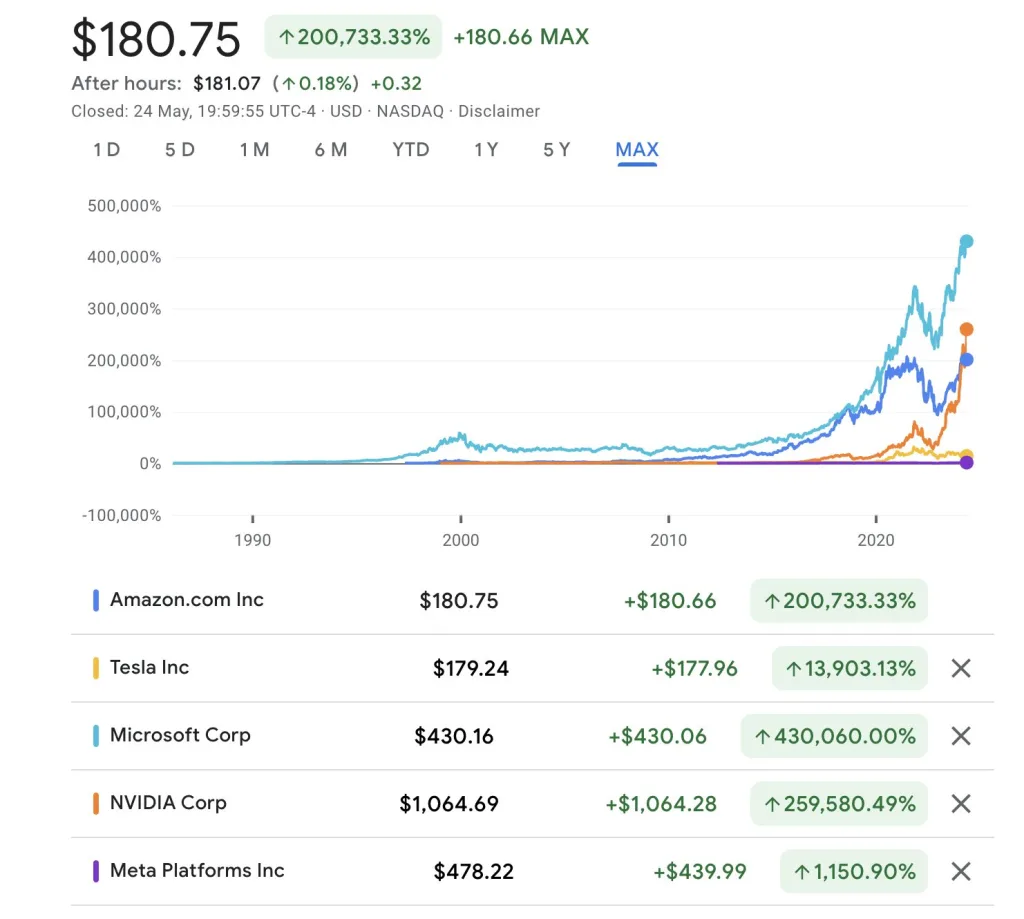
The Rise of AI?
The rise of AI has likely led to the creation of the new moniker. Since the debut of chatGPT, the world has been ablaze with development after development, leading to massive speculation and many technology companies focusing on or refocusing on artificial intelligence. The LLM from OpenAI has been the fastest-growing service, reaching 100 million users. OpenAI is not public, so it obviously is not part of the Magnificent 7, but we think it would be in there or making Magnificent 8 if it were public.
Companies such as Nvidia are critical enablers in the AI revolution. Nvidia makes GPUs, or Graphical Processing Units, which enable rapid computation of the often deep neural networks within LLMs that power services from OpenAI, such as chatGPT. The world has gotten GPU fever in the race to create AI services powered by models with often billions and billions of parameters that would never work with just a CPU. Hence, Nvidia was incorporated into the company collection.
Quantum Computing in the Magnificent 7
There are no pure-play quantum companies in the “Magnificent 7” line-up. Only Microsoft, Amazon, Nvidia, and Google/Alphabet have notable quantum programs. Apple, Tesla, and Meta have not built significant or visible quantum programs. Companies such as D-Wave and IonQ are pure-play quantum companies but minnows compared to the market caps of those large tech companies in the Mag 7. IonQ has a market cap of under 2 billion, while Google is around the 2 Trillion USD mark.
For some, Quantum may feel like the natural successor to AI, but it presents an entirely new computing paradigm and operates differently from a GPU. The key difference between Quantum Processing Units (QPUs) and other technologies lies in their fundamental approach to computation. While classical computers rely on binary bits to process information, QPUs leverage quantum bits or qubits, which can exist simultaneously in multiple states due to superposition and entanglement principles.
This allows QPUs to perform complex calculations in parallel, potentially enabling them to solve specific problems much faster than classical computers. Additionally, QPUs utilize quantum phenomena such as interference and tunneling to manipulate qubits, leading to the exploration of new algorithms and computational techniques beyond classical systems’ capabilities. As a result, QPUs promise to revolutionize various fields by tackling problems currently intractable with classical computing methods.
As we examine each of these companies and their quantum efforts, it’s worthwhile noting Nvidia. Of course, Nvidia is well known for its GPU devices, such as the Blackwell Chip, but its GPUs are also used to simulate quantum computers. So, in some ways, you might even say that Nvidia is the pathfinder for quantum computing.
Magnificent 7: What is missing?
IBM is missing from the “Magnificent 7” list, one of the world’s foremost providers of quantum computing services. We’re not saying it should be included, but Big Blue or IBM has one of the most famous quantum computing cloud services. However, when it comes down to AI, IBM isn’t a well-known player. Yes, it has cloud services and provides a range of IT services, but it’s not well known in this space and doesn’t appear to have the traction in tool uptake, unlike say Meta, Google, or Nvidia.
Also, there is no AMD or Intel among the magnificent 7. The market capitalization of these companies is far from that of its closest company, Nvidia, but both are working on GPUs and pushing their AI capabilities. Only Intel is building quantum devices or quantum hardware, unlike Nvidia, which hasn’t made a foray into actual quantum hardware.
The Magnificent 7 LineUp
Tesla
Tesla, Inc. was founded in July 2003 by engineers Martin Eberhard and Marc Tarpenning in San Carlos, California. The company’s mission was to prove that electric vehicles could be better, quicker, and more fun to drive than gasoline cars. The early development of Tesla was significantly influenced by Elon Musk, who led the initial Series A funding round in February 2004 and became the largest shareholder and chairman of the board. Musk played a crucial role in defining Tesla’s strategic vision, aiming to accelerate the world’s transition to sustainable energy. Tesla’s first vehicle, the Roadster, launched in 2008, utilized lithium-ion battery cells and demonstrated that electric cars could deliver high performance and long range.
Today, Tesla’s range of projects extends far beyond electric vehicles. The company produces a lineup of cars, including the Model S, Model 3, Model X, and Model Y, each targeting different segments, from luxury sedans to mass-market vehicles. Tesla has also made significant strides in renewable energy through Tesla Energy, which offers solar panels, solar roofs, and energy storage solutions like the Powerwall, Powerpack, and Megapack. These products aim to provide sustainable energy solutions for homes, businesses, and utilities.
Furthermore, Tesla is pioneering autonomous driving technology with its Full Self-Driving (FSD) software, which is continually updated to improve the capabilities of its vehicles. Tesla’s Gigafactories worldwide play a critical role in scaling production and driving down the costs of batteries and electric vehicles.
Tesla continues to innovate with projects that push the boundaries of technology in the automotive and energy sectors. The company is developing the Tesla Semi, an all-electric truck designed for freight transport, and the Cybertruck, a futuristic pickup truck. Tesla’s advancements in battery technology, including its work on the 4680 battery cell, promise to increase energy density and reduce costs, making electric vehicles more accessible. The company is also exploring new frontiers with its projects in energy grid services and vehicle-to-grid technology, which enable electric vehicles to contribute to the stability of electrical grids. Tesla’s commitment to sustainability and technological innovation positions it as a leader in transitioning to a sustainable energy future.
Tesla is the only metal basher in the “Magnificent 7” line-up. It is the only one shipping a product other than chips or software. It might be seen as a computer on wheels and an increasingly smarter platform on wheels at that. With the rise of competition from China, we think the company’s renewed focus on AI is going to come into focus as it tries to move up the value chain away from “just” an EV and into areas like robot taxis and full automation, and of course its robots like Optimus.
Tesla and Quantum Computing
Tesla might be vaunted as an AI company rather than a metal-bashing car company, and its efforts to drive AI into our lives have so far been lacking. Even self-driving isn’t quite here yet, but we are confident it’s the next natural evolution and will eventually happen. Tesla is also working on robotic technology.
We don’t know of any quantum technology efforts from Tesla. Still, we certainly think it could explore this in the future, for it would have some potential use cases, such as in route planning and optimization, which has seen the likes of companies such as Ford and VW explore. One area might well be in battery tech, where creating better materials to extend battery performance, including range and battery lifetime, could be potential quantum computing applications.
Some investors and analysts see Tesla as an “AI” player rather than an automaker. Whether Elon Musk will ever start a Quantum Computing effort remains to be seen. Elon already covers Space, Autos, Brain Interface, and AI (via Grok), so perhaps Tesla will not be the natural home for any quantum innovation that Musk wants to pursue and thus will remain outside of the Magnificent 7.
Microsoft
Microsoft Corporation was founded on April 4, 1975, by Bill Gates and Paul Allen in Albuquerque, New Mexico. It is one of the more mature and established Magnificent 7 companies which is approaching almost a half a century in business.
The company initially aimed to develop and sell BASIC interpreters for the Altair 8800, an early personal computer. Microsoft’s breakthrough came in 1980 when it partnered with IBM to provide an operating system for IBM’s personal computers, leading to the creation of MS-DOS. The success of MS-DOS, followed by the introduction of Microsoft Windows in 1985, established Microsoft as a dominant player in the software industry. Windows graphical user interface revolutionized personal computing, making it more accessible to a broader audience and setting the stage for Microsoft’s growth and influence in the technology sector.
Today, Microsoft’s range of projects spans many sectors beyond operating systems. The company’s flagship products include the Windows operating system, Microsoft Office suite, and Azure cloud computing platform. Azure has become one of the leading global cloud service providers, competing with Amazon Web Services (AWS). Microsoft is also heavily invested in the gaming industry through its Xbox console and game development studios and the acquisition of ZeniMax Media. Additionally, Microsoft offers a variety of enterprise solutions such as Dynamics 365, LinkedIn, and GitHub, which enhance productivity and collaboration across businesses and developers. The company’s Surface line of hardware products, including laptops, tablets, and accessories, further exemplifies its commitment to creating integrated hardware and software solutions.
Microsoft continues to innovate with significant investments in artificial intelligence (AI), machine learning, and mixed reality technologies. The company’s AI research division, Microsoft Research, works on advancements in natural language processing, computer vision, and predictive analytics. Microsoft is also pioneering mixed reality with its HoloLens device, which merges digital content with the physical world for applications in education, healthcare, and industry. In addition, the company is focusing on sustainability and carbon reduction initiatives, pledging to be carbon-negative by 2030. Microsoft’s future directions include expanding its cloud services, enhancing AI capabilities, and developing new technologies that integrate seamlessly into everyday life and business processes.
Microsoft Quantum Computing Efforts
Microsoft’s quantum computing efforts are spearheaded by its Quantum program, which aims to develop scalable quantum computers to solve complex problems beyond the reach of classical computers. The company is developing quantum hardware (or was), a topological qubit, a new type of qubit that promises greater stability and error rates lower than those of existing quantum systems.
Microsoft provides a comprehensive quantum development environment through its Azure Quantum platform, which includes quantum hardware from various partners and the Q# programming language specifically designed for quantum applications. This platform allows researchers and developers to explore quantum algorithms and applications, leveraging Microsoft’s cloud infrastructure to simulate and run quantum computations.
By making quantum computing accessible through Azure Quantum, Microsoft aims to democratize the technology, enabling businesses and researchers to solve problems in cryptography, material science, and complex system simulations. Collaborations with academic institutions and industry partners will be crucial in pushing the boundaries of what quantum computing can achieve. As Microsoft continues to innovate in this space, it positions itself as a critical player in the future of computing technology.
Microsoft has extensive experience creating developer tools such as C#, VB, and Visual Studio. However, according to popularity, Q# comes in second after Qiskit (the quantum framework from IBM) regarding ranking.
Apple
Apple Inc. was founded on April 1, 1976, by Steve Jobs, Steve Wozniak, and Ronald Wayne in Cupertino, California. The company’s first product was the Apple I, a personal computer designed and hand-built by Wozniak. Following the success of the Apple I, Apple launched the Apple II in 1977, which became one of the first highly successful mass-produced microcomputers. The introduction of the Macintosh in 1984, with its innovative graphical user interface, further solidified Apple’s position in the personal computer market. Despite facing financial difficulties in the mid-1990s, Apple underwent a significant transformation after Jobs returned to the company in 1997, leading to rapid innovation and growth.
Today, Apple is known for its wide range of products and services that span various sectors. The company’s flagship product lines include the iPhone, iPad, Mac, Apple Watch, and Apple TV. Each product has its own ecosystem, supported by the iOS, macOS, watchOS, and tvOS operating systems, respectively. In addition to hardware, Apple offers a suite of digital services such as the App Store, Apple Music, Apple Pay, and iCloud. The company has also ventured into original content production with Apple TV+, its streaming service featuring exclusive movies, TV shows, and documentaries. Apple’s commitment to integrating hardware, software, and services has created a worldwide robust and loyal customer base.
Apple continues to innovate with projects that push the boundaries of technology and design. The company’s recent focus includes augmented reality (AR) advancements through ARKit, providing developers with tools to create immersive AR experiences for iOS devices. Apple is also heavily invested in health and wellness technologies, as evidenced by features like ECG monitoring in the Apple Watch and the development of HealthKit and ResearchKit frameworks. Apple’s commitment to environmental sustainability is reflected in its initiatives to use recycled materials and renewable energy across its supply chain. Looking ahead, Apple is rumored to be developing augmented reality glasses and exploring opportunities in autonomous systems and electric vehicles.
Quantum Computing Efforts
While Apple has not made as much of a push into quantum computing as some of its tech counterparts, the company is known for its secretive and strategic approach to emerging technologies. Apple reportedly has a secret EV car project, but it was never released. Could something be rumbling in the quantum space? We think not; we’ve not heard rumors or hiring for quantum specialist people.
Of all the companies in the magnificent 7, Apple is somewhat the most conservative and focused on products it can deliver with an edge. Therefore, we expect to wait for a clear commercial imperative to enter the quantum space. Apple has hardware experience, which could lend itself naturally to Quantum Technologies.
Amazon
Amazon was founded by Jeff Bezos on July 5, 1994, in Seattle, Washington. Initially launched as an online bookstore, Amazon quickly expanded its product range to include electronics, clothing, and other consumer goods. Bezos’s vision was to create an “everything store” that could capitalize on the growing internet commerce market. The company’s innovative approach to online retail, including features such as customer reviews and personalized recommendations, helped it quickly gain market share. Amazon went public in 1997, and its growth has been exponential since, evolving into one of the world’s largest and most influential e-commerce and technology companies.
Today, Amazon’s projects span a wide array of industries beyond e-commerce. Amazon Web Services (AWS), launched in 2006, has become a cornerstone of the company, providing scalable cloud computing services that power countless websites and applications worldwide. Amazon Prime, introduced in 2005, offers customers benefits like free shipping and streaming services, significantly boosting customer loyalty and revenue. Additionally, Amazon has made significant strides in hardware with products like the Kindle e-reader, Echo smart speakers powered by the Alexa voice assistant, and the Fire tablet. The company also owns Whole Foods Market, extending its reach into the grocery industry.
Amazon continues to innovate across multiple sectors. The company’s commitment to artificial intelligence and machine learning is evident in AWS’s advanced AI services and the development of Alexa. Amazon Go stores, utilizing “Just Walk Out” technology, showcase the company’s push towards a future of automated retail. Furthermore, Amazon is investing heavily in logistics and delivery, including developing drone delivery through its Prime Air service and expanding its own transportation network. Amazon’s foray into entertainment, producing original content through Amazon Studios, reflects its ambition to be a dominant player in the media industry as well.
Amazon and Quantum Computing
Amazon has also entered the quantum computing arena, primarily through its AWS division. AWS offers Amazon Braket, a fully managed quantum computing service that allows researchers and developers to explore and experiment with quantum algorithms using different quantum hardware providers, including D-Wave, IonQ, and Rigetti. This platform makes quantum computing more accessible, enabling users to build, test, and run quantum algorithms in a simulated environment before deploying them on real quantum processors. Amazon Braket is part of AWS’s broader strategy to support cutting-edge research and development in quantum computing.
Amazon’s involvement in quantum computing is expected to grow as the technology matures. The company’s investment in this field aims to harness quantum computing’s potential to solve complex problems in optimization, cryptography, and materials science beyond classical computers’ capabilities. By integrating quantum computing capabilities into its robust AWS ecosystem, Amazon aims to provide a comprehensive platform for innovation that could revolutionize industries ranging from pharmaceuticals to logistics. This strategic focus underscores Amazon’s commitment to being at the forefront of technological advancements and delivering powerful tools to its customers.
Nvidia
Nvidia Corporation was founded in April 1993 by Jensen Huang, Chris Malachowsky, and Curtis Priem. The three engineers saw a growing market for graphics-based computing and anticipated that multimedia would become central to personal computing. Nvidia’s initial focus was on creating graphics processing units (GPUs) to enhance the performance of computer graphics. The company’s breakthrough came in 1999 with the release of the GeForce 256, the world’s first GPU, which significantly advanced the capabilities of personal computer graphics. This innovation established Nvidia as a leader in the graphics industry and set the stage for its future growth.
Today, Nvidia’s project range extends far beyond GPUs for gaming. The company has diversified into sectors like artificial intelligence (AI), data centers, and autonomous vehicles. Nvidia’s GPUs are now integral to AI and machine learning applications, with its CUDA platform enabling developers to leverage GPU power for various computational tasks. The company’s data center products, including the Nvidia A100 Tensor Core GPU, are critical for high-performance computing and AI workloads. Additionally, Nvidia’s DRIVE platform is a comprehensive solution for autonomous vehicles, encompassing hardware, software, and simulation tools to develop self-driving technologies.
Nvidia continues to innovate with projects that push the boundaries of technology. The company is heavily invested in AI research, developing frameworks like Nvidia TensorRT for deep learning inference and Nvidia Clara for healthcare imaging and genomics. Nvidia’s Omniverse platform is designed to facilitate collaboration and simulation in virtual worlds, enabling professionals to create and connect 3D workflows. Moreover, Nvidia collaborates with industry giants and academic institutions to advance AI and high-performance computing, positioning itself at the forefront of technological innovation across multiple sectors.
Nvidia Quantum Computing Efforts
Nvidia has also ventured into the quantum computing domain, aiming to bridge the gap between classical and quantum computing. The company introduced the Nvidia cuQuantum SDK, a set of libraries and tools to accelerate quantum circuit simulations on GPUs. This effort is part of Nvidia’s broader strategy to support quantum research and development by providing powerful computational resources for simulating quantum algorithms. By enabling researchers to simulate quantum workloads on classical hardware, Nvidia helps accelerate the development and testing of quantum applications.
Looking ahead, Nvidia’s role in quantum computing is expected to grow as the field matures. The company’s GPUs will likely remain crucial for quantum simulations, providing a platform for researchers to explore quantum algorithms’ potential and performance. Nvidia’s collaborations with quantum computing companies and research institutions aim to seamlessly integrate quantum and classical computing workflows. This integration will be vital for advancing quantum computing applications in cryptography, materials science, and optimization problems, solidifying Nvidia’s position as a key player in the emerging quantum computing ecosystem.
Google / Alphabet
Google was founded in September 1998 by Larry Page and Sergey Brin while they were Ph.D. students at Stanford University. Their initial project, a search engine called “Backrub,” utilized a unique algorithm that analyzed the relationships between websites to rank search results. This algorithm was later renamed “Google,” derived from the mathematical term “googol,” which signifies the large number 1 followed by 100 zeros. Google’s mission was to “organize the world’s information and make it universally accessible and useful.” The search engine quickly gained popularity for its accuracy and speed, leading to its dominance in the search engine market by the early 2000s.
Over the years, Google has diversified far beyond its search engine roots. The company has expanded into various sectors, including advertising (with Google AdWords and AdSense), software (such as the Android operating system), hardware (like the Google Pixel phones and Google Home smart speakers), and cloud computing services through Google Cloud Platform. Google also owns YouTube, the world’s largest video-sharing platform, and has invested in artificial intelligence (AI) through its AI research lab, Google AI. These projects reflect Google’s broad strategy of leveraging technology to create interconnected ecosystems that enhance user experiences across multiple platforms.
Today, Google’s range of projects includes cutting-edge initiatives in artificial intelligence, quantum computing, autonomous vehicles, and healthcare technology. For instance, Google AI focuses on machine learning research and applications, developing tools like Google Assistant and advancements in natural language processing. Waymo, an autonomous driving technology company, originated as a Google project and is now a leader in self-driving car technology. Google Health aims to improve medical outcomes in healthcare through data-driven approaches and AI. Additionally, Google continues to enhance its core search engine capabilities, integrating AI to provide more personalized and efficient search experiences.
Alphabet and Quantum Computing
Google’s quantum computing endeavors are spearheaded by Google Quantum AI (Quantum Artificial Intelligence Lab). The lab aims to build quantum processors and develop new quantum algorithms to advance the field. In 2019, Google announced a major milestone by achieving “quantum supremacy,” where their 54-qubit processor, Sycamore, performed a specific computation significantly faster than the most powerful classical supercomputers available. This achievement highlighted the potential of quantum computers to solve complex problems currently intractable for classical computers. The two key developments from Google are hardware and software and their research into quantum supremacy,
Cirq is an open-source quantum computing framework developed by Google. It provides tools for writing, simulating, and executing quantum algorithms on quantum computers and simulators. Cirq is designed to be flexible and scalable, allowing researchers and developers to experiment with quantum circuits and explore quantum computing’s potential.
One of Cirq’s key features is its focus on hardware compatibility. It supports various quantum hardware platforms, including Google’s own quantum processors, such as the Sycamore processor. This compatibility enables users to run their quantum algorithms on real quantum hardware, providing valuable insights into their performance and scalability.
Cirq offers a Python-based programming interface, making it accessible to many users, from quantum researchers to software developers. Its intuitive syntax allows users to easily define quantum circuits, apply quantum gates, and simulate quantum operations. Additionally, Cirq provides powerful tools for error mitigation and noise modeling, helping users understand and address the challenges associated with quantum hardware.
Google’s commitment to quantum computing continues with efforts to scale quantum processors and refine error correction techniques. The company collaborates with academic institutions and research organizations to further the development of quantum technologies.
Meta, aka Facebook
Meta, originally known as Facebook, was founded in February 2004 by Mark Zuckerberg, along with fellow Harvard University students Eduardo Saverin, Andrew McCollum, Dustin Moskovitz, and Chris Hughes—one of the youngest Magnificent 7 companies.
Initially launched as a social networking site exclusive to Harvard students, Facebook quickly expanded to other universities and then to the general public. The platform’s rapid growth attracted significant investment and led to its initial public offering (IPO) in 2012. Facebook rebranded as Meta in October 2021, reflecting its broader ambitions beyond social media, particularly in the realm of the metaverse—a virtual reality space where users can interact with a computer-generated environment and other users.
Meta’s project range has significantly diversified since its inception. While the core Facebook platform remains a major focus, the company has developed and acquired several other prominent services, including Instagram, WhatsApp, and Oculus VR. Instagram and WhatsApp have grown into leading platforms in social media and messaging, respectively, each boasting billions of users. The acquisition of Oculus VR marked Meta’s entry into virtual reality, leading to the development of VR headsets like the Oculus Rift and Oculus Quest. Additionally, Meta invests heavily in AI, developing technologies for content moderation, augmented reality (AR), and advanced machine learning algorithms.
Currently, Meta is pioneering the development of the metaverse, an expansive, interconnected virtual space that integrates AR and VR to offer immersive experiences. Meta’s Horizon Workrooms and Horizon Worlds are early examples of its metaverse initiatives, aiming to revolutionize how people work, play, and interact online. The company also continues enhancing its AI capabilities, focusing on natural language processing and computer vision. Meta’s Reality Labs division is dedicated to researching and developing AR and VR technologies, including the anticipated AR glasses, which are expected to blend digital and physical worlds seamlessly.
Meta’s Quantum Computing Efforts
Despite creating many tools such as PyTorch and being an instrument in the AI space, there is no dedicated quantum program. Of course, naturally, AI may blend with quantum, leading to the development of a more concerted quantum effort. There are versions of PyTorch quantum which enable people to simulate quantum computations on classical hardware using PyTorch. It supports state vector simulation and pulse simulation on GPUs. It can scale up to the simulation of 30+ qubits with multiple GPUs.
So far, the Quantum work at Meta seems to relate to security, such as Post-quantum readiness for TLS at Meta. But we can discern no major push into quantum, but who knows? Meta has some very smart engineers and scientists working on various problems, and you never know when their interests will bleed over into the quantum domain.
A Magnificent 7 Round-Up
Only Amazon, Nvidia, Google, and Microsoft are actively involved in developing quantum technologies—four out of the Magnificent 7. Microsoft is developing quantum hardware with its topological qubits, which could offer error-corrected qubits. Google is still working on Quantum hardware based around superconducting qubits and has its own language, Cirq, which we think comes in roughly third, trailing Qiskit and Q#.
Microsoft has its Q# programming language (we like it a lot) for developing quantum circuits; however, it’s not a leading language compared to IBM’s Qiskit, the current “Go-to” quantum programming language and the most popular.
Google remains the only company doing both Hardware and Software in the Google space in what we would say is a meaningful way. Sorry, Microsoft. We love the tools, but we’d love to see a coordinated push into more areas and get the language better adopted among developers! Ditto for Google’s Cirq, which has some great syntax that seems pretty natural, especially for Python developers.
Amazon wants to be your gateway to quantum computing and remains agnostic about what provider or ultimate technology you choose to use to compute your quantum circuits, allowing you to decide how to run circuits in the cloud. Just as its AWS service has come to dominate how the world computes, it wants to recreate this for quantum computing workflows.
Legal Disclaimer
Quantum Zeitgeist does not provide personal investment or financial advice, or act as personal financial, legal, or institutional investment advisors, or individually advocate the purchase or sale of any security or investment or the use of any particular financial strategy. All investment strategies include the risk of loss for some or even all of your capital. Before pursuing any financial strategies discussed or relying on information within this website, you should always consult with a licensed financial advisor. Any analysis we provide is for informational purposes only and does not take into consideration your circumstances or other factors that may be important in making decisions. It should not be considered an individualized recommendation or personalized investment advice. Any investment vehicles, stocks, or securities mentioned may not be suitable for all investors.
References
- Meta Platforms, Inc. (2023). Our History. [online] Available at: https://about.fb.com/company-info/ [Accessed 27 May 2024].
- Zuckerberg, M. (2021). Founder’s Letter, 2021. [online] Available at: https://about.fb.com/news/2021/10/founders-letter/ [Accessed 27 May 2024].
- Meta Platforms, Inc. (2023). Reality Labs. [online] Available at: https://about.facebook.com/realitylabs [Accessed 27 May 2024].
- Stone, B. (2013). The Everything Store: Jeff Bezos and the Age of Amazon. New York: Little, Brown and Company.
- Meta AI. (2023). AI Research at Meta. [online] Available at: https://ai.facebook.com/ [Accessed 27 May 2024].
- Levy, S. (2021). Facebook: The Inside Story. New York: Blue Rider Press.
- Vance, A. (2015). Elon Musk: Tesla, SpaceX, and the Quest for a Fantastic Future. New York: Ecco.
- Tesla, Inc. (2023). About Tesla. [online] Available at: https://www.tesla.com/about [Accessed 27 May 2024].
- Lambert, F. (2021). Tesla’s Full Self-Driving Beta Update Released. [online] Available at: https://electrek.co/2021/10/24/tesla-full-self-driving-beta-update-release-notes/ [Accessed 27 May 2024].
- Tesla, Inc. (2023). Tesla Energy. [online] Available at: https://www.tesla.com/solarpanels [Accessed 27 May 2024].
- Kolodny, L. (2016). Tesla’s Acquisition of SolarCity. [online] Available at: https://www.cnbc.com/2016/11/21/tesla-solarcity-deal-approved-by-shareholders.html [Accessed 27 May 2024].
- Reuters. (2023). Tesla’s Battery Research and Development. [online] Available at: https://www.reuters.com/business/autos-transportation/tesla-expands-battery-research-lab-north-america-2023-03-29/ [Accessed 27 May 2024].
- Page, L., & Brin, S. (1998). The anatomy of a large-scale hypertextual Web search engine. Computer Networks and ISDN Systems, 30(1-7), 107-117.
- Google. (2023). Our history in depth. [online] Available at: https://about.google/our-story/ [Accessed 27 May 2024].
- Arute, F., Arya, K., Babbush, R., Bacon, D., Bardin, J. C., Barends, R., … & Neven, H. (2019). Quantum supremacy using a programmable superconducting processor. Nature, 574(7779), 505-510.
- Google AI Blog. (2019). Quantum Supremacy Using a Programmable Superconducting Processor. [online] Available at: https://ai.googleblog.com/2019/10/quantum-supremacy-using-programmable.html [Accessed 27 May 2024].
- Google Cloud. (2023). Google Cloud Platform. [online] Available at: https://cloud.google.com/ [Accessed 27 May 2024].
- Nvidia Corporation. (2023). About Nvidia. [online] Available at: https://www.nvidia.com/en-us/about-nvidia/ [Accessed 27 May 2024].
- Montrym, J., & Moreton, H. (1999). The GeForce 256 GPU architecture. IEEE Micro, 19(2), 41-52.
- Nvidia Developer Blog. (2021). Nvidia cuQuantum SDK: Accelerating Quantum Circuit Simulations. [online] Available at: https://developer.nvidia.com/blog/nvidia-cuquantum-sdk-accelerating-quantum-circuit-simulations/ [Accessed 27 May 2024].
- Huang, J., Malachowsky, C., & Priem, C. (1993). Nvidia Corporation. [online] Available at: https://www.forbes.com/companies/nvidia/ [Accessed 27 May 2024].
- Nvidia. (2023). AI & Deep Learning. [online] Available at: https://www.nvidia.com/en-us/deep-learning-ai/ [Accessed 27 May 2024].
- Amazon. (2023). Our History. [online] Available at: https://www.aboutamazon.com/our-company/history [Accessed 27 May 2024].
- Bezos, J. (1997). 1997 Letter to Shareholders. [online] Available at: https://www.aboutamazon.com/news/company-news/1997-letter-to-shareholders [Accessed 27 May 2024].
- Amazon Web Services. (2023). Amazon Braket: Quantum Computing on AWS. [online] Available at: https://aws.amazon.com/braket/ [Accessed 27 May 2024].
- Stone, B. (2013). The Everything Store: Jeff Bezos and the Age of Amazon. New York: Little, Brown and Company.
- Amazon. (2023). AWS Overview. [online] Available at: https://aws.amazon.com/what-is-aws/ [Accessed 27 May 2024].
- Gates, B., & Allen, P. (1975). Microsoft Founding Story. [online] Available at: https://www.microsoft.com/en-us/about [Accessed 27 May 2024].
- Microsoft Corporation. (2023). Our Company. [online] Available at: https://www.microsoft.com/en-us/about [Accessed 27 May 2024].
- Moody, G. (2001). Rebel Code: Inside Linux and the Open Source Revolution. Cambridge, MA: Perseus Publishing.
- Azure Quantum. (2023). Microsoft Quantum Development. [online] Available at: https://azure.microsoft.com/en-us/services/quantum/ [Accessed 27 May 2024].
- Microsoft Research. (2023). AI and Quantum Computing. [online] Available at: https://www.microsoft.com/en-us/research/research-area/artificial-intelligence/ [Accessed 27 May 2024].
- Turk, V. (2020). Microsoft’s Quantum Computing Ambitions. [online] Available at: https://www.wired.com/story/microsoft-quantum-computing-ambitions/ [Accessed 27 May 2024].
- Isaacson, W. (2011). Steve Jobs. New York: Simon & Schuster.
- Apple Inc. (2023). Apple Leadership and Company History. [online] Available at: https://www.apple.com/leadership/ [Accessed 27 May 2024].
- O’Grady, J. D. (2008). Apple Inc. Westport, CT: Greenwood Press.
- Lardinois, F. (2017). Apple ARKit: The Future of Augmented Reality. [online] Available at: https://techcrunch.com/2017/06/05/apple-arkit-the-future-of-augmented-reality/ [Accessed 27 May 2024].
- Apple Inc. (2023). Apple Environmental Responsibility. [online] Available at: https://www.apple.com/environment/ [Accessed 27 May 2024].
- Patents Assigned to Apple Inc. (2023). Quantum Computing Patents. [online] Available at: https://patents.justia.com/assignee/apple-inc [Accessed 27 May 2024].