The year 2024 has ushered in a wave of transformative technological advancements, shaping industries and redefining the boundaries of innovation. Artificial intelligence is being rapidly integrated into edge computing. Humanoid robots are beginning to enter mainstream markets. Here, we take a look at 7 Technology Trends of 2024.
The technological landscape is evolving at an unprecedented pace. Breakthroughs in generative AI highlight a shift toward machines capable of more complex reasoning. Early strides toward Artificial General Intelligence (AGI) demonstrate their advancing creativity.
Physics simulation has seen remarkable progress, enhancing gaming, robotics, and scientific research applications. Cyberpunk-like technologies are emerging simultaneously. They include augmented human interfaces and immersive virtual reality experiences. This signals the blending of digital and physical worlds. Quantum computing is taking a more central stage. It promises to unlock solutions to problems previously considered unsolvable.
Edge Computing Goes AI
As data grows exponentially, the cloud remains a cornerstone of modern technology. Edge computing brings computation closer to the data source. It is gaining traction for applications requiring real-time processing. This approach also reduces latency. Edge computing took on a new dimension with NVIDIA’s Nano Product.
Nvidia in 2024 has launched the Jetson Orin Nano Super Developer Kit recently. It is a powerful and compact AI supercomputer. It is designed for edge computing applications. This pocket-sized device offers a significant boost in performance compared to its predecessor, with a 1.7x increase in generative AI inference capabilities.

Humanoid Robots Become Obtainable
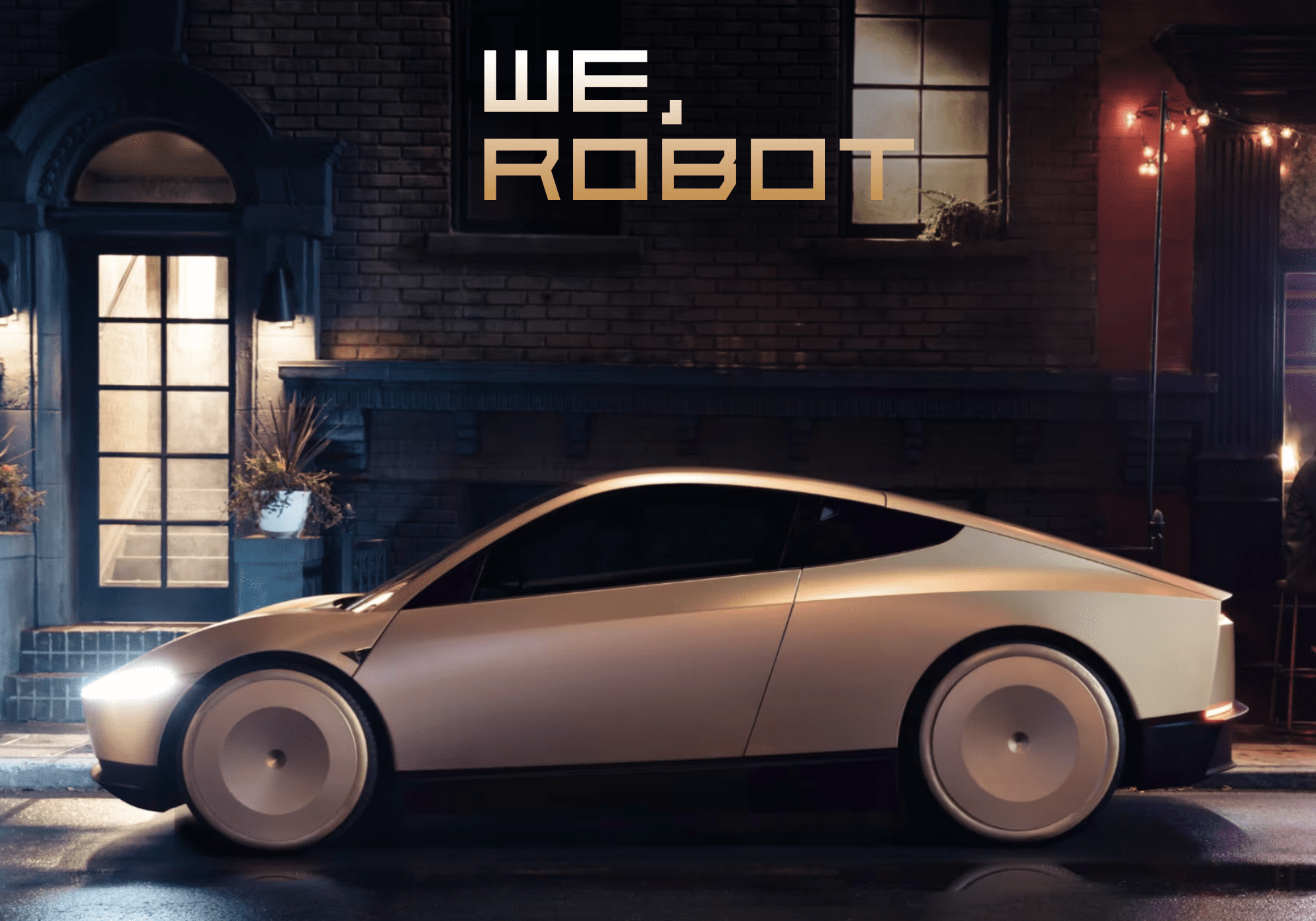
At Tesla’s “We, Robot” event in October 2024, Optimus was showcased with interactive demonstrations that garnered positive attention. Critics pointed out the robot’s interactions with the crowd depended heavily on tele-operation. This raised concerns about Tesla’s transparency regarding the robot’s capabilities. Elon Musk stated that Optimus is expected to handle daily tasks at home. It will also manage tasks in external environments. He projected that the robot would be available for purchase at an estimated price of approximately $30,000.
STAR1 is a highly advanced humanoid robot created by the Chinese robotics company Robot Era. It was officially unveiled in October 2024, making a splash with its impressive speed and agility.
This robot is designed for general-purpose use and stands at 171 cm tall, weighing 63 kg. It has powerful Intel processors. The Nvidia Orin computing platform gives it the ability to perform complex AI tasks. STAR1 also has incredibly dexterous hands with 12 degrees of freedom each, allowing it to grasp and manipulate objects with precision.
What sets STAR1 apart is its remarkable speed and agility. It can run at speeds up to 6 m/s and even achieved a record-breaking 3.6 m/s while navigating uneven terrain in the Gobi Desert. This is thanks to its advanced motion control, strong legs and feet, and AI algorithms that help it maintain balance and adapt to different surfaces.
Robot Era envisions STAR1 being used in a variety of applications, particularly in logistics and warehousing . Its ability to identify items, grasp and handle objects, and navigate complex warehouse environments makes it well-suited for tasks like picking, packing, and transporting goods.

Generative AI and AGI
Oh wow. Where do we begin? Just simply too many releases. We’ll only focus on a single innovation. The purported reasoning engine from OpenAI. This leads some to suggest that we have reached AGI.
Artificial General Intelligence (AGI) is a form of artificial intelligence. It is capable of understanding, learning, and performing any intellectual task that a human can do. Narrow AI is designed for specific tasks like language translation or image recognition. In contrast, AGI can generalize knowledge across domains. It can adapt to new, unfamiliar problems without requiring retraining for each task.
The OpenAI o3 model was announced on December 20, 2024. The name “o3” was selected to avoid potential trademark conflicts with the UK mobile carrier O2. The model is offered in two versions: o3 and o3-mini. OpenAI invited safety and security researchers to apply for early access. The application period is open until January 10, 2025. OpenAI plans to publicly release o3-mini in January 2025.
The o3 model utilizes reinforcement learning to improve its reasoning capabilities, employing what OpenAI calls a “private chain of thought.” This method allows the model to engage in intermediate reasoning steps, planning ahead to solve complex problems. While this enhances performance in challenging tasks, it requires more computational resources, leading to increased response latency.
In testing, o3 outperformed o1 in areas such as coding, mathematics, and science. It achieved an 87.7% score on the GPQA Diamond benchmark, which features expert-level science questions not available online. On SWE-bench Verified, a software engineering benchmark, o3 scored 71.7%, significantly higher than o1’s 48.9%. The model also demonstrated superior performance on Codeforces, achieving an Elo score of 2727 compared to o1’s 1891. In the ARC-AGI benchmark, o3 achieved three times the accuracy of o1. This benchmark assesses AI performance in handling novel mathematical and logical problems.
Physics Simulation Takes a Leap Ahead
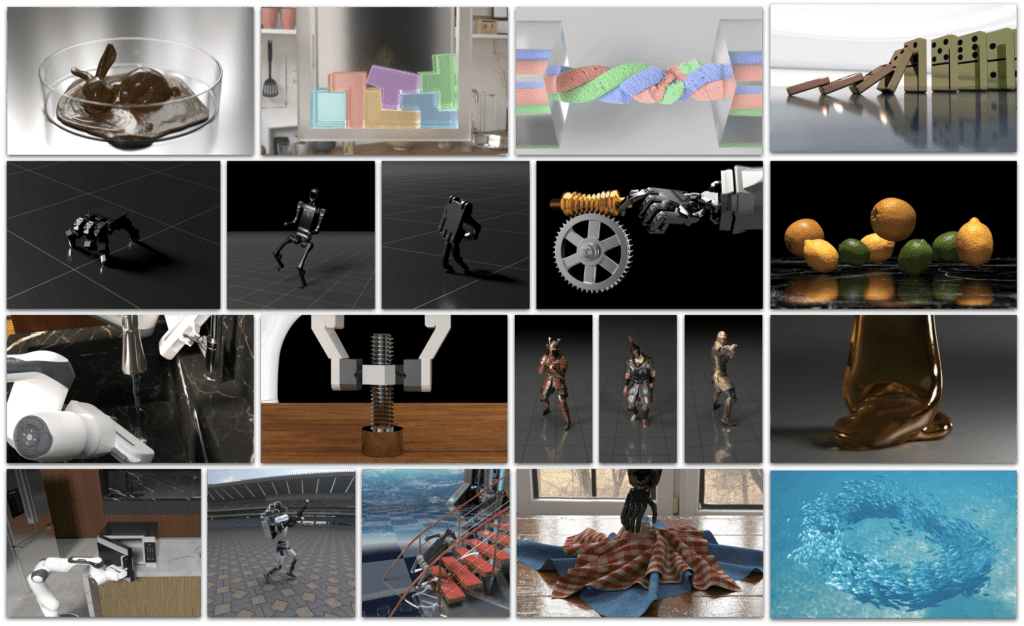
The Genesis simulation framework is a high-performance tool designed to support robotics, embodied AI, and physical AI applications. It excels in speed. It can simulate over 43 million frames per second (FPS) for robotic systems. This is achieved through GPU-accelerated parallel computation and advanced optimization techniques. This speed significantly surpasses other simulators like Isaac Gym and Mujoco. Genesis offers a universal physics engine that can simulate diverse materials and phenomena, including rigid bodies, liquids, gases, and deformable objects, creating a unified platform for physics-based simulations.
Genesis also features a user-friendly, pythonic interface that caters to developers and researchers with varying expertise levels. Its photo-realistic rendering system enables the creation of visually immersive simulations. Additionally, Genesis includes a generative data engine that can convert natural language descriptions into diverse datasets, streamlining the process of virtual environment creation and AI training data generation.
With applications spanning robotics training, embodied AI research, gaming physics, and AI data generation, Genesis is a versatile and valuable tool. As an open-source project, it invites collaboration and customization, fostering innovation and adaptation within the research community. Its performance and comprehensive capabilities position it as a key resource for advancing robotics and AI development.
Cyber Punk is Here
In October 2024, Tesla CEO Elon Musk unveiled the “Cybercab.” It is a fully autonomous robotaxi without traditional steering wheels or pedals. This vehicle represents Tesla’s commitment to advancing autonomous transportation solutions. The Cybercab is expected to enter production in 2026, with a target price below $30,000.
The Cybercab’s design emphasizes a minimalist interior, focusing on passenger comfort and maximizing space. Notably, it can be operated with an Xbox-style gaming controller. The controller plugs directly into the vehicle for manual control when necessary. This innovative approach aligns with Tesla’s vision of a future. In this future, autonomous vehicles are commonplace. This reduces the need for traditional driving interfaces.
Tesla’s Full Self-Driving (FSD) technology powers the Cybercab. It utilizes advanced AI and machine learning algorithms. These algorithms navigate complex urban environments without human intervention. Tesla plans to roll out FSD capabilities to other models, like the Model 3 and Model Y, in select regions by 2025. Meanwhile, the Cybercab is a dedicated autonomous vehicle. It aims at revolutionizing urban transportation.

Virtual Reality Gets Another Device
2024 was a significant year for Virtual Reality (VR). Exciting advancements marked it. There was a growing sense of the technology’s potential. We got to look at some new hardware from Apple: Vision Pro.
Apple Vision Pro is Apple’s augmented and virtual reality headset. It is a device that has been developing for over a decade. Vision Pro marks the company’s first entrance into a major new product category since the 2015 Apple Watch. The device launched on February 2, 2024.
Meta (formerly Facebook) launched the Meta Quest 3. It is at the more inexpensive end of the spectrum. The device offers improved performance and features at a more accessible price point.
New games, including Batman: Arkham Shadow and Behemoth, were released. These titles garnered critical acclaim for their engaging game-play and immersive experiences.

Quantum Computing Hits Limelight
As you’d expect from a largely quantum publication, a lot happened in 2024. Too detailed for here, but there are two aspects we think are notable. One is the rise of the logical qubits. That means qubits are stable against errors. This contrasts with previous work methods where errors were essentially “baked” into the system.
A logical qubit is a robust and error-corrected version of a physical qubit. Physical qubits are the basic units of information in a quantum computer. They are extremely fragile and prone to errors. This fragility is due to a phenomenon called decoherence. In decoherence, they lose their quantum properties through interaction with the environment. We see the movement away from the NISQ paradigm of quantum computing.
A single unit of quantum information is distributed across multiple physical qubits. This process employs sophisticated quantum error correction codes. These codes form a logical qubit. These codes are designed to detect and correct errors on the individual physical qubits. They create a more stable and reliable logical qubit. This logical qubit can maintain coherence for much longer periods.
Investors may have finally found quantum computing in 2024. They hope this will usher in the next round of technological enhancements, such as Quantum AI and other cross-overs. Share prices of companies like IonQ, Rigetti, and D-Wave have risen meteoric. This rise is partly due to a release from Google’s Quantum Team.
Look ahead to 2025
We have some predictions for 2025, predominantly in the quantum space, along with a 2025 Guide to Quantum Computers.