Researchers from the Technion Israel Institute of Technology and the University of Chicago have proposed a new approach to quantum information processing called bosonic encoding. This method, which uses the conditional NOT displacement control method, allows for fast and efficient control of multiple modes while minimizing hardware overhead and crosstalk.
The team demonstrated their method on a superconducting transmon qubit weakly coupled to a multimode superconducting cavity, creating both entangled and separable cat states. This research could pave the way for more advanced quantum computing systems in the future.
What is the New Approach to Quantum Information Processing?
Quantum information processing is a rapidly evolving field that has the potential to revolutionize computing. A team of researchers from the Department of Physics at the Technion Israel Institute of Technology and the Pritzker School of Molecular Engineering at the University of Chicago have proposed a new approach to quantum information processing. This approach, known as bosonic encoding, promises lower hardware overhead by encoding in the many levels of a harmonic oscillator mode.
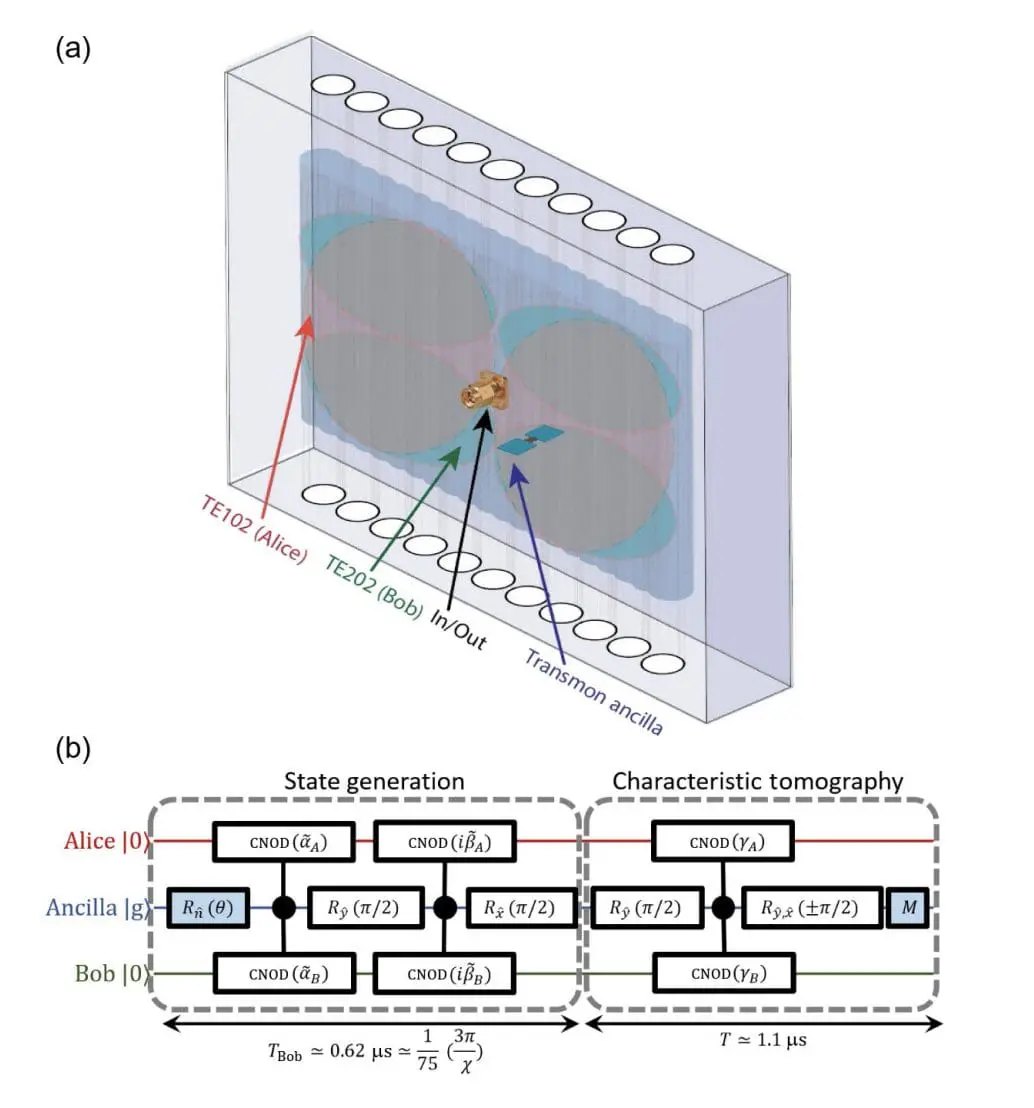
The researchers have found that displacements conditioned on the state of a single qubit ancilla coupled to multiple harmonic oscillators are sufficient for universal control. This is a significant finding as it addresses the challenge of applying fast and efficient universal control on multiple modes, which has been an open problem in the field. The team has developed the conditional NOT displacement control method, which enables fast generation and control of bosonic states in multimode systems weakly coupled to a single ancilla qubit.
The method is fast despite the weak ancilla coupling. The weak coupling allows for excellent separability and thus independent control. The researchers demonstrated their control on a superconducting transmon qubit weakly coupled to a multimode superconducting cavity. They were able to create both entangled and separable cat states in different modes of the multimode cavity, showing entangling operations at low crosstalk while maintaining independent control of the different modes.
How Does the Conditional NOT Displacement Control Method Work?
The conditional NOT displacement control method is a novel approach to quantum information processing. It is based on the conditional NOT operation concept, which can be used to reduce the duration of entangling gates. The researchers have found that displacements conditioned on the state of a single qubit ancilla coupled to multiple harmonic oscillators are sufficient for universal control.
The conditional NOT operation concept is general and can be understood as follows: Rather than applying a narrowband pulse at a selected frequency to realize a controlled operation, nodes are introduced to select where the operation does not occur. The NOT operation is achieved by designing a zero amplitude at the selected frequencies in the Fourier spectrum of the control pulse. This approach alleviates the requirement for a narrow pulse bandwidth and is extendable to multiple frequencies.
The conditional NOT displacement (CNOD) gate for an oscillator dispersively coupled to a qubit is constructed using the conditional NOT concept. The CNOD duration is not limited by the typical timescale 1/χ, where χ is the cross-Kerr coupling strength associated with the frequency shift of the oscillator dependent on the ancilla state.
What are the Implications of this Research?
The research conducted by the team from the Technion Israel Institute of Technology and the University of Chicago has significant implications for the field of quantum information processing. The conditional NOT displacement control method they have developed allows for fast and efficient multimode bosonic encoding and measurement. This is a significant step forward in the field, as it addresses the challenge of applying fast and efficient universal control on multiple modes.
The researchers have demonstrated that their method is fast despite the weak ancilla coupling. The weak coupling allows for excellent separability and thus independent control. This is a significant finding, as it shows that it is possible to achieve fast and efficient control of multiple modes while minimizing hardware overhead and crosstalk.
The research also opens up a new approach towards general entangling operations. The ability to create both entangled and separable cat states in different modes of a multimode cavity, while maintaining independent control of the different modes, is a significant achievement. This could pave the way for more advanced quantum computing systems in the future.
How Does this Research Advance the Field of Quantum Information Processing?
The research conducted by the team from the Technion Israel Institute of Technology and the University of Chicago represents a significant advancement in the field of quantum information processing. The conditional NOT displacement control method they have developed allows for fast and efficient multimode bosonic encoding and measurement. This is a significant step forward in the field, as it addresses the challenge of applying fast and efficient universal control on multiple modes.
The researchers have demonstrated that their method is fast despite the weak ancilla coupling. The weak coupling allows for excellent separability and thus independent control. This is a significant finding, as it shows that it is possible to achieve fast and efficient control of multiple modes while minimizing hardware overhead and crosstalk.
The research also opens up a new approach towards general entangling operations. The ability to create both entangled and separable cat states in different modes of a multimode cavity, while maintaining independent control of the different modes, is a significant achievement. This could pave the way for more advanced quantum computing systems in the future.
What are the Future Directions for this Research?
The research conducted by the team from the Technion Israel Institute of Technology and the University of Chicago has opened up new possibilities in the field of quantum information processing. The conditional NOT displacement control method they have developed allows for fast and efficient multimode bosonic encoding and measurement. This is a significant step forward in the field, as it addresses the challenge of applying fast and efficient universal control on multiple modes.
The researchers have demonstrated that their method is fast despite the weak ancilla coupling. The weak coupling allows for excellent separability and thus independent control. This is a significant finding, as it shows that it is possible to achieve fast and efficient control of multiple modes while minimizing hardware overhead and crosstalk.
The research also opens up a new approach towards general entangling operations. The ability to create both entangled and separable cat states in different modes of a multimode cavity, while maintaining independent control of the different modes, is a significant achievement. This could pave the way for more advanced quantum computing systems in the future.
Publication Date: 2024-03-26
Authors: Asaf A. Diringer, Eytan Z. Blumenthal, Avishay Grinberg, Liang Jiang, et al.
Source: Physical review. X
DOI: https://doi.org/10.1103/physrevx.14.011055