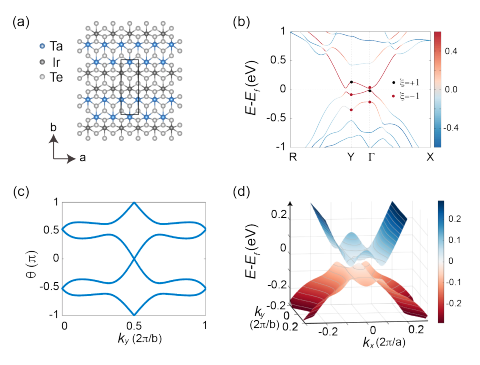
Research demonstrates that monolayer TaIrTe exhibits a diverse range of electronic states, including Quantum Spin Hall insulator, trivial insulator, higher-order topological insulator, and metallic phases. Theoretical modelling and experimental transport measurements confirm interaction-driven topological phase transitions achieved via dielectric screening and strain tuning, offering a pathway beyond moiré superlattices.
The pursuit of materials exhibiting both topological properties and strong electron correlation continues to yield fascinating results, potentially enabling novel electronic devices and fundamentally advancing condensed matter physics. Recent attention has focused on monolayer tantalum iridium telluride (TaIrTe₄) as a promising candidate, displaying robust spin Hall insulator phases influenced by both inherent band structure and electron interactions. A collaborative investigation, led by researchers from The University of Tennessee, Boston College, and the University of California, alongside contributions from the National Institute for Materials Science in Japan, details a comprehensive theoretical and experimental study of this material. Their work, entitled “Interaction-Driven Topological Transitions in Monolayer TaIrTe₄”, published in a leading peer-reviewed journal, maps the complex phase behaviour of monolayer TaIrTe₄, revealing a landscape of quantum states including topological and trivial insulators, metallic phases, and higher-order topological insulators, all driven by the interplay of electron interactions and external stimuli. The research team, comprising Jiangxu Li, Jian Tang, Louis Primeau, Thomas Siyuan Ding, Rahul Soni, Tiema Qian, Kenji Watanabe, Takashi Taniguchi, Ni Ni, Adrian Del Maestro, Qiong Ma, and Yang Zhang, employed Hartree-Fock calculations alongside detailed transport measurements to characterise these transitions and establish a foundation for future exploration of correlation-driven topological phenomena in two-dimensional materials.
Monolayer tantalum iridium telluride (TaIrTe₃) presents a significant platform for exploring the relationship between topology and strong electron correlations, with potential implications for advancements in quantum materials. Researchers systematically investigate its properties to identify and characterise various topological phases through electrostatic doping, combining computational modelling with detailed experimental analysis of fabricated devices. This work establishes a foundational understanding of correlation-driven topological phenomena and facilitates the engineering of exotic phases within low-dimensional materials.
Computational studies, utilising Hartree-Fock calculations, predict a complex
Computational studies, utilising Hartree-Fock calculations, predict a complex phase diagram in the vicinity of van Hove singularities (vHSs), which are points in a material’s electronic band structure where the density of states is particularly high. These calculations reveal the possibility of transitions between a quantum spin Hall insulator (QSHI), a trivial insulator, a higher-order topological insulator, and a metallic phase. The calculations demonstrate that manipulating dielectric screening – the reduction of electric fields within a material – and applying strain actively influences the stability of these phases, offering a route to control the material’s electronic behaviour. Experimentally, researchers fabricate and characterise numerous TaIrTe₃ devices, employing both local and nonlocal transport measurements at cryogenic temperatures to gather comprehensive data.
Analysis of resistance as a function of carrier density – the number of charge carriers available to conduct electricity – and temperature allows for classification of devices into three distinct categories, providing a clear picture of the material’s diverse behaviour. Thirty-five per cent of devices exhibit characteristics consistent with a dual QSHI phase, displaying quantized edge conductance – a measure of electrical conductivity along the edges of the material – both at the charge neutrality point (where the number of electrons and holes are equal) and within correlated insulating states, confirming the existence of robust topological protection. Seven per cent of devices display quantized edge conductance only at the charge neutrality point, transitioning to metallic behaviour with finite doping, suggesting weaker electron correlations. The remaining devices exhibit insulating behaviour, highlighting the complexity of the material’s phase diagram.
The prevalence of insulating devices underscores the sensitivity of correlated topological states to fabrication conditions, demanding precise control over material quality and device geometry. Variations in strain, sample quality, and the uniformity of the applied gate voltage significantly impact the realisation of the desired topological phases, necessitating further refinement of fabrication techniques. The reproducible observation of the dual QSHI phase in a substantial proportion of devices confirms the experimental accessibility of interaction-induced topological states in TaIrTe₃, paving the way for future investigations.
Investigating the temperature dependence of the observed phases
Investigating the temperature dependence of the observed phases will be crucial for understanding the underlying physics and identifying potential applications, allowing researchers to map out the phase diagram and explore the stability of the different phases. Exploring the impact of external stimuli, such as magnetic fields or pressure, could reveal new pathways for tuning and controlling the correlated topological states within this promising material system, opening up new avenues for device design and functionality. Theoretical modelling, coupled with advanced spectroscopic techniques, will be essential for mapping the complete phase diagram of TaIrTe₃ and elucidating the role of specific interactions in driving the observed topological transitions.
🗞 Interaction-Driven Topological Transitions in Monolayer TaIrTe4
🧠 DOI: https://doi.org/10.48550/arXiv.2506.18412