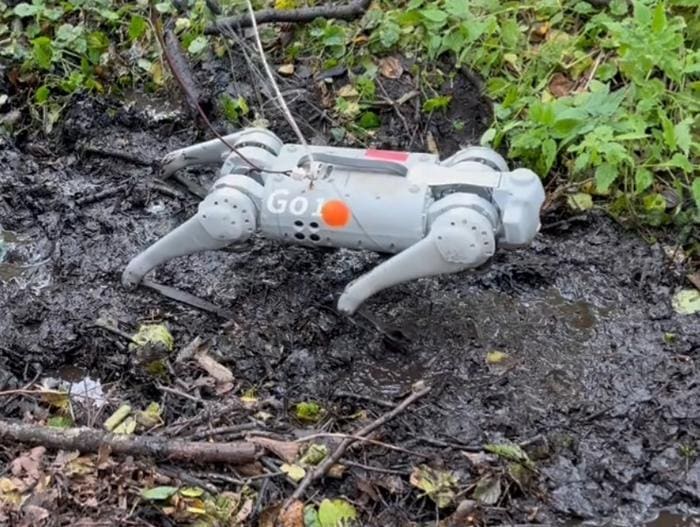
Roboticists at the Tallinn University of Technology have developed a new class of bio-inspired feet that enhance robot mobility on challenging terrains like mud and wet snow. Led by Professor Maarja Kruusmaa, the team designed silicon feet for legged robots that replicate the behavior of moose hooves, allowing them to navigate complex natural environments with greater ease.
Simon Godon, a doctoral candidate at the TalTech Centre for Biorobotics, drew inspiration from his observations of cattle on his family’s farm in France and combined it with his knowledge of mechanical engineering and biorobotics. The resulting technology has been shown to reduce sinkage and suction force by half, while cutting energy consumption by up to 70 percent. This innovation could expand the capabilities of robots, enabling them to conduct environmental monitoring, aid in agriculture, and participate in disaster response in previously inaccessible areas.
Introduction to Bio-Inspired Robotics
The field of robotics has been rapidly advancing in recent years, with a growing focus on developing robots that can navigate and interact with complex natural environments. One of the key challenges in this area is creating robots that can effectively traverse difficult terrains, such as mud and wet snow. To address this challenge, researchers at the Tallinn University of Technology (TalTech) have developed a new class of bio-inspired feet that significantly enhance robot mobility on challenging terrains. This innovation has the potential to expand the capabilities of robots, allowing them to conduct sensitive environmental monitoring, aid in agriculture, and participate in disaster response.
The development of these bio-inspired feet was led by Prof. Maarja Kruusmaa, a renowned expert in biorobotics, and Simon Godon, a doctoral candidate at the TalTech Centre for Biorobotics. The team drew inspiration from the unique characteristics of moose feet, which are well adapted to navigating muddy and slippery terrains. By studying the physical properties of moose feet and replicating their behavior in robotic systems, the researchers were able to create a new class of robot feet that can effectively traverse challenging environments.
The importance of this innovation cannot be overstated, as many natural environments are inaccessible to traditional robots due to their inability to navigate difficult terrains. Wetlands, bogs, coastal marshes, river estuaries, and fields are just a few examples of the types of environments that are abundant in nature but have remained largely inaccessible to robots. By developing robots that can effectively traverse these environments, researchers can gain a better understanding of these ecosystems and develop new strategies for conservation and management.
The development of bio-inspired feet is a significant advancement in the field of robotics, as it has the potential to enable robots to navigate a wide range of natural environments. This innovation is based on a deep understanding of the physical properties of moose feet and their behavior in different environments. By replicating these properties in robotic systems, researchers can create robots that are better adapted to navigating complex natural environments.
The Science Behind Bio-Inspired Feet
The development of bio-inspired feet is based on a thorough understanding of the physical properties of moose feet and their behavior in different environments. Moose feet are unique in that they have split hooves that expand and shrink as they step into and out of mud, increasing and reducing their contact area. This adaptation allows moose to effectively navigate muddy and slippery terrains, as it helps to break the suction force that can trap their feet in the mud.
The researchers at TalTech conducted physical experiments with real moose feet in laboratory conditions to better understand their behavior. They found that the moose’s hoof behaves similarly to a suction cup, creating a seal with the surface of the mud that makes it difficult to pull out. However, when the moose moves its hooves, it breaks this tension, allowing it to easily pull its feet out of the mud. This adaptation is critical for moose, as it helps them to avoid getting stuck in the mud and sinking too deep.
The researchers used this knowledge to design silicon feet for legged robots that replicate the same behavior. The resulting robot feet have a split hoof design that expands and shrinks as they step into and out of mud, increasing and reducing their contact area. This adaptation allows the robots to effectively navigate muddy and slippery terrains, reducing the sinkage of the robot and the suction force by half. Additionally, the energy consumption of the robot is reduced by up to 70%, making it more efficient and effective in its navigation.
The science behind bio-inspired feet is complex and multifaceted, involving a deep understanding of the physical properties of moose feet and their behavior in different environments. By replicating these properties in robotic systems, researchers can create robots that are better adapted to navigating complex natural environments. This innovation has the potential to enable robots to navigate a wide range of natural environments, from wetlands and bogs to coastal marshes and river estuaries.
Applications of Bio-Inspired Robotics
The development of bio-inspired feet has significant implications for the field of robotics, as it enables robots to navigate complex natural environments with greater ease and efficiency. This innovation has the potential to be used in a wide range of applications, from environmental monitoring and conservation to agriculture and disaster response.
One of the key applications of bio-inspired robotics is environmental monitoring. By developing robots that can effectively navigate natural environments, researchers can gain a better understanding of these ecosystems and develop new strategies for conservation and management. For example, robots equipped with bio-inspired feet could be used to monitor water quality in wetlands and rivers, or to track the movement of wildlife in coastal marshes and forests.
Another key application of bio-inspired robotics is agriculture. By developing robots that can navigate complex natural environments, farmers can use these systems to monitor crop health, detect pests and diseases, and optimize irrigation and fertilization strategies. This could lead to significant improvements in crop yields and reductions in environmental impact.
Bio-inspired robotics also has significant implications for disaster response. By developing robots that can effectively navigate complex natural environments, emergency responders can use these systems to search for survivors, assess damage, and provide critical aid in the aftermath of a disaster. For example, robots equipped with bio-inspired feet could be used to navigate rubble-strewn streets after an earthquake, or to search for survivors in flooded areas.
External Link: Click Here For More