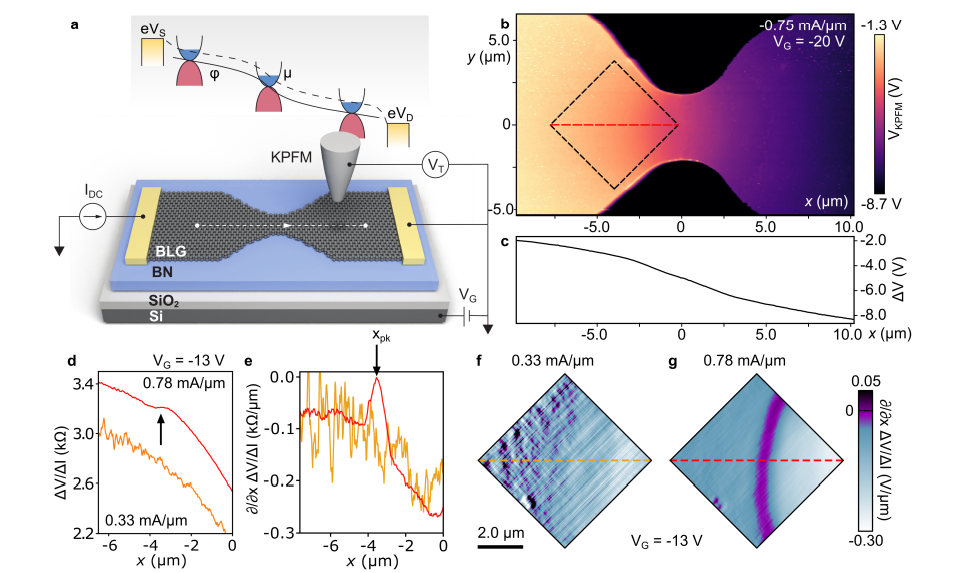
The behaviour of electrons in extremely pure materials increasingly resembles the flow of fluids, prompting scientists to explore ‘electron hydrodynamics’. Johannes Geurs from Columbia University, Tatiana A Webb from Barnard College, and Yinjie Guo from Columbia University, alongside colleagues including Itai Keren and Jack H Farrell, now present compelling evidence of electrons exceeding the speed of sound within a specially designed electronic device. Their experiments demonstrate that electrons, when accelerated through a microscopic ‘de Laval nozzle’, exhibit compressible behaviour, forming shock waves and choked flow, phenomena previously predicted but never directly observed in electronic systems. This achievement represents a significant step towards harnessing intrinsically nonlinear electron flow, potentially paving the way for a new generation of electronic devices that operate beyond the limitations of conventional, incompressible electronics.
Electron Flow Hydraulics in Graphene Nozzle
Researchers investigate the emergence of a hydraulic jump within an electronically defined de Laval nozzle fabricated in a dual-layer graphene heterostructure. The device confines and accelerates electrons, creating a supersonic flow analogous to gas dynamics, and allows for precise control of electron density and velocity. By tuning the gate voltages, scientists induce a transition from subsonic to supersonic flow, and subsequently observe the formation of a hydraulic jump, a sharp, localized change in electron flow characteristics. This jump manifests as a sudden increase in electron density and a corresponding decrease in velocity, mirroring the behaviour of hydraulic jumps in classical fluids.
The team demonstrates that the position of the jump is tunable via gate voltages, offering control over the electron flow profile within the nozzle. This electronically controlled hydraulic jump represents a novel platform for studying fundamental fluid dynamics phenomena in a solid-state setting, and opens possibilities for creating nanoscale electronic devices with tailored transport properties. The observed behaviour confirms theoretical predictions regarding the formation of hydraulic jumps in two-dimensional electron systems, and provides a new avenue for exploring non-equilibrium electron transport. In very clean solid-state systems, where interactions between electrons dominate over other scattering mechanisms, the flow of electrons can be described using principles from fluid dynamics. In these cases, phenomena analogous to viscous fluid behaviour have been experimentally observed.
Electronic Shocks in Two-Dimensional Electron Gases
Scientists have developed a detailed computational model to simulate compressible flow and the formation of electronic shocks in two-dimensional electron gases (2DEGs), particularly within graphene-like materials. This research explores how electrons behave under conditions analogous to supersonic flow in fluids, leading to the formation of abrupt changes in electron density and velocity known as electronic shocks. The model utilizes hydrodynamic equations, similar to those used to describe fluid flow, and solves them numerically using a finite volume method, a technique commonly employed for simulating shockwaves. The simulations are designed to explain and validate experimental observations of differential resistance and shock formation, obtained using Kelvin probe force microscopy.
Researchers employ a time-stepping scheme to improve the accuracy and stability of the numerical solution. The results provide evidence that electrons in the 2DEG exhibit hydrodynamic behaviour, meaning they can be described by fluid-like equations. This work validates the hydrodynamic model and demonstrates its ability to accurately predict the behaviour of the 2DEG, contributing to a better understanding of electron transport in these materials and providing a framework for designing new electronic devices.
Electronic Shockwaves and Compressible Electron Flow
Researchers have demonstrated compressible flow in an electronic system, achieving a breakthrough in understanding how electrons behave as a fluid under extreme conditions. By fabricating a device resembling a de Laval nozzle, commonly used to accelerate gases, the team successfully accelerated electrons past the speed of sound within a two-dimensional electron gas. This acceleration resulted in the formation of an electronic shock, a sudden deceleration of the electron flow, which was confirmed through both electronic transport measurements and local potential mapping using Kelvin probe force microscopy. This achievement opens new avenues for exploring intrinsically nonlinear electronic devices, moving beyond the limitations of traditional, incompressible electron flow models. While acknowledging that a complete description of compressible electron flow requires further investigation, the researchers highlight the potential for practical applications, including the generation of terahertz radiation. Furthermore, the work establishes a novel platform for mapping phenomena observed in classical fluids onto electronic devices, potentially leading to entirely new operating principles and the exploration of unusual transport phenomena in advanced quantum materials.
🗞 Supersonic flow and hydraulic jump in an electronic de Laval nozzle
🧠 ArXiv: https://arxiv.org/abs/2509.16321