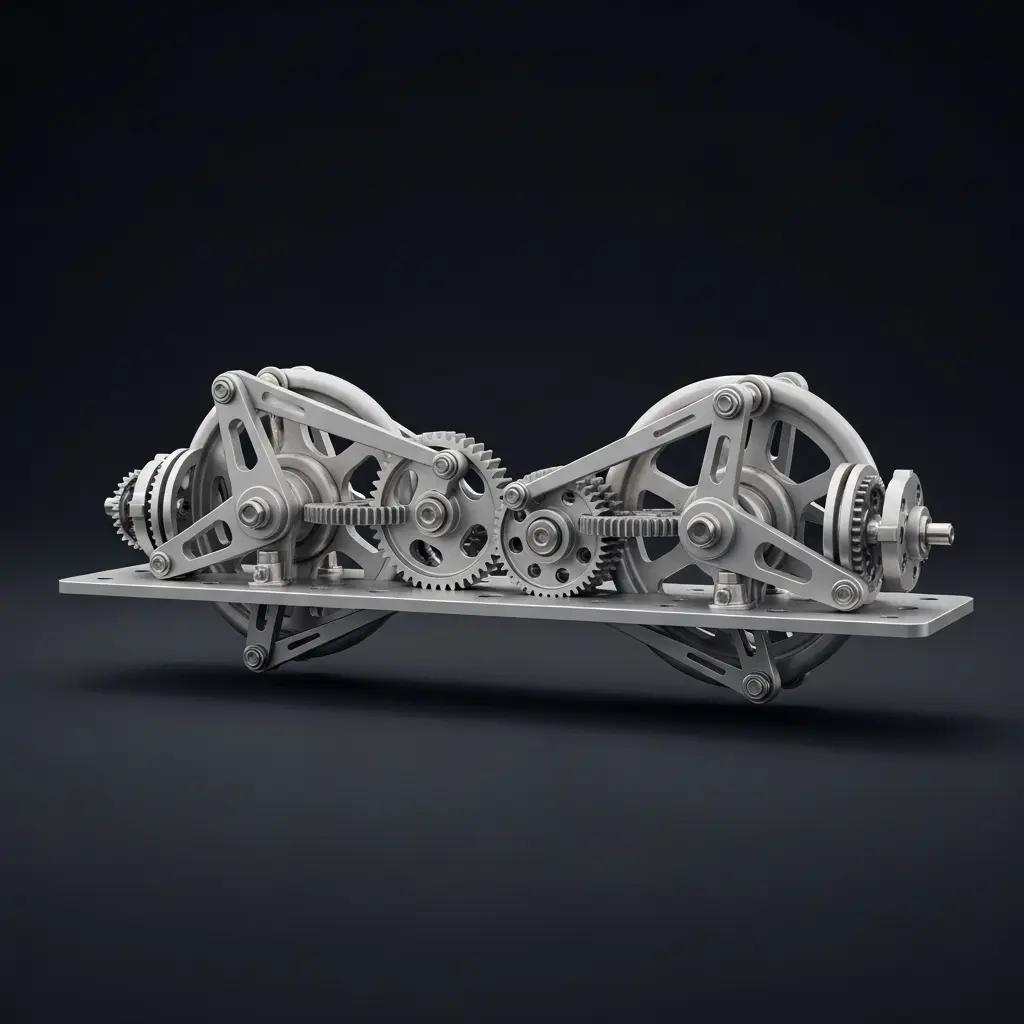
Researchers are increasingly interested in superintegrable mechanical systems, and a new study by D. Latini explores the surprising link between rigid body rotors and planar potentials. This work demonstrates how coupling a rigid rotor to a two-dimensional isotropic harmonic oscillator generates a system with enhanced symmetry, extending the oscillator’s known algebraic structure. Latini’s findings reveal that these combined systems consistently exhibit five independent integrals of motion, confirming maximal superintegrability and suggesting a novel route to creating resonant superintegrable systems with potentially far-reaching implications for understanding complex dynamics.
This research investigates the superintegrability of these combined systems, specifically focusing on the isotropic harmonic oscillator in two dimensions where a central force acts on the rotor’s centre of mass constrained to planar motion. By incorporating an internal rotational degree of freedom, the resulting system possesses three degrees of freedom , two translational and one rotational , and exhibits enhanced symmetry when orbital motion and internal rotation are tuned to resonance. The study reveals that these resonant conditions give rise to additional integrals of motion, extending the hidden symmetry algebras inherent in the underlying models, with the conserved momentum playing a key role as a deformation parameter.
Exploring Rotor-Oscillator Coupled Dynamics
Exploring Superintegrability in Rotor-Oscillator Coupling
The team achieved maximal superintegrability, evidenced by the existence of five functionally independent integrals in all settings examined, thereby confirming a significant expansion of known superintegrable dynamics. Researchers explored the harmonic oscillator, demonstrating how its well-known su(2) symmetry algebra is enlarged by the presence of the rotor. This work extends beyond the isotropic case, also examining the oscillator in a vertical plane under a uniform gravitational field, confirming that the algebraic structure persists as a translated version of the isotropic scenario, as anticipated. The findings suggest that rigid-body rotors offer a natural mechanism for generating new families of resonant superintegrable systems and their associated symmetry algebras.
Experiments show that tuning the motion and internal rotation to resonance is crucial for unlocking these additional conserved quantities and expanding the symmetry algebras. The research establishes that these systems, while simple, are nontrivial and provide a foundation for further investigation into hybrid translational-rotational dynamics. This breakthrough reveals a pathway to constructing more complex superintegrable systems with potentially far-reaching implications for both classical and quantum mechanics, offering a new perspective on the relationship between symmetry, integrability, and the solutions of these systems. The study unveils that the extended dynamics consistently admits five functionally independent integrals, solidifying the confirmation of maximal superintegrability across all configurations tested. This work opens avenues for exploring the connection between these systems and special functions, particularly those arising from the Askey scheme of hypergeometric orthogonal polynomials, which naturally emerge as solutions to exactly solvable problems. Ultimately, this research serves as an invitation to the scientific community to further investigate these intriguing models and their potential applications in diverse areas of physics and mathematics.
Rotor-oscillator coupling revealing resonant symmetry algebras
Scientists investigated the superintegrability of rigid body rotors coupled to planar systems, focusing on the isotropic harmonic oscillator in two dimensions. The study employed a system where a central force acts on the rotor’s centre of mass, constrained to planar motion, and incorporated an internal rotational degree of freedom. This configuration resulted in a three-degree-of-freedom system , two translational and one rotational , allowing researchers to explore resonant conditions where additional integrals of motion emerge. The team meticulously tuned the motion and internal rotation to induce these resonances, thereby revealing extended symmetry algebras beyond those inherent in the underlying models.
Methodology for Conserved Momentum Identification
Methodology: Identifying Conserved Momenta and Symmetries
Researchers constructed the system by combining the harmonic oscillator with a rigid rotor, effectively creating a coupled dynamic. Experiments involved analysing the resulting planar system to identify conserved momenta, which functioned as deformation parameters within the enlarged symmetry algebra. To rigorously confirm superintegrability, the study examined the oscillator in a vertical plane, subject to a uniform gravitational field and coupled with a rotor. This setup served as a translated version of the isotropic case, validating the persistence of the algebraic structure as predicted. The research pioneered a method for generating new superintegrable systems through the incorporation of resonant rigid-body rotors.
The team demonstrated that the extended dynamics consistently admitted five functionally independent integrals, definitively confirming maximal superintegrability across all tested configurations. This achievement relied on precise control of the resonant frequencies and careful analysis of the resulting integrals of motion. The work’s innovative approach enables the systematic exploration of symmetry algebras in coupled systems, suggesting a pathway for discovering new families of superintegrable models and furthering understanding of their underlying mathematical structures. This study’s findings suggest that rigid-body rotors offer a natural mechanism for generating resonant superintegrable systems, aligning with the primary objective of this work. The team’s methodology provides a robust framework for investigating these complex dynamics and uncovering hidden symmetries, potentially impacting fields ranging from celestial mechanics to quantum physics.
Achieving Maximal Superintegrability Confirmation
Resonant rotors yield five conserved integrals of motion
Novel Approaches to Resonant Superintegrable Dynamics
Scientists have demonstrated the superintegrability of rigid body rotors coupled to planar systems, revealing a novel approach to generating resonant superintegrable systems. The research focused on the isotropic harmonic oscillator in two dimensions, where a central force acts on the rotor’s centre of mass constrained to planar motion. Experiments combined translational and internal rotational degrees of freedom, resulting in a three-degree-of-freedom system, and measurements showed that when motion and internal rotation are tuned to resonance, additional integrals of motion emerge. These findings extend the hidden symmetry algebras of the underlying models, with conserved momentum acting as a deformation parameter.
The team measured five functionally independent integrals in all settings examined, thereby confirming maximal superintegrability within the extended dynamics. Data shows that the symmetry algebra of the oscillator can be enlarged by the presence of the rotor, and this algebraic structure persists in a translated version when examining the oscillator in a vertical plane under a uniform gravitational field. Tests prove that rigid-body rotors provide a natural mechanism for generating new families of resonant superintegrable systems, aligning with the primary objective of the work. Researchers recorded that the extended dynamics consistently admits five functionally independent integrals, validating the concept of maximal superintegrability across different configurations.
The study highlights that these systems, possessing more constants of motion than required for Liouville integrability, exhibit invariant tori and quasi-periodic dynamics. Measurements confirm the emergence of special functions as solutions to exactly solvable problems, linking the work to the Askey scheme of hypergeometric orthogonal polynomials. Furthermore, the work demonstrates that every second-order superintegrable system in two dimensions can be obtained as a limiting case of a three-parameter potential on the two-sphere, denoted S9. Results demonstrate that the associated quadratic symmetry algebras are obtained by contraction from the quadratic algebra of S9. The research establishes that potentials VI and VII are isospectral deformations of the isotropic and anisotropic harmonic oscillator, while VIII and VIV are isospectral deformations of the Kepler, Coulomb potential, with classical trajectories, quantum energy levels, and wavefunctions already known for these systems. This breakthrough delivers a foundation for exploring hybrid translational, rotational dynamics and the role of resonance conditions in controlling conserved quantities and symmetry algebras.
Rotor-oscillator coupling yields maximal superintegrability and symmetry
Scientists have demonstrated the superintegrability of rigid body rotors when coupled with planar systems, specifically examining the isotropic harmonic oscillator in two dimensions. By incorporating a rigid rotor with its center of mass constrained to planar motion, the system gains three degrees of freedom, and resonant conditions lead to the emergence of additional integrals of motion. These findings extend the symmetry algebras inherent in the underlying models, with conserved momentum acting as a deformation parameter. Researchers found that the dynamics consistently admits five functionally independent integrals, confirming maximal superintegrability across various settings, including the oscillator in a vertical plane subject to a uniform gravitational field.
This suggests that rigid-body rotors offer a viable method for generating new resonant superintegrable systems and their associated symmetry algebras. The authors acknowledge that the algebraic structures identified require further investigation, and propose that this work serves as an invitation for continued research into these models. Future work could focus on a more complete understanding of the extended symmetry algebras and exploring the implications of these superintegrable systems in higher dimensions.
🗞 Rigid Body Rotors in Planar Potentials: A Novel type of Superintegrable Mechanical Systems in the Plane
🧠 ArXiv: https://arxiv.org/abs/2601.21491