

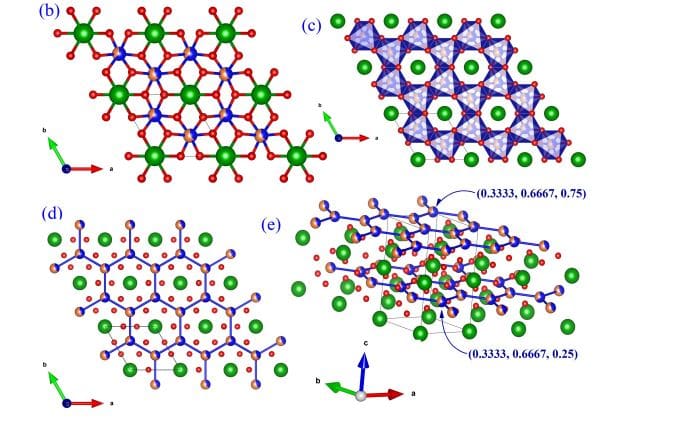
Layered honeycomb materials are attracting considerable attention as potential hosts for novel magnetic phenomena, and recent research focuses on understanding the complex interactions within these structures. Arkadeb Pal, from the Zernike Institute for Advanced Materials at the University of Groningen, alongside P. H. Lee and J. Khatua et al., now present a detailed investigation of bismuth chromium tellurium oxide, a material exhibiting a series of fascinating magnetic and electrical properties. Their work reveals not one, but two distinct transitions into antiferromagnetic states, alongside a strong connection between magnetism and electrical polarization, ultimately establishing this compound as a new example of a multiferroic material, where magnetic and electric orders coexist. This discovery is significant because it expands the range of known multiferroics and offers potential for developing new technologies based on controlling both magnetic and electric properties within a single material.
Researchers combined experimental techniques, including neutron diffraction, magnetization measurements, and dielectric constant measurements, to characterise the magnetic structure and its coupling with electric polarization. Neutron diffraction experiments revealed a complex magnetic structure with multiple transitions occurring at 88 K, 58 K, and 22 K, indicating a series of magnetic orderings. Magnetization measurements confirmed these transitions and demonstrated that the magnetic moments align antiferromagnetically within the honeycomb planes. Importantly, dielectric constant measurements showed a clear coupling between the magnetic ordering and electric polarization, with a noticeable change in the dielectric constant at the magnetic transition temperatures. These findings demonstrate the emergence of multiferroic behaviour in BiCrTeO6, where magnetic order drives electric polarization, establishing it as a promising candidate for novel multiferroic devices and expanding the understanding of complex magnetic phenomena in layered honeycomb materials.
RuCl3 Crystal Growth and Structural Characterisation
Single crystals of RuCl3 were grown using a flux method, employing a mixture of RuCl3 and KCl in a specific ratio. The mixture was sealed in an alumina tube and subjected to a carefully controlled heating and cooling process, first heated to a high temperature, then slowly cooled over an extended period, and finally furnace cooled to room temperature. Resulting crystals were carefully selected based on their size and quality using optical microscopy, and their structure and purity were confirmed using X-ray diffraction at a synchrotron facility. Magnetization measurements were conducted using a superconducting quantum interference device magnetometer in both zero-field-cooled and field-cooled modes, while neutron scattering experiments were performed using a four-circle diffractometer equipped with a cryostat for measurements at very low temperatures. Samples were aligned using a single-crystal aligner, and data were collected over a wide range of reciprocal space. Specific heat measurements were also performed over a broad temperature range to further characterise the material’s properties.
Complex Multiferroic Ordering in BiFeO3 Material
This research focuses on a material exhibiting multiferroicity, the simultaneous presence of both ferroelectric and magnetic order. Researchers discovered complex magnetic ordering, including both ferromagnetic and antiferromagnetic components, sensitive to temperature and external fields, and characterised this ordering using techniques like magnetization measurements, neutron diffraction, and muon spin rotation/relaxation (µSR). The material’s crystal structure is rhombohedral, and researchers identified structural distortions linked to the tilting of oxygen octahedra, which play a crucial role in both the ferroelectric and magnetic properties. A key finding is the strong coupling between the ferroelectric and magnetic order parameters, where changes in one order parameter can influence the other.
Researchers investigated the dynamic magnetic behaviour using techniques like AC susceptibility and µSR, finding evidence of various magnetic excitations and both static and dynamic magnetic order. µSR proved valuable in probing the internal magnetic fields and the magnetic structure at the microscopic level, resolving the complex magnetic ordering and identifying different magnetic phases. The study provides a detailed characterization of the material’s structural, magnetic, and dynamic properties using a wide range of experimental techniques. Researchers also suggest the presence of polar nanoregions within the material, contributing to the overall ferroelectric behaviour. This research contributes to a deeper understanding of the fundamental mechanisms underlying multiferroicity and makes this material a promising candidate for novel device applications, such as multiferroic memory and spintronic devices.
Multiferroicity and Structural Transition in Bismuth Chromite
This research presents a comprehensive investigation of the layered honeycomb lattice antiferromagnet BiCrTeO6, revealing a complex interplay of magnetic, structural, and dielectric properties. Researchers identified two successive magnetic transitions at 16 K and 11 K, establishing long-range antiferromagnetic ordering. Notably, the magnetic transition at 11 K coincides with the emergence of ferroelectric order, establishing BiCrTeO6 as a new spin-driven multiferroic material. High-resolution synchrotron X-ray diffraction studies demonstrate a structural phase transition at 11 K, where the material’s symmetry lowers, directly linked to the onset of ferroelectricity. Researchers also observed dielectric relaxor behaviour at higher temperatures, attributed to chromium and tellurium anti-site disorder within the material’s structure. Further investigation using neutron diffraction could offer additional insight into the origins of the spin-driven ferroelectricity, and future work will likely focus on single crystals and detailed theoretical modelling to fully elucidate the observed phenomena and explore the potential of this intriguing multiferroic system.
👉 More information
🗞 Successive magnetic transitions and multiferroicity in layered honeycomb BiCrTeO
🧠 ArXiv: https://arxiv.org/abs/2512.13387


