Understanding the behaviour of electrons in complex materials presents a significant challenge in modern physics, and researchers increasingly turn to tensor networks as a powerful tool for tackling these problems. Simon H. Hille and Attila Szabó, both from the University of Zürich, have developed TeMFpy, a new Python library that bridges a critical gap in this field. This software efficiently converts fermionic mean-field states, a common starting point for modelling electron behaviour, into the tensor network format, specifically matrix product states. By simplifying this conversion process and integrating with existing tensor network tools, TeMFpy empowers scientists to explore strongly correlated electron systems, including exotic phases of matter like spin liquids, with greater ease and accuracy.
Slater determinants and Pfaffian states, combined with Gutzwiller projection, enable the construction of variational wave functions for various strongly correlated electron systems, including quantum spin liquids. TeMFpy builds upon TeNPy, integrating seamlessly with existing matrix product state-based algorithms.
Fermionic Systems via Tensor Network Simulations
Researchers increasingly employ tensor network states (TNS), particularly matrix product states (MPS), to represent and simulate quantum many-body systems, offering a powerful approach to understanding complex phenomena in fermionic systems and strongly correlated physics. The ITensor library serves as a key software tool for these calculations. Hartree-Fock-Bogoliubov (HFB) theory provides a starting point for constructing more accurate wave functions. Researchers represent fermionic Gaussian states using Pfaffians, allowing computation of their properties, such as overlap, with essential algorithms and software tools including ITensor and pfapack.
These methods enable the study of strongly correlated electron systems, including high-temperature superconductivity, fractional Chern insulators, and spin liquids. Key to these calculations is converting fermionic Gaussian states to MPS form, allowing the use of efficient TNS algorithms. Calculating the Pfaffian of skew-symmetric matrices is crucial for determining overlaps and other properties of Gaussian states, utilising extended Wick’s theorem and the Onishi formula to calculate many-body correlation functions. Calculating the overlap between different wave functions, such as HFB states, is important for variational optimisation and studying the stability of different phases.
Researchers also apply TNS to study symmetry-protected topological phases and their edge states, considering resonating valence bond (RVB) states as potential ground states for high-temperature superconductors. This work provides a comprehensive guide to using TNS, particularly MPS, for studying fermionic systems and strongly correlated physics, covering theoretical background, algorithms for converting fermionic Gaussian states to MPS, calculating Pfaffians, and computing overlaps. The document details the software tools ITensor and pfapack, providing examples of how these methods can be applied to study various physical systems, such as high-temperature superconductors, fractional Chern insulators, and spin liquids, representing a valuable resource for researchers in condensed matter physics and aiding in the development of numerical methods.
Efficient Fermionic Wave Function Conversion with TeMFpy
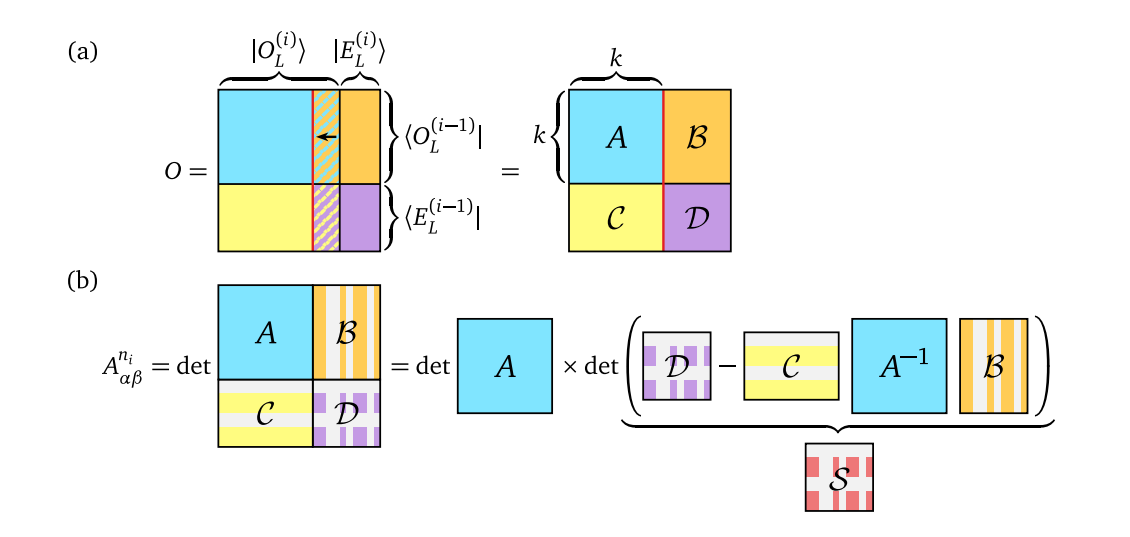
Scientists have developed TeMFpy, a new Python library designed to convert fermionic mean-field states into either finite or infinite matrix product state (MPS) form. This conversion provides efficient methods for both Slater determinants and Pfaffian states, enabling the construction of wave functions for strongly correlated electron systems, including those exhibiting spin liquid behaviour, and builds upon the existing TeNPy framework. A key achievement of TeMFpy lies in its computational efficiency, specifically in precomputing entangled orbitals, requiring O(N 3 ) time. Subsequent calculations of MPS tensor entries involve determinants of size O(logχ), resulting in an overall time complexity of O(N 3 + χ 2 log 3 χ), matching existing methods with fewer computational steps.
For Pfaffian states, the library handles the complexities introduced by anomalous correlations, requiring specification of both number-conserving and anomalous terms, supporting two bases: a complex-fermion basis and a Majorana basis. TeMFpy provides tools for converting between these bases, maintaining Nambu symmetry throughout the calculations, and performs the Schmidt decomposition of the correlation matrix using the Majorana basis to simplify the process and guarantee Nambu-symmetric eigenvectors. The library’s implementation of the Schmidt decomposition for Pfaffian states is noteworthy. By diagonalizing the Nambu correlation matrix restricted to a subsystem, the library obtains eigenvalues and eigenvectors that define the reduced density matrix. The resulting Schmidt values are products of either the square root of the eigenvalue or the square root of one minus the eigenvalue, and the corresponding Schmidt vectors are Pfaffian states annihilated by specific Majorana operators, ensuring that the entangled eigenvectors respect Nambu symmetry.
TeMFpy Bridges Mean-Field and Tensor Networks
Researchers have developed TeMFpy, a new Python library designed to convert fermionic mean-field states into matrix product state (MPS) form, enabling the use of powerful algorithms, such as the density matrix renormalisation group and variational uniform MPS, to further analyse and optimise these states. TeMFpy incorporates efficient methods for both Slater determinants and Pfaffian states, and includes tools for Gutzwiller projection, allowing construction of wave functions for complex systems like quantum spin liquids. This work addresses a key challenge in combining mean-field theory with tensor network methods, providing a bridge between these approaches and facilitating more accurate and efficient simulations of strongly correlated electron systems. The resulting MPS representation also allows access to important physical quantities, such as entanglement entropy, which are difficult to obtain using other methods. The authors acknowledge that the current implementation is geared towards one-dimensional systems, reflecting the natural form of matrix product states, and future work could explore extending these techniques to higher dimensions. Ultimately, TeMFpy provides a valuable tool for researchers seeking to combine the strengths of mean-field theory and tensor network methods in the study of complex quantum systems.
🗞 TeMFpy: a Python library for converting fermionic mean-field states into tensor networks
🧠 ArXiv: https://arxiv.org/abs/2510.05227