

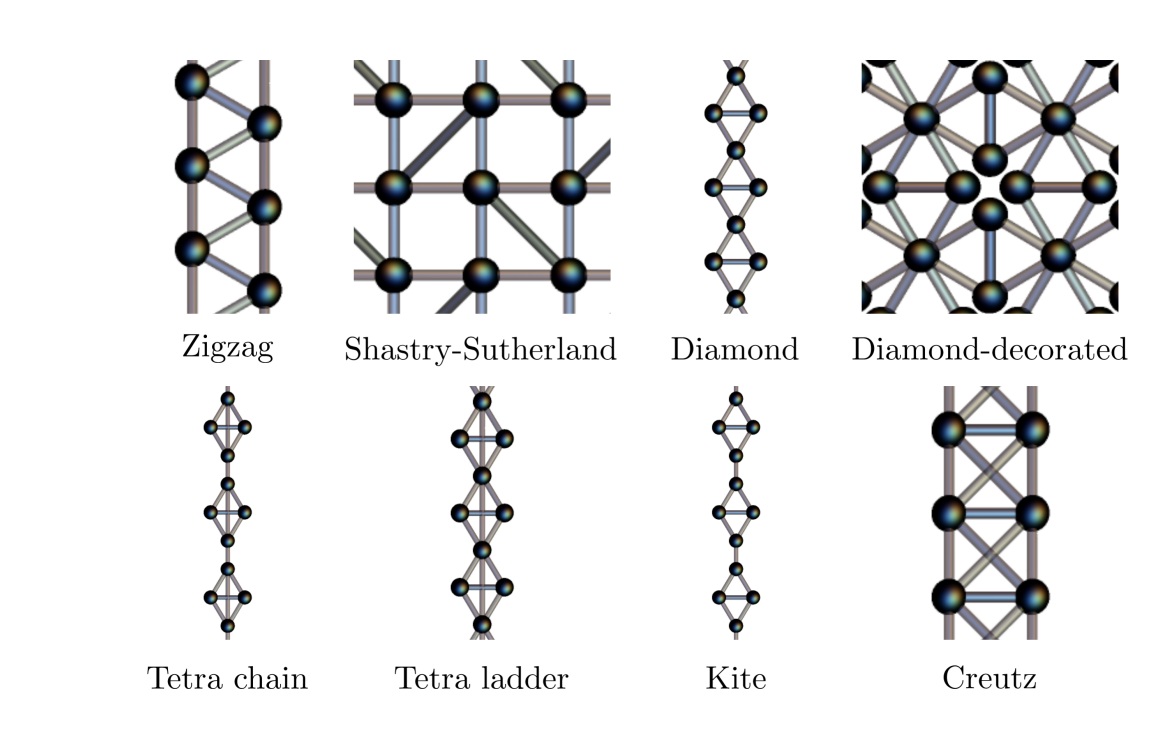
Geometric frustration profoundly influences the behaviour of materials with strongly interacting electrons, often leading to unexpected and exotic properties. Researchers, including F. P. M. Méndez-Córdoba, J. Tindall, D. Jaksch, and F. Schlawin, now present a detailed analysis determining the magnetization of electrons in the fundamental ground state of these frustrated systems. The team focuses on ‘superstable’ states, which represent particularly robust configurations resistant to the effects of frustration, and demonstrates that these calculations apply to a wide range of materials, including those exhibiting altermagnetic and superconducting behaviour. This work provides crucial evidence for how magnetic arrangements change as materials transition between different phases, offering new insights into the origins of complex magnetism and superconductivity.
Magnetization in Frustrated Superstable Graphs
Research into the magnetization of electronic ground states in frustrated superstable graphs continues to attract considerable attention due to the complex behaviour and potential for novel magnetic phases these systems exhibit. These materials, characterised by competing interactions, display a rich landscape of ground states and excitations. Superstable graphs possess unique topological properties and a high degree of degeneracy, arising from their specific connectivity. Understanding how magnetization develops in these systems presents a significant challenge, as traditional theoretical approaches often struggle to capture the interplay between frustration, topology, and quantum fluctuations.
Determining the stability of different magnetic configurations and predicting their response to external fields requires advanced computational techniques and a thorough understanding of the underlying physics. The potential for exotic magnetic phases, such as spin glasses or quantum spin liquids, necessitates a detailed investigation of the system’s low-energy spectrum and excitations. This work investigates the magnetization of electronic ground states in frustrated superstable graphs, focusing on how lattice geometry, electronic interactions, and magnetic ordering interact, and aims to identify critical fields at which transitions between different magnetic phases occur.
Identifying Superstable Magnetization in Frustrated Systems
Geometric frustration lies at the heart of many unconventional quantum phases in strongly interacting electron systems. This work analytically determines the ground state magnetization of the half-filled Hubbard model on frustrated geometries where superstable states, eigenstates robust against frustration, are manifest. The methodology involves a detailed analysis of the Hubbard model, a fundamental framework for understanding strongly correlated electron systems, adapted to accommodate geometric frustration. Specifically, the researchers focus on identifying and characterizing superstable states, which represent resilient configurations of electron spins. These states provide a stable foundation for understanding the emergence of novel quantum phases, even in the presence of competing interactions. The analysis extends to a wide range of lattice structures, allowing for a comprehensive understanding of how geometric frustration influences magnetic properties and potentially leads to the discovery of new superconducting or altermagnetic behaviours.
Superstability Guarantees Ground State Robustness
This research presents a theoretical framework for understanding and manipulating the ground states of quantum systems, specifically the diamond chain, a model system in condensed matter physics. The central theme is superstability, where a superstable ground state is robust against perturbations. The authors are developing a method to guarantee the existence of such states, crucial for designing materials with predictable and stable properties. The diamond chain serves as a test case, a one-dimensional chain of atoms often used to study magnetism and electron interactions. The authors focus on the first order expansion and leverage the concept of adiabatic continuation, stating that a smoothly changing Hamiltonian will also smoothly change the ground state, as long as it remains unique.
This allows connection between different physical regimes. The research addresses frustrating terms, interactions that make it difficult to find a simple, ordered ground state, aiming to eliminate or control these terms to achieve stability. Key steps involve identifying superstable graphs by removing frustrating edges and balancing components, then adiabatically connecting the original diamond chain to a superstable graph by smoothly changing the Hamiltonian, allowing calculation of the magnetization in the ground state.
Bipartite Graphs Reveal Frustrated Magnetism’s Ground State
This research provides new analytical insights into the magnetic properties of frustrated systems with strongly interacting electrons. The team demonstrated the existence of a ground state regime where the magnetization and ferrimagnetic correlations of certain frustrated lattices can be determined using properties of a bipartite graph. This approach reveals how charge fluctuations can lift degeneracies and stabilize specific magnetic configurations, potentially including topological spin textures. These findings are relevant to several areas of condensed matter physics, including the study of altermagnetism, flat-band physics, and driven quantum materials. The work offers a framework for understanding recent observations of transient superconducting signals and could guide the development of theoretical models and the search for new methods for optical control of quantum materials.
🗞 On the magnetization of electronic ground states in frustrated superstable graphs
🧠 ArXiv: https://arxiv.org/abs/2509.07079


