

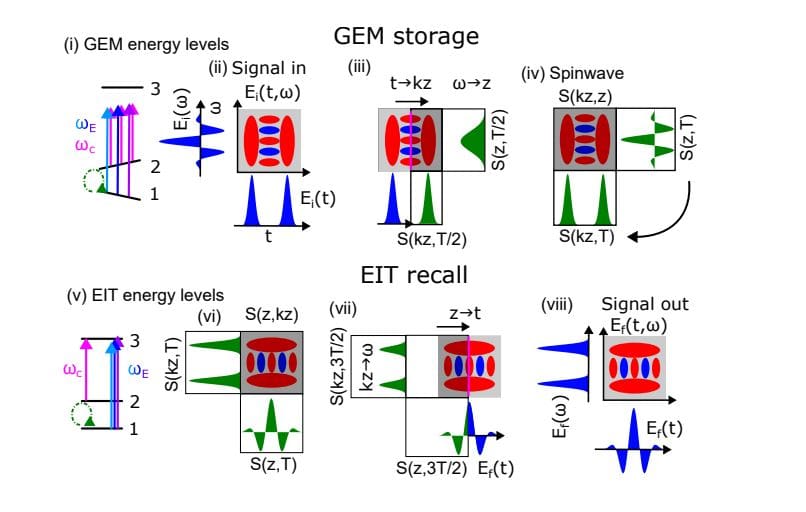
Spectrotemporal encoding represents a promising frontier in information technology, and researchers are actively exploring new ways to process information across both frequency and time. Jesse L Everett from Australian National University, along with colleagues, investigates a novel approach to this challenge, simulating a process called the fractional Fourier transform within a unique memory system. This system combines the strengths of gradient echo memory with electromagnetically-induced transparency, creating a dual memory capable of advanced spectrotemporal processing. The work demonstrates the potential of utilising electromagnetically-induced transparency for manipulating information in ways that could significantly enhance future memory technologies and signal processing capabilities.
This research demonstrates the potential of electromagnetically-induced transparency for advanced spectrotemporal processing, manipulating signals encoded in both time and frequency. Processing optical quantum signals using ensemble memories forms the basis for numerous quantum information technologies, including generating signals, entangling photons, and converting frequencies.
Atomic Memory Implements Fractional Fourier Transform
Researchers successfully implemented the fractional Fourier transform using atomic quantum memory, demonstrating control over light pulses via electromagnetically-induced transparency and gradient echo techniques within an atomic vapour cell. This work aims to create a platform for advanced quantum information processing, including high-dimensional entanglement and temporal mode control. The team employed techniques such as slow light and temporal mode shaping to overcome limitations of existing methods. The researchers used detailed simulations to model the behaviour of the atomic medium and optimise experimental parameters.
These simulations accurately predict the system’s performance and confirm the ability to manipulate light pulses. Key concepts include the fractional Fourier transform, which allows for partial transformations between time and frequency, and electromagnetically-induced transparency, a quantum phenomenon that creates a transparent window within an opaque atomic medium, enabling light propagation with reduced absorption. Gradient echo memory stores light pulses in an atomic medium using carefully timed pulses, allowing for long storage times and coherent retrieval. Temporal mode control manipulates the shape of light pulses in the time domain, crucial for encoding and processing quantum information.
Spectrotemporal Processing via Electromagnetically Induced Transparency
Scientists demonstrate spectrotemporal processing using a system combining gradient echo memory and electromagnetically-induced transparency. This work simulates the fractional Fourier transform, a key process in information technology, and confirms the potential of electromagnetically-induced transparency for manipulating information encoded in both time and frequency. Detailed simulations, based on solutions of optical equations, accurately describe the system’s behaviour and predict performance characteristics. The team investigated the fidelity and efficiency of this system, modelling the transformation of signals with varying characteristics.
Experiments reveal that the system accurately reproduces the expected phase shifts for Hermite-Gauss modes, a type of optical signal, across a range of rotations. Measurements confirm that the output phases closely match predicted values, demonstrating precise control over the signal’s spectrotemporal properties. The conditional fidelity, a measure of overlap between the desired and actual output, was assessed for several modes and rotations. Results show that the efficiency of the system is influenced by the signal bandwidth and optical depth. Comparisons between the current electromagnetically-induced transparency and gradient echo memory protocol and a gradient echo memory protocol reveal distinct scaling behaviours. The electromagnetically-induced transparency efficiency scales more strongly with mode volume, while the gradient echo memory efficiency exhibits an exponential scaling. These findings demonstrate the potential for optimising the system’s performance through careful control of these parameters and suggest avenues for future research in spectrotemporal information processing.
Spectrotemporal Signal Control via Dual Memory System
This research demonstrates a novel approach to spectrotemporal signal processing using a dual memory system based on gradient echo memory and electromagnetically-induced transparency. Through simulations of the fractional Fourier transform, scientists successfully rotated Gaussian pulses, confirming the potential of this combined system for manipulating signals in both the time and frequency domains. The results show accurate performance of the fractional Fourier transform and suggest increasing efficiency with larger time-bandwidth products, indicating the system’s capacity for complex signal processing tasks. Further analysis focused on Hermite-Gauss modes, revealing the relationship between rotation angle, conditional fidelity, and efficiency.
The team observed that increased rotation angles lead to lower conditional fidelity due to attenuation of higher frequency components, and that higher-order modes exhibit lower fidelity overall. Comparisons between the gradient echo memory-electromagnetically-induced transparency protocol and a gradient echo memory-gradient echo memory protocol revealed differing efficiency scaling with mode order, linked to factors such as control field scattering and incoherent absorption. The authors acknowledge that efficiency is limited by signal loss outside the electromagnetically-induced transparency window, resulting in a scaling effect related to mode order. Future work could focus on mitigating these losses to improve overall system performance and explore applications in advanced signal processing technologies.
👉 More information
🗞 Spectrotemporal processing in a dual gradient echo and electromagnetically-induced transparency memory
🧠 ArXiv: https://arxiv.org/abs/2511.14156