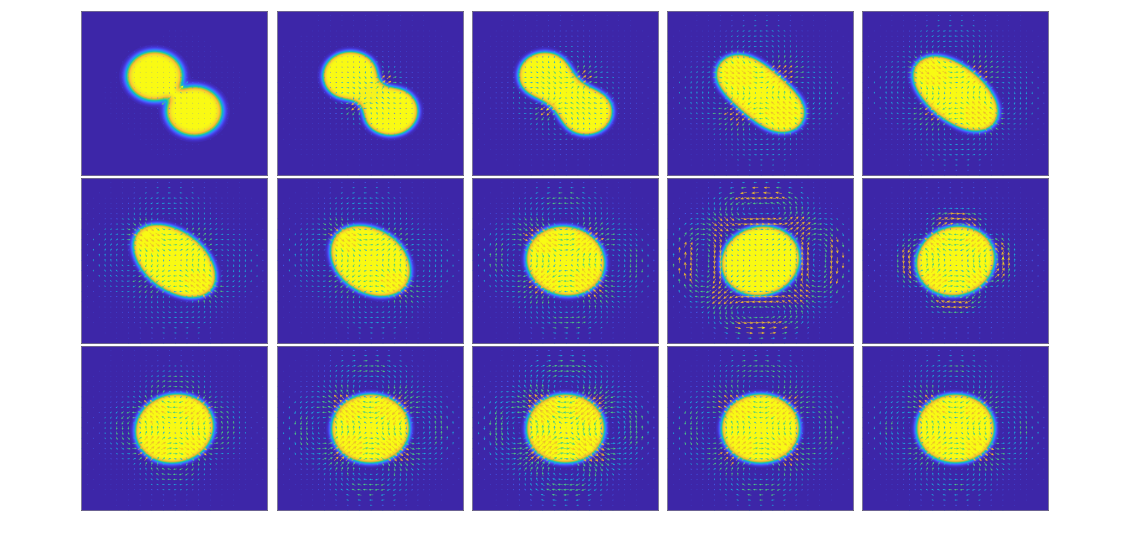
The accurate modelling of physical systems often requires capturing both reversible and irreversible processes, a challenge that traditionally complicates numerical simulations. Xuelong Gu and Qi Wang propose a new framework, Skew Gradient Embedding, which reformulates these complex systems as generalized gradient flows, offering a systematic approach to consistent modelling across diverse fields including fluid mechanics, electrodynamics, and solid mechanics. This innovative method exploits the underlying mathematical structure of these flows, specifically the skew-symmetric component, to create robust numerical schemes that either maintain the rate of energy dissipation or guarantee energy stability. The resulting flexibility allows for the design of both efficient first and second-order schemes, and importantly, facilitates decoupling of equations in multiphysics systems, potentially leading to significant improvements in computational performance without sacrificing accuracy or stability.
Energy-Stable Schemes for Complex Fluid PDEs
This document presents research focused on numerical methods for solving partial differential equations that describe complex fluids and materials science. A central goal is to develop energy-stable and accurate numerical schemes, methods that approximate solutions while preserving key physical properties like energy, preventing instabilities and ensuring reliable simulations. The research spans mathematical and computational aspects of these methods, addressing challenges in modeling complex physical phenomena. Several numerical techniques are explored, including the Scalar Auxiliary Variable (SAV) approach and Invariant Energy Quadratization (IEQ), both designed to preserve energy during simulations.
Widely used techniques like Crank-Nicolson and Runge-Kutta methods are often combined with these approaches to enhance stability and accuracy. Finite Element Methods are employed for spatial discretization, while Implicit-Explicit (IMEX) schemes balance accuracy and stability by treating different equation terms differently. Multi-Relaxation methods improve efficiency and stability, and Auxiliary Variable methods simplify equations and enhance stability. The research focuses on key equations and principles, including the Cahn-Hilliard equation, which models phase separation in materials, and the Navier-Stokes equations, which govern fluid flow.
The work incorporates Onsager Reciprocal Relations from irreversible thermodynamics to ensure consistency and utilizes Gradient Flow as a mathematical framework for describing systems evolving towards equilibrium. Phase-Field Models describe interface evolution, while Darcy’s Law models fluid flow through porous media. Liquid Crystal Models and Hydrodynamic Equations are also investigated, alongside the Allen-Cahn equation, another model for phase separation. This research has broad applicability to diverse materials and systems, including polymer blends, liquid crystals, and complex fluids. It provides tools for modeling fluid flow through porous media like rocks and soils, and for simulating phase transformations and microstructure evolution in materials. The methods are also applicable to Bose-Einstein Condensates, Hele-Shaw flow, surfactant models, and nematic liquid crystalline polymers. The overall impression is one of mathematical rigor, interdisciplinary collaboration, and a focus on computational efficiency alongside energy stability, representing a significant advancement in simulating complex physical phenomena.
Skew Gradient Embedding for Gradient Flows
Scientists have developed a novel Skew Gradient Embedding (SGE) framework to systematically reformulate complex partial differential equation models, encompassing both reversible and irreversible processes, as generalized gradient flows. This work transforms the zero-energy contribution term into an equivalent skew-gradient form using an exterior 2-form, effectively recasting the original equations as a generalized gradient flow system and preserving discrete properties regardless of spatial discretization methods. This transformation facilitates the design of numerical schemes that either preserve the energy dissipation rate or ensure discrete energy stability, offering flexibility in algorithm development. The core of this research involves a stabilization strategy guided by the convex-splitting idea, applied to the generalized gradient flow system.
Scientists devised this approach to construct structure-preserving numerical algorithms, enabling fully explicit implementation of the zero-energy contribution term within the computational scheme, contrasting with many existing methods that require implicit implementations. By discretizing the energy gradient using a linearly implicit scheme, the resulting numerical scheme achieves computational efficiency comparable to scalar auxiliary variable (SAV)-based approaches, while maintaining thermodynamic consistency. Researchers systematically constructed thermodynamically consistent numerical algorithms for general models, addressing limitations of previous methods that often focused on specific systems or preserved only modified energies. The study pioneers a method where the discrete energy dissipation law depends solely on the discretization of the energy, ensuring accuracy and stability, and overcoming challenges associated with complex energy functionals, such as those found in liquid crystal models.
Skew Gradient Embedding Enables Consistent Algorithms
Scientists have developed a novel framework, termed Skew Gradient Embedding (SGE), to systematically reformulate models describing both reversible and irreversible processes as generalized gradient flows. This work applies to a wide range of physical systems, including those found in electrodynamics, fluid mechanics, and statistical physics. The core of the SGE approach involves transforming the zero-energy-contribution term into an equivalent skew-gradient form using an exterior 2-form, which naturally preserves discrete properties regardless of spatial discretization methods. Experiments demonstrate that the SGE framework enables the construction of thermodynamically consistent numerical algorithms with fully explicit implementation of the zero-energy contribution term.
When combined with a linearly implicit discretization of the energy gradient, the resulting schemes achieve computational efficiency comparable to state-of-the-art approaches. Crucially, the discrete energy dissipation law depends solely on the discretization of the energy gradient, rigorously preserving the original energy-dissipation law. Guided by the principle of convex-splitting, researchers devised a set of stabilization schemes that deliver both first and second-order energy-stable schemes for the system. This innovative approach enables the construction of numerical schemes that accurately model these complex systems while preserving key thermodynamic properties. The research demonstrates a unified strategy for designing algorithms that maintain either a constant rate of energy dissipation or ensure discrete energy stability, applicable to both conservative and dissipative systems. A key achievement lies in the explicit treatment of the reversible components within these equations, leading to a natural decoupling of governing equations in multiphysics systems and improving computational efficiency without sacrificing accuracy or stability. Through rigorous numerical experiments, the team confirms the robustness and performance advantages of their proposed schemes across a range of physical phenomena. This systematic modeling and computational framework has broad applicability to equations arising in diverse fields including electrodynamics, fluid mechanics, and statistical physics, offering a versatile toolkit for algorithm design in computational science and engineering.
🗞 Skew Gradient Embedding for Thermodynamically Consistent Systems
🧠 ArXiv: https://arxiv.org/abs/2509.18601