Coherent structure interactions in spatially extended systems arise from the nonlinear interplay of localized disturbances, playing a crucial role in energy transfer and pattern formation. Understanding these interactions is fundamental to predicting and controlling behaviour in diverse physical phenomena, ranging from fluid dynamics and optical systems to biological networks and chemical reactions. This research investigates these interactions, driven by excited hidden modes, to develop a theoretical framework that accurately describes their influence on the stability and evolution of coherent structures. Researchers study the emergence of strong interactions between dissipative coherent structures, specifically pulses, in spatially extended systems, initially focusing on a model of liquid film flowing down a vertical plane. Results demonstrate that under certain conditions, a two-pulse system undergoes a transition from decaying oscillatory dynamics to self-sustained oscillations, governed by a novel mechanism distinct from standard Hopf bifurcations.
Coherent Structure Interactions in Dissipative Systems
This research focuses on the interactions of coherent structures, such as solitary waves and pulses, in spatially extended, dissipative systems, investigating how these structures form, interact, and potentially bind together. The primary model system is thin film flows, extending to excitable media and potentially plasma physics, exploring nonlinear wave dynamics, solitary wave stability, and pulse replication. The study examines instabilities and waves on film flows, alongside forced film flows and control mechanisms, including electrified flows. Researchers investigate binary interactions of solitary pulses and bound-state formation in interfacial turbulence, alongside pulse dynamics and coarsening, employing mathematical and numerical methods, including continuation methods and eigenvalue analysis. Ultimately, the research seeks to answer fundamental questions about coherent structure formation, interaction, and binding, investigating the effects of dissipation, dispersion, and external forcing.
Resonance Poles Dictate Dynamic System Interactions
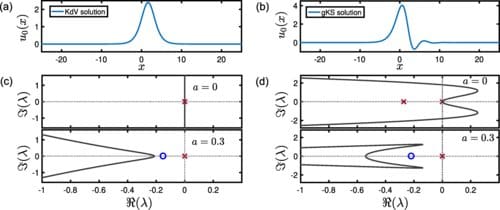
This research establishes that interactions between coherent structures in extended systems are significantly influenced by a hidden feature of the system’s spectrum, termed a resonance pole. The team demonstrates that this pole, apparent through specific mathematical frameworks, dictates transitions between dynamic behaviours, including oscillatory and chaotic motion, as shown through investigation of a falling liquid film, alongside the gKS equation and the FHN system. They demonstrate how the splitting of this resonance pole governs the interactions between pulses, leading to self-sustained oscillations and, ultimately, separation. The findings reveal a previously unrecognised mechanism driving the dynamics of these systems, offering a new perspective on how coherent structures organise long-term behaviour. Importantly, the research highlights that standard numerical continuation methods may miss this critical bifurcation, underlining the need for appropriate analytical frameworks. Further work is needed to fully understand the precise effects of resonance poles on coherent structure interactions and the transitions between dynamic regimes, and exploring the behaviour of these systems with a greater number of interacting pulses could reveal even more complex dynamics.
👉 More information
🗞 Coherent Structure Interactions in Spatially Extended Systems Driven by Excited Hidden Modes
🧠 DOI: http://link.aps.org/doi/10.1103/PhysRevX.15.031010