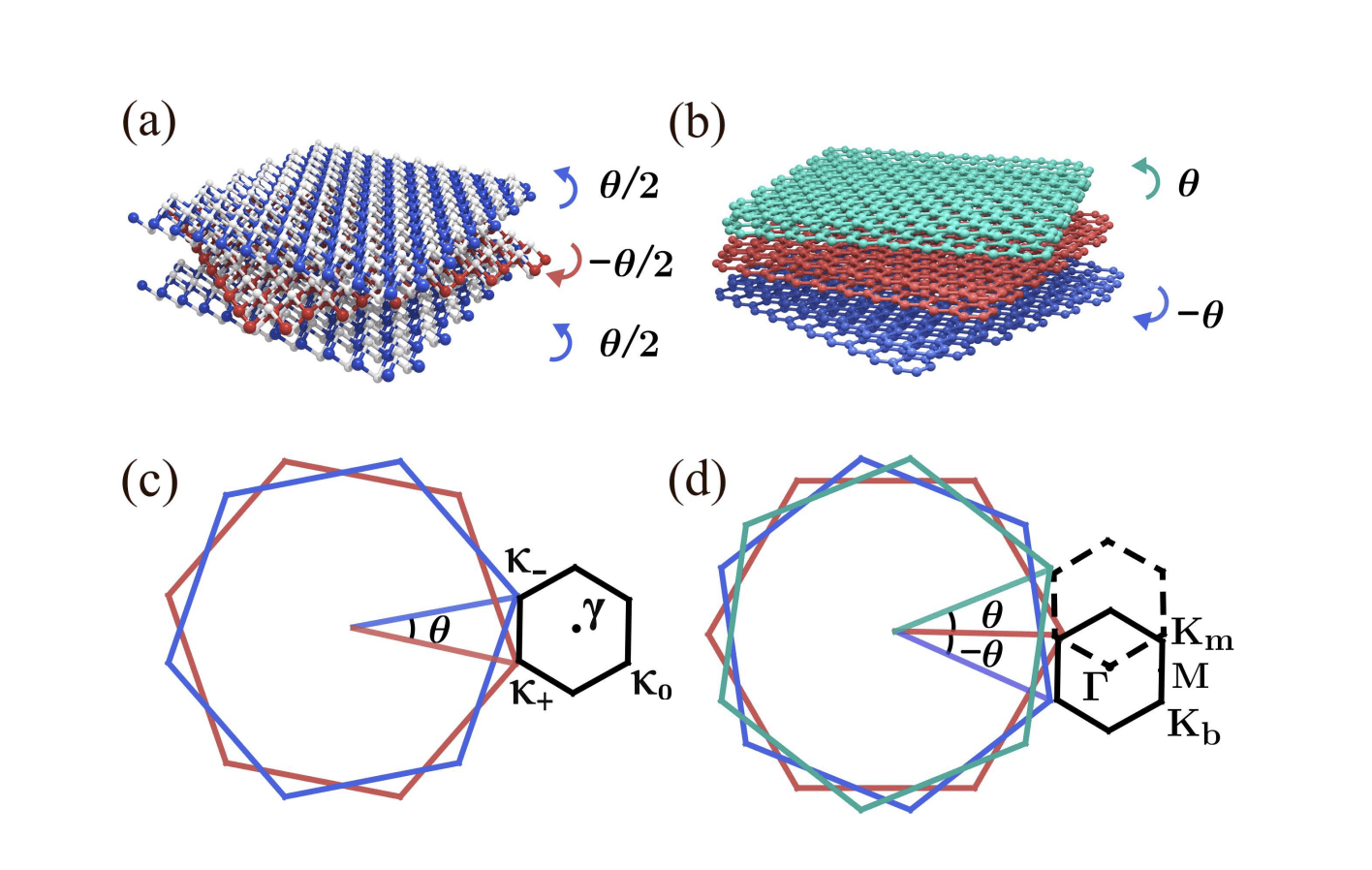
Moiré systems, created by layering two-dimensional materials with a slight twist, exhibit a surprising tendency to slide, a phenomenon that scientists are now discovering profoundly impacts their electronic properties. Shi-Ping Ding, Miao Liang, and Tian-Le Wu, along with colleagues at Huazhong University of Science and Technology, demonstrate that this sliding motion offers a novel way to control the quantum geometry of these materials, specifically the Berry curvature and quantum metric, surpassing the limitations of existing techniques. Their theoretical work predicts that strategically designed moiré systems, including alternating twisted trilayer and chirally twisted triple bilayer graphene, will exhibit exotic quantum phenomena, such as a nonlinear Hall effect and significant modulation of the quantum metric. This research establishes sliding as a crucial new parameter for manipulating quantum properties in moiré materials, potentially paving the way for advanced electronic devices and a deeper understanding of correlated quantum states.
Sliding Layers Control Fractional Chern Insulator States
This research provides supporting evidence that manipulating the layers in twisted trilayer MoTe2 allows precise control over its electronic properties, specifically enabling and manipulating fractional Chern insulator (FCI) states. Detailed calculations and visualizations of the band structure, Berry curvature, and Berry curvature dipole (BCD) demonstrate how interlayer sliding influences these properties. A fractional Chern insulator is an exotic state of matter characterized by topologically protected edge states and fractionalized excitations, requiring specific band structure engineering to achieve. Twisted trilayer MoTe2 is a heterostructure created by stacking three layers of MoTe2 with a slight twist angle, which modifies the electronic band structure.
Berry curvature describes the effective magnetic field experienced by electrons due to their wave-like nature, and is crucial for realizing topological states like FCIs. The Berry curvature dipole measures the overall distribution of Berry curvature within the band structure and can drive the formation of topological states. The research mathematically demonstrates that any interlayer sliding displacement can be mapped to an equivalent displacement within the Wigner-Seitz cell, simplifying calculations. The physics depends on the relative displacement, not the absolute position, meaning analysis can focus on the fundamental repeating unit.
Calculations show that the bandwidth of the first valence band remains nearly constant as the sliding vector changes, a desirable characteristic for strongly correlated states like FCIs. The Berry curvature is relatively uniform across the Brillouin zone for most sliding configurations, also favorable for FCI formation, with deviations indicating transitions between different states. The research focuses on the Berry curvature dipole, revealing that the second valence band contributes significantly more to the overall dipole than the first. Maximum dipole values occur at specific sliding configurations and Fermi levels, coinciding with changes in the material’s electronic state. The sign of the dipole can be controlled by the sliding configuration, allowing for precise manipulation of the material’s topological properties. These findings demonstrate that interlayer sliding provides a powerful way to tune the electronic band structure and control the Berry curvature, opening possibilities for realizing and manipulating fractional Chern insulator states, and providing a deeper understanding of the relationship between interlayer sliding, Berry curvature, and topological properties in moiré materials.
Sliding Layers Control Quantum Geometry and Curvature
This work establishes that sliding between layers in moiré systems provides a novel pathway to manipulate quantum geometry, specifically the Berry curvature and quantum metric of electronic bands. Researchers demonstrate that sliding, unlike conventional methods, offers a unique degree of freedom for controlling these properties in multi-twist moiré systems, focusing on alternating twisted trilayer (AT3L) and chirally twisted triple bilayer (CT3BLG) materials. Calculations reveal that applying a sliding displacement directly impacts the Berry curvature, a property linked to the quantum behaviour of electrons. In AT3L-MoTe2, zero sliding results in zero Berry curvature due to inherent symmetry, but a sliding displacement generates a Berry curvature dipole as large as 80 ̊A at a specific energy level.
The resulting Berry curvature distribution breaks the symmetry of the material, inducing a nonlinear Hall effect. The magnitude of the dipole is dependent on both the direction of the sliding and the energy level, reaching maximum values under optimal conditions. Similar results are observed in CT3BLG, demonstrating an analogous physical mechanism. Furthermore, the research demonstrates that sliding not only alters the Berry curvature distribution but also modulates the quantum metric, which describes the shape of the electronic bands. Analysis of AT3L-MoTe2 reveals that the bandwidth of the first moiré band changes as a function of the sliding displacement. Visualizing the quantum metric distribution shows a clear transformation from a symmetrical pattern with zero sliding to a modified pattern with a different displacement. These findings establish sliding as a powerful and tunable method for engineering quantum geometric properties in moiré materials, potentially opening new avenues for exploring and controlling electronic behaviour in these systems.
Sliding Layers Control Quantum Geometry and Effects
This research demonstrates that sliding between layers in moiré systems significantly influences their quantum geometry, offering a new pathway to control the electronic properties of these materials. The team theoretically predicts that sliding can induce unique quantum geometric phenomena, specifically a nonlinear Hall effect in chirally twisted triple bilayer graphene and substantial modulation of the quantum metric in alternating twisted trilayer structures. These effects arise from the way sliding alters the quantum mechanical characteristics of electrons within the material. The findings establish sliding as a previously overlooked factor in understanding and manipulating moiré systems, particularly those with multiple layers and complex twisting. The authors note that uncontrolled sliding in real devices can introduce variations in measurements of quantum geometric properties, highlighting the importance of considering this phenomenon in experimental studies. Future research should explore the full extent to which sliding modulates all quantum geometry-related phenomena and further investigate the implications for observing and controlling exotic electronic states like fractional Chern insulators.
👉 More information
🗞 Sliding-tuned Quantum Geometry in Moiré Systems: Nonlinear Hall Effect and Quantum Metric Control
🧠 ArXiv: https://arxiv.org/abs/2509.09077