
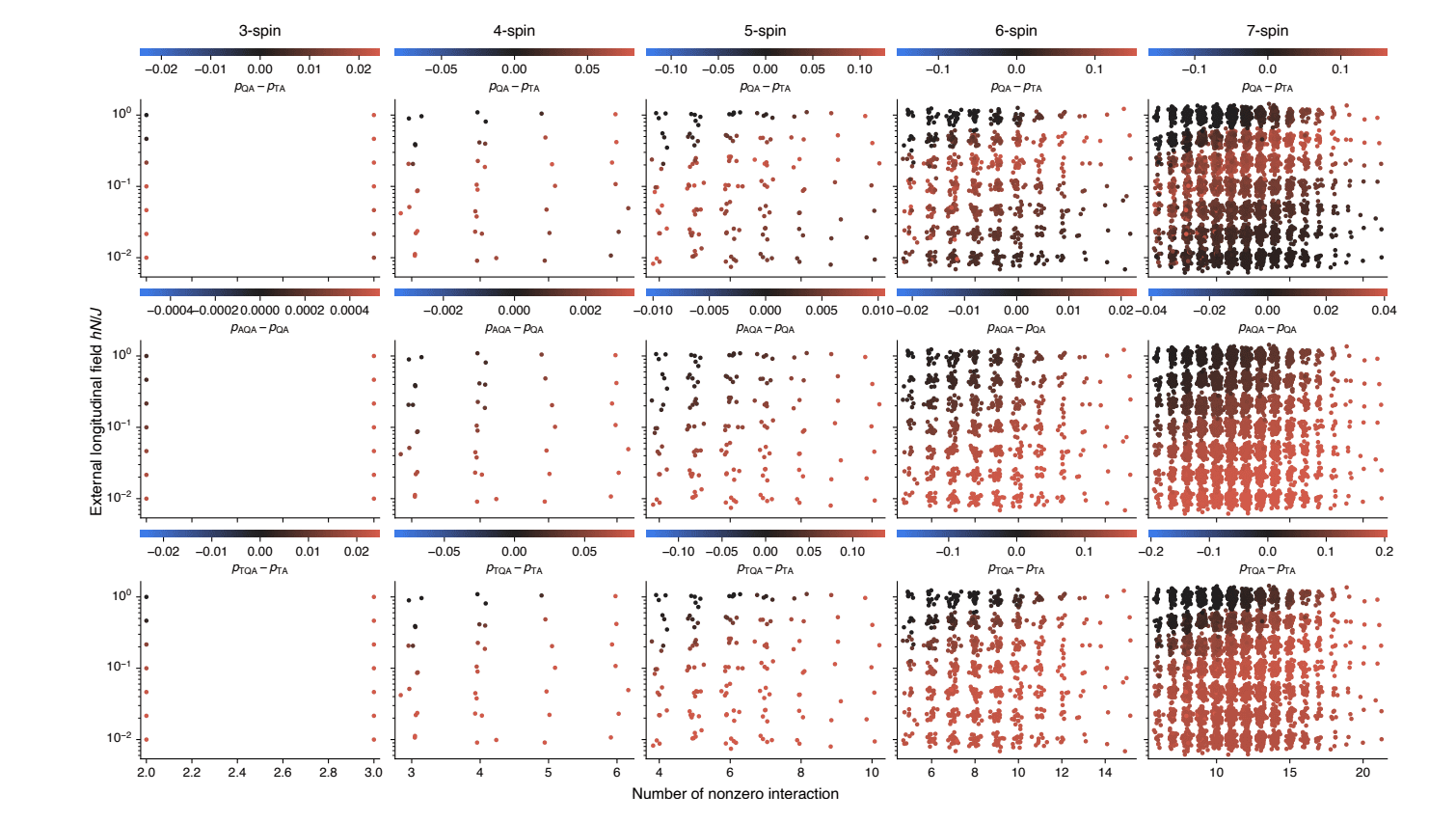
Combinatorial optimisation presents a significant challenge across numerous fields, and scientists increasingly turn to methods inspired by physics, such as thermal and quantum annealing, to find effective solutions. Yoshiaki Horiike and Yuki Kawaguchi, from Nagoya University, alongside their colleagues, now demonstrate a fundamental distinction between these two approaches. Their research investigates how the structure of the problem itself, specifically the network of interactions within a system, influences the dynamics of both thermal and quantum annealing. By comprehensively examining all possible interaction networks for systems up to seven spins, the team reveals that differences emerge not from the methods themselves, but from how each navigates the resulting energy landscape, identified through detailed analysis of probability fluxes. This work provides crucial insight into optimising the mapping of complex problems onto these physical systems, potentially leading to faster and more accurate solutions with broad applications in industry and beyond.
Studies have revealed both similarities and differences between these two approaches, yet a complete understanding of thermal and quantum annealing remains elusive, hindering the design of problem instances for meaningful comparison. This research investigates the dynamics of thermal and quantum annealing by examining all possible interaction networks within Ising spin systems, extending up to seven spins, revealing new insights into these complex processes.
Mapping Energy Landscapes in Spin Systems
Scientists undertook a comprehensive investigation of thermal and quantum annealing, techniques used to solve complex optimization problems, by examining the many-body dynamics of Ising spin systems. The study systematically explored all possible interaction networks within these systems, extending up to seven spins, to reveal fundamental differences between the two annealing methods. This involved constructing a complete map of potential energy landscapes to understand how each approach navigates toward optimal solutions, a feat requiring substantial computational resources and innovative algorithmic design. Researchers employed numerical simulations to model both thermal and quantum annealing processes, meticulously tracking the probability fluxes within the state space of the Ising spin systems.
This detailed analysis allowed them to visualize how each method explores the energy landscape, identifying the microscopic origins of any observed differences in performance. The team focused on understanding whether quantum fluctuations, which allow systems to tunnel through energy barriers, offered a distinct advantage over thermal fluctuations, which rely on overcoming barriers through energy input. To ensure a fair comparison, the study moved beyond typical benchmark problems, recognizing the difficulty in designing instances that accurately reflect the strengths of each method. Instead, scientists focused on a complete survey of interaction networks, systematically varying the connections between spins to create a diverse range of energy landscapes.
This approach enabled them to identify specific network structures where quantum annealing demonstrably outperformed thermal annealing, and vice versa, revealing the conditions under which quantum advantages emerge. The team’s work provides insight into the fundamental mechanisms driving both thermal and quantum annealing, potentially leading to improved algorithms and more efficient solutions for real-world optimization problems. Furthermore, the research addresses the ongoing debate surrounding the superiority of quantum annealing by providing a detailed, network-dependent analysis of its performance.
Annealing Pathways Reveal Search Strategies
Researchers have developed a method to visualize the pathways taken by thermal and quantum annealing algorithms as they search for solutions to complex problems. The team analyzed the probability fluxes, or the rate of transition between different states, to understand how each method explores the ‘energy landscape’ of a problem. By applying this technique to small Ising spin systems, they revealed that the structure of the interaction network significantly influences the effectiveness of each approach. The visualizations demonstrate how thermal annealing relies on overcoming energy barriers, while quantum annealing utilizes ‘tunnelling’ to pass through them.
This work builds upon existing studies of larger systems and confirms the importance of network structure in optimizing annealing performance. The team has made their data and code publicly available, enabling other researchers to build upon their findings. This provides a foundation for designing more effective problem instances and mapping optimization problems onto Ising spin systems, potentially leading to faster and more accurate solutions for applications in fields such as machine learning and materials science.
Quantum Tunnelling Shapes Annealing Pathways
Researchers have investigated thermal and quantum approaches to simulated annealing, a technique used to find solutions to complex optimization problems. Their work focuses on understanding how these two methods navigate the ‘energy landscape’ of a problem to identify the best possible solution. Through a comprehensive analysis of all possible interaction networks within small Ising spin systems, up to seven spins, the team demonstrates that differences between thermal and quantum annealing arise from the specific structure of these interaction networks. The investigation reveals that the microscopic origins of these differences lie in the pathways of state transitions, specifically how ‘tunnelling’ affects the process.
By visualizing probability fluxes, the movement between different states, the researchers pinpoint how thermal and quantum fluctuations explore the energy landscape. While the study is currently limited to relatively small systems, the findings align with existing research on larger systems and suggest that understanding interaction network structure is crucial for optimizing annealing performance. Future work should extend these findings to larger systems and leverage recent advances in atomic, molecular, and optical physics to experimentally validate the results. These insights may guide the design of problem instances and improve the mapping of optimization problems onto Ising spin systems, potentially leading to faster and more accurate solutions with benefits for applications in machine learning, pharmaceuticals, and transportation.
👉 More information
🗞 Distinguishing thermal versus quantum annealing using probability-flux signatures across interaction networks
🧠 ArXiv: https://arxiv.org/abs/2511.16457