

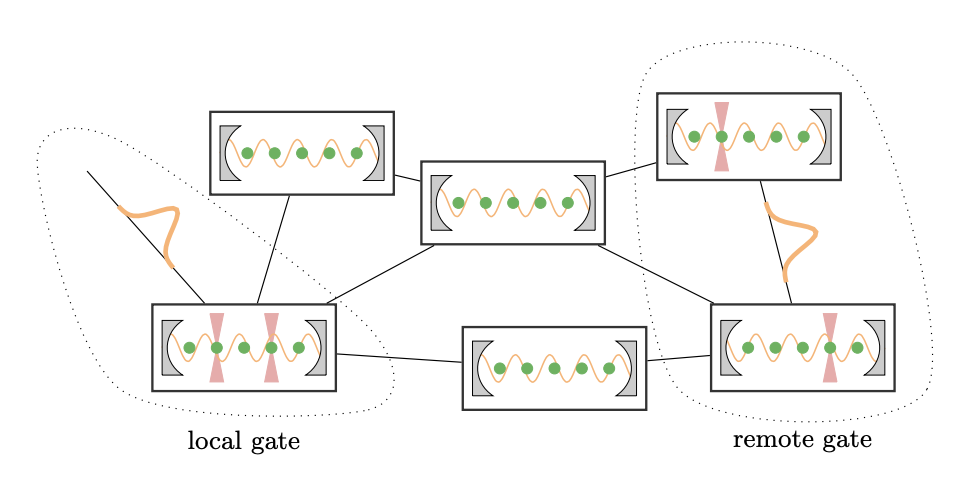
Scaling up quantum computing requires innovative architectures, and researchers are now exploring networks of interconnected quantum modules, as demonstrated by Tim Keller, Seigo Kikura, and Rui Asaoka, alongside colleagues from Waseda University and NTT Corporation. This team investigates a promising all-fiber system where individual quantum modules, based on atoms interacting with light within nanofiber cavities, connect via standard optical fibers. They demonstrate how to perform quantum logic operations on atoms both within the same module and between distant modules, crucially addressing the challenge of unwanted interactions, or crosstalk, that can corrupt calculations. The results show how precise control of light and atom positioning enables high-fidelity quantum gates, paving the way for more complex and scalable quantum networks.
Fiber Network Gate Implementation Details
This document provides detailed mathematical and technical information supporting the research findings, enabling verification and expansion of this work by other scientists. This supplementary material is essential for reproducibility and a thorough understanding of the methods. Appendix A details the calculation of the optical mode propagating within the optical fiber, crucial for accurately modeling light-atom interactions. The appendix considers a step-index fiber, utilizing effective wavenumbers and propagation constants, and involves Bessel functions arising from solving Maxwell’s equations in cylindrical geometry.
Accurate knowledge of the fiber mode is essential for determining coupling efficiency and impacting gate fidelity. Appendices B and C detail the mathematical framework used to quantify errors in the quantum gates, explaining how to calculate error rates from Kraus operators and utilizing completely positive maps to represent quantum channels. The framework employs Pauli channels and transfer matrices to analyze their effects, and the Pauli twirling approximation simplifies the analysis of noisy quantum channels. This appendix provides the tools to quantify gate performance and identify the dominant sources of error, crucial for evaluating the feasibility of a scalable quantum network.
All-Fiber Quantum Computing with Nanofiber Cavities
This study pioneers an all-fiber architecture for distributed quantum computing, connecting modules via optical fibers and utilizing nanofiber cavities to strongly couple atoms to light. Researchers trapped atoms in optical tweezer arrays near these cavities, enabling interaction through surrounding light and communication between modules. This setup combines strong light-matter coupling with established optical fiber infrastructure, offering a pathway towards scalable quantum computing networks. Scientists performed quantum operations by controlling light-matter coupling through atom-cavity distance and applying local light shifts.
This dual approach allows precise targeting of individual atoms within and between cavities, essential for performing photon-mediated controlled-Z gates. The team numerically modeled a network of nanofiber cavities, each containing multiple atoms, to determine the optimal parameters for achieving nearly crosstalk-free gate operation. The research focused on both local and remote controlled-Z gates, linking atoms within a single cavity or in separate cavities via photons. Scientists calculated average gate fidelities, success probabilities, and Pauli error rates to assess performance under various conditions. Analytic approximations were also derived to determine the theoretical maximum gate fidelity, limited by factors such as cavity reflectivity, the strength of coupling, and the energy level spacing within the qubits.
Scalable Quantum Gates with Neutral Atoms and Photons
This research demonstrates a pathway towards scalable quantum computing using a distributed network of neutral atoms connected by photons. Scientists evaluated the parameters required to perform high-fidelity quantum gates within this architecture, focusing on controlling interactions between atoms located both within the same module and in distant, interconnected modules. The core of this work involves utilizing nanofiber cavities to strongly couple atoms to light, enabling the creation of quantum gates mediated by photons. Experiments reveal that by precisely controlling the coupling strength between atoms and the nanofiber cavities, through techniques like local light shifts and adjusting atom-fiber distance, nearly crosstalk-free gate operations are achievable.
The team calculated that, under ideal conditions, the system can achieve optimal gate performance limited by factors such as cavity reflectivity, the degree of coupling between atoms and the cavity, and the energy level spacing within the atoms. Detailed analysis of the photonic phase-flip mechanism shows that a photon’s reflection from a cavity can be manipulated to induce a sign change in its wave function, depending on the atom’s presence and coupling strength. Specifically, the researchers determined that by tuning the photon frequency to match the cavity resonance and optimizing coupling strengths, a controlled-Z gate can be achieved. Furthermore, the study presents calculations for both local and remote controlled-Z gates, demonstrating the feasibility of connecting distant atomic qubits via photons. This work establishes a solid foundation for building larger, more complex quantum computers based on distributed networks of neutral atoms and photon-mediated interactions.
Scalable Quantum Gates with Neutral Atoms
This research investigates photon-mediated quantum gates within a distributed network of neutral atoms, demonstrating a pathway towards scalable quantum computing architectures. Scientists numerically and analytically evaluated the performance of both local and remote controlled-Z gates, considering factors like cavity properties, qubit level splitting, and addressing techniques. Results indicate that high-fidelity gates are achievable, with performance limited by fundamental system parameters, and that combining methods for controlling light-matter coupling, specifically adjusting atom-fiber distance and applying light shifts, can significantly reduce addressing requirements. Interestingly, the study reveals a trade-off between local and remote gate operations; while local gates generally exhibit higher potential fidelities, remote gates may require less stringent addressing.
This suggests that, depending on network configurations and resource constraints, remote gates could offer a more practical solution. The authors acknowledge certain simplifications within their model, such as assuming perfect operation of additional optical components and neglecting the effects of finite laser beam waists. Future work could incorporate these imperfections for more realistic performance estimates and explore the optimal arrangement of qubits within the network structure to further enhance scalability and efficiency.
🗞 Addressing requirements for crosstalk-free quantum-gate operation in many-body nanofiber cavity QED systems
🧠 ArXiv: https://arxiv.org/abs/2509.08408


