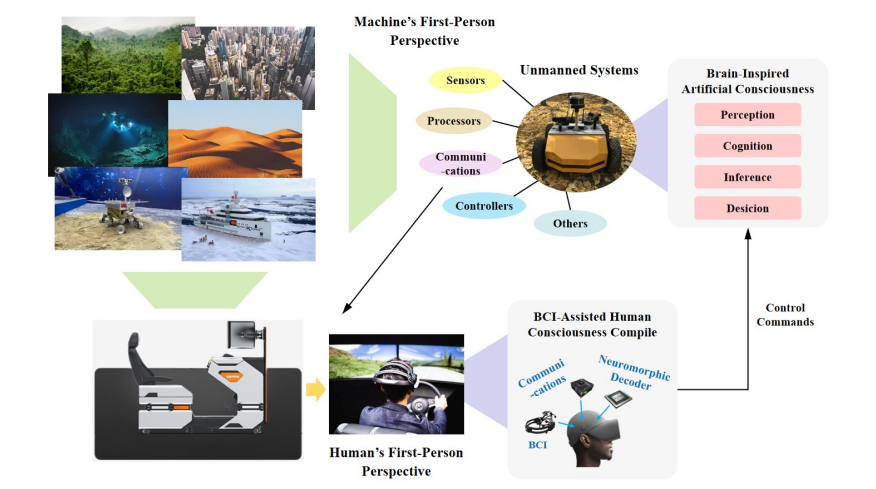
The challenge of reliable navigation in complex environments, crucial for missions ranging from deep space exploration to disaster response, demands increasingly sophisticated approaches to artificial intelligence. Xu He, Xiaolin Meng from Southeast University, Youdong Zhang, Lingfei Mo, and Wenxuan Yin propose a new framework integrating human intelligence with brain-inspired artificial intelligence, addressing a current disconnect between brain-computer interfaces and brain-inspired navigation technologies. Their work champions a collaborative system where machine intelligence, enhanced by artificial consciousness, extends human capabilities, with brain-computer interfaces providing a vital safety net in case of machine failure. This innovative approach not only promises to significantly improve the performance of unmanned systems, but also offers potential avenues for understanding and diagnosing spatial cognition disorders, while acknowledging the important ethical and security considerations inherent in such advanced technologies.
Brain-Inspired Navigation For Challenging Environments
This research explores Brain-Inspired Navigation (BIN), a field drawing inspiration from the brain’s remarkable ability to navigate and understand space, and aims to improve the adaptability, robustness, and intelligence of autonomous systems operating in demanding environments like space and the ocean. Building on the Nobel Prize-winning discovery of the brain’s internal “GPS”, scientists are developing brain-inspired computing methods and hardware to replicate the brain’s spatial cognition. This work proposes a new approach integrating Brain-Computer Interfaces (BCI) to enhance system performance, bridging neuroscience, Brain-Inspired Intelligence (BII), and Positioning, Navigation, and Timing (PNT) to unlock new possibilities for unmanned exploration. Artificial intelligence, while powerful, often falls short of the brain’s computational efficiency and general intelligence, driving interest in BII and the potential of BCI as a key interface between humans and machines.
This research proposes a pipeline for integrating human and machine intelligence, creating unmanned systems that are both capable and reliable in demanding missions. Machine intelligence can extend human capabilities, but human intelligence can also serve as a crucial safeguard against machine failures, effectively extending human cognition. Neuromorphic computing, with its high energy efficiency and low latency, is proposed as a vital component for decoding human intentions and facilitating real-time communication between humans and machines. This approach could also benefit the medical field, offering new BCI-based methods for diagnosing spatial cognition disorders and furthering our understanding of the brain’s navigation circuitry. Researchers acknowledge the ethical and security considerations surrounding the practical implementation of these technologies, and are actively addressing these concerns.
Brain-Inspired Navigation via Brain-Computer Interface
This work pioneers a novel integration of Brain-Computer Interfaces (BCI) into the field of Brain-Inspired Navigation (BIN), addressing a disconnect between these areas of research. Scientists recognize that while artificial intelligence excels in specific tasks, it still lags behind the brain’s overall computational efficiency and general intelligence, driving interest in brain-inspired computing and BCI. The study highlights the potential for BCI to directly utilize brain signals to decode intentions and enable “thought communication” for controlling external machines. Researchers are developing efficient brain signal decoding techniques, increasingly turning to neuromorphic computing to improve performance.
Furthermore, the application of ANN2SNN technology, which translates Artificial Neural Networks into Spiking Neural Networks, allows many AI-powered BCI decoding methods to be adapted for deployment on neuromorphic hardware. The study proposes a pipeline for human intelligence-assisted navigation in demanding missions, recognizing the complementary nature of human and machine intelligence. Scientists envision machine intelligence extending human capabilities, while human intelligence provides a critical safeguard against machine failures. To achieve this, researchers advocate for integrating BCI technology into BIN research, bridging the gap between human and machine intelligence to enhance the reliability of unmanned systems in challenging environments. This approach seeks to synthesize validated neural functions and structures through simulation, approximating brain intelligence and establishing BIN as a vital entry point for broader BII advancements.
BCI and Brain-Inspired Navigation for Unmanned Systems
This work details a novel approach to unmanned system navigation, advocating for the integration of Brain-Computer Interfaces (BCI) with Brain-Inspired Navigation (BIN) to bolster performance in challenging environments. Researchers demonstrate that while artificial intelligence excels in areas like visual and natural language processing, it still lags behind the brain’s computational efficiency and general intelligence, driving interest in brain-inspired intelligence. The study highlights the potential of BCI, which directly uses brain signals as input, to enable “thought communication” and control external machines, citing Meta’s Brain2Qwerty system as an example capable of decoding sentences from brain activity. The team proposes a pipeline where BCI serves as a crucial link between human and machine intelligence, acting as a safeguard against failures in fully autonomous operations, particularly in scenarios like extraterrestrial exploration, ocean exploration, and polar expeditions.
Experiments reveal that unmanned systems currently struggle with navigation in the absence of spatial priors, and the researchers propose leveraging BCI to introduce human intelligence as a fail-safe mechanism. This approach builds on existing “thought-driven driving” technology, exemplified by work at Ford Global Technologies, which interprets human driving intentions using BCI for remote operation. Central to this integration is the development of neuromorphic computing, utilizing brain-inspired chips that offer high energy efficiency, low latency, and low power consumption compared to traditional computer architecture. The team advocates for integrated neuromorphic hardware and software for decoding human intentions, enabling dynamic task execution for unmanned systems. This work demonstrates a pathway to enhance unmanned system reliability by bridging human and machine intelligence, maximizing autonomy and self-control in diverse and challenging environments.
BCI Bridges Neuroscience and Brain-Inspired Navigation
This work establishes a clear connection between neuroscience, Brain-Inspired Intelligence (BII), and Brain-Inspired Navigation (BIN), highlighting a disconnect between Brain-Computer Interface (BCI) research and the field of BIN. The analysis advocates for integrating BCI technologies into BIN systems, with the potential to significantly enhance the reliability of unmanned systems operating in complex environments, such as deep space exploration. By leveraging brain-inspired artificial intelligence, and with human intelligence mediated through BCI acting as a safety net, these systems can extend cognitive capabilities and potentially mitigate failures in machine intelligence. The research demonstrates how BCI, originating from efforts to augment human intelligence, can directly utilise brain signals to control external devices and execute tasks. Advances in decoding these signals, particularly through neuromorphic computing and technologies bridging Artificial and Spiking Neural Networks, offer promising avenues for efficient and low-power BCI systems. The authors acknowledge that this field remains largely theoretical and exploratory, with a technical roadmap still under development, but they present a compelling case for the synergistic benefits of combining BCI with BIN to create more robust and intelligent unmanned systems, and potentially offer new diagnostic tools for spatial cognition disorders.
🗞 Navigate in Demanding Missions: Integrating Human Intelligence and Brain-Inspired Intelligence
🧠 ArXiv: https://arxiv.org/abs/2510.17530