The challenge of efficiently connecting the near and mid-infrared regions of the electromagnetic spectrum has driven significant research, and a new platform now bridges this gap using the principles of optomechanics and self-mixing. Tecla Gabbrielli, Chenghong Zhang, and Francesco Cappelli, alongside Iacopo Galli, Andrea Ottomaniello, and Jérôme Faist, demonstrate a system where a membrane’s oscillation, induced by near-infrared light, is detected using the self-mixing signal from a mid-infrared laser. This innovative approach establishes a wavelength-independent link between these spectral regions, potentially revolutionising advanced sensing technologies and opening new avenues for exploring and utilising different parts of the infrared spectrum. The research represents a significant step towards creating versatile platforms capable of seamlessly integrating and manipulating radiation across a broad range of wavelengths.
Terahertz Signal Generation via Membrane Modulation
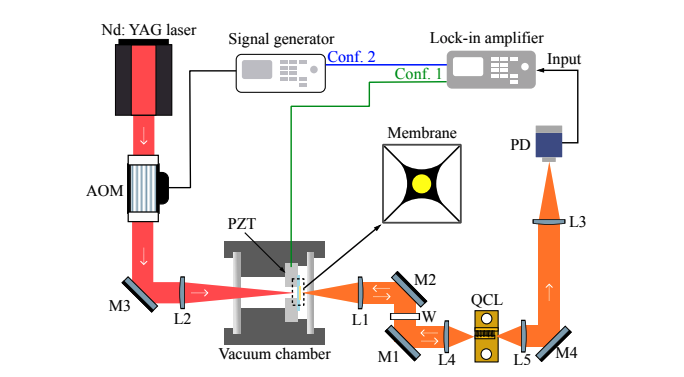
This research details a new method for generating terahertz (THz) signals using readily available near-infrared (NIR) technology. The team developed a system that converts amplitude modulation in NIR light into a detectable signal in the THz range, utilizing a vibrating membrane and a quantum cascade laser (QCL). This approach overcomes limitations of traditional THz technology, potentially enabling more compact and cost-effective systems for remote sensing and communication. The core principle involves mechanically modulating the reflection of NIR light with a vibrating membrane, then directing this modulated light towards a THz QCL. Changes in the reflected light influence the QCL’s self-mixing signal, effectively translating the NIR signal into a detectable THz signal. This innovative technique opens up possibilities for new applications in sensing, communication, and imaging by providing a pathway to generate and detect THz waves using simpler and more accessible technology.
Optomechanical Link Between Near and Mid-Infrared
Scientists engineered an optomechanical platform that links near- and mid-infrared radiation, demonstrating a new way to detect membrane oscillation induced by radiation pressure. The system utilizes a self-mixing signal from a mid-infrared cascade laser to detect the oscillation of a silicon nitride membrane driven by amplitude-modulated near-infrared light. This wavelength-independent method establishes a versatile link between different spectral regions for both excitation and probing, promising advancements in sensing systems. The experimental setup features a silicon nitride membrane, fixed onto a piezoelectric actuator for precise control and calibration, and operates within a vacuum chamber allowing simultaneous transmission of both near- and mid-infrared beams.
Near to Mid-Infrared Spectral Bridging Demonstrated
This work demonstrates a novel optomechanical platform capable of transferring information between near- and mid-infrared radiation, achieving a significant breakthrough in spectral bridging. The system utilizes a membrane whose oscillation, induced by radiation pressure, is detected using a self-mixing signal from a mid-infrared cascade laser. Experiments reveal that the membrane’s resonance frequency shifts predictably with changes in optical power, enabling precise control and measurement of these interactions. The team measured a quantifiable shift in resonance frequency as the mid-infrared power increased, demonstrating the system’s sensitivity and establishing a linear relationship between frequency shift and incident radiation.
Mid to Near Infrared Signal Transfer
This research demonstrates a self-mixing-assisted optomechanical platform capable of transferring information between near- and mid-infrared radiation, effectively creating a communication link between these spectral regions. The team successfully used amplitude modulation of a near-infrared beam to induce membrane oscillations, then detected these oscillations via changes in a mid-infrared laser signal, confirming the potential for encoding and transmitting information across wavelengths. This approach leverages the wavelength-independent properties of the membrane interface, allowing for versatile connections regardless of the excitation source’s colour, and suggests potential applications extend to sensing and imaging, including the development of membrane-based arrays for spatial control of modulation and hybrid photoacoustic mid-infrared sensing techniques.
🗞 Bridging mid and near infrared by combining optomechanics and self mixing
🧠 ArXiv: https://arxiv.org/abs/2509.11729