

The behaviour of self-reinforcing waves, known as solitons, extends beyond one dimension to create complex structures in diverse physical systems, and recent work significantly advances our understanding of these phenomena. Boris A. Malomed from Tel Aviv University and colleagues present an updated overview of multidimensional soliton systems, particularly within nonlinear optics and atomic Bose-Einstein condensates. This research highlights new experimental achievements, including the creation of multiple droplets within elongated condensates and the observation of expanding ring-shaped light structures, alongside theoretical predictions of stable, three-dimensional vortex solitons in condensates with long-range interactions. By consolidating these recent advances, the work provides a valuable resource for researchers exploring the fundamental properties and potential applications of these complex wave phenomena.
Briefly summarises some notable results on this topic that have been reported very recently, and offers a compact outline of the directions of current experiment and theoretical work in this and related fields. Recent experimental findings include the creation of multiple quantum droplets in prolate Bose-Einstein condensates, and the observation of expanding toroidal light structures in linear optics. Theoretical work includes analysis of two-dimensional solitons in optical systems with quadratic nonlinearity and fractional diffraction, and the prediction of stable three-dimensional vortex solitons in Bose-Einstein condensates with long-range interactions. This article offers an.
Quantum Droplets and Soliton Dynamics in BECs
update to recent work, which provided a concise review of the creation, stability, dynamics, and potential applications of two- and three-dimensional solitons and soliton-like states, such as self-trapped modes with embedded vorticity, and quantum droplets in Bose-Einstein condensates. The review addressed both theoretical and experimental aspects of the topic, providing a condensed compendium of the subject published in 2022. This update details recent progress in the field, including observations of quantum liquid droplets in mixtures of Bose-Einstein condensates and investigations of self-bound quantum droplets of atomic mixtures in free space. Dynamical formation of multiple quantum droplets in a Bose-Bose mixture has also been studied.
Researchers have explored topological quasiparticles of light, including photonic skyrmions, and observed toroidal pulses of light. Recent theoretical work includes investigations of two-dimensional solitons in second-harmonic-generating media with fractional diffraction, and the formation and propagation of fundamental and vortex soliton families in one- and two-dimensional fractional nonlinear Schrödinger equations with cubic-quintic nonlinearity. Physics-informed neural networks have been applied to the nonlinear dynamics of self-trapped necklace beams. Theoretical studies have also focused on vortex quantum droplets under competing nonlinearities, discrete and semi-discrete multidimensional solitons and vortices, and the properties of three-dimensional vortex solitons in Rydberg-dressed Bose-Einstein condensates with spin-orbit coupling.
Stable three-dimensional vortex solitons of high topological charge have been predicted in a Rydberg-dressed Bose-Einstein condensate with spin-orbit coupling. Further theoretical work has explored the formation of three-dimensional vortex and multipole quantum droplets in a toroidal potential, and solitons in Bose-Einstein condensates with attractive self-interaction on a Möbius strip. Colloquium reviews on quantum properties and functionalities of magnetic skyrmions are also relevant. Specifically, studies have investigated the properties of strongly anisotropic vortices in dipolar quantum droplets, tightly self-trapped modes and vortices in three-dimensional bosonic condensates with electromagnetically induced gravity, and the stability of three-dimensional vortex solitons in a dipolar Bose gas. Applying a torque imparting perpendicular angular momentum to a vortex quantum droplet results in robust precession motion.
Splitting Bose-Einstein Condensates into Stable Droplets
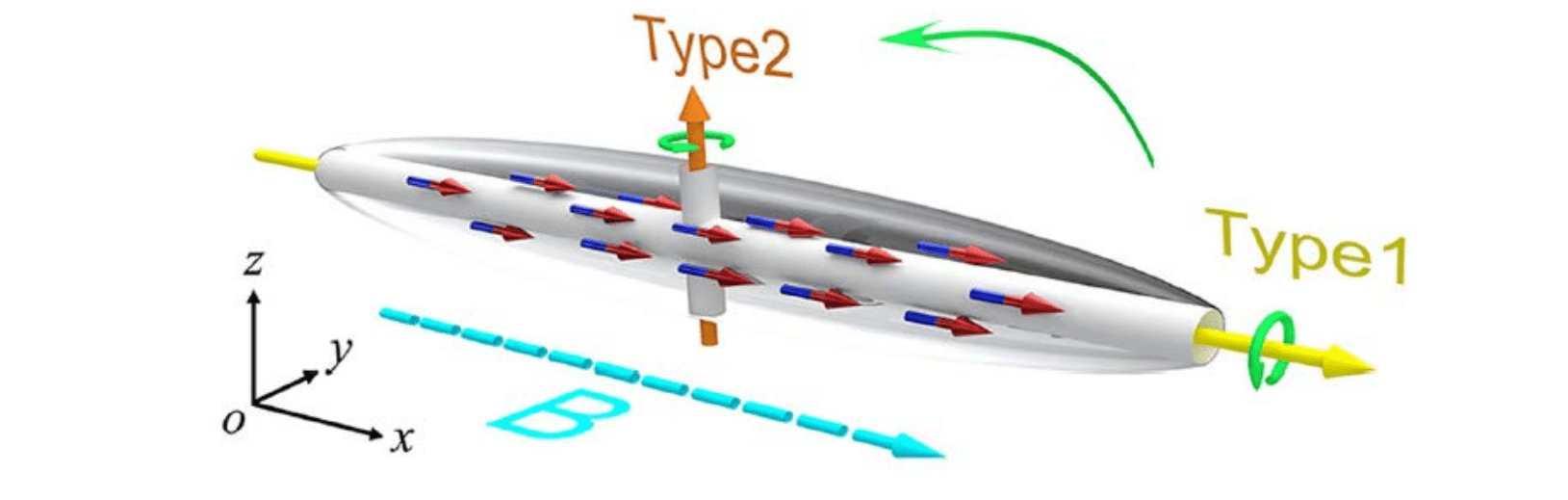
Recent work expands upon the study of multidimensional solitons, particularly within nonlinear optics and atomic Bose-Einstein condensates. Experiments have successfully created multiple quantum droplets in prolate Bose-Einstein condensates through capillary instability of elongated atomic clouds, resulting in fission into stable droplets. These droplets were formed by applying a sudden quench via Feshbach resonance, effectively making atomic collisions attractive and initiating the splitting process. Observations reveal the spontaneous splitting of elongated clouds of ultracold 41K atoms into pairs of stable quantum droplets, captured as a sequence of atomic-density patterns at varying time points.
In optics, researchers observed expanding toroidal light structures during linear light propagation, revealing spatially-confined states similar to three-dimensional solitons. While these optical modes exhibit complex inner structures, such as skyrmions, they differ from true solitons as they gradually expand without self-trapping. Measurements of the expanding toroidal mode show a local dominant wavelength distribution and a power-density profile, demonstrating a distinct distribution compared to three-dimensional vortex solitons in nonlinear media. Theoretical investigations have focused on two-dimensional solitons within systems exhibiting quadratic nonlinearity and fractional diffraction.
Analysis of a system governed by propagation equations for fundamental and second-harmonic waves reveals that the fractional diffraction operator, defined as a two-dimensional Riesz derivative, can lead to collapse and instability for certain conditions. However, stable fundamental two-dimensional solitons have been produced under specific parameters, opening new avenues for exploring wave dynamics in complex optical media. These findings represent a significant step forward in understanding and controlling multidimensional solitons, with implications for both fundamental research and potential technological applications.
Soliton Formation in Bose-Einstein Condensates
Recent investigations continue to expand understanding of multidimensional solitons and related nonlinear modes, demonstrating ongoing progress in optics, photonics, quantum matter, and potentially other fields. Researchers have experimentally created multiple droplets within prolate Bose-Einstein condensates and observed expanding toroidal light structures, adding to the growing body of evidence for these unique quantum states. Theoretical work complements these experimental findings, with analyses predicting stable three-dimensional vortex solitons in Bose-Einstein condensates featuring long-range interactions and exploring two-dimensional solitons within systems exhibiting quadratic nonlinearity and fractional diffraction. Furthermore, studies have examined solitons in settings with complex topologies, including matter-wave solitons existing on Möbius strips, and investigated the formation and propagation of soliton families in fractional nonlinear Schrödinger equations. These combined efforts reveal the continued relevance and rapid development of this subject, with ongoing research pushing the boundaries of knowledge regarding these complex nonlinear phenomena.
👉 More information
🗞 Multidimensional Soliton Systems: an Update
🧠 ArXiv: https://arxiv.org/abs/2511.01503


