

The loss of quantum coherence, a major obstacle to building powerful quantum technologies, arises from interactions with the surrounding environment, often treated as unstructured noise, but a new framework offers a different perspective. Ridwan Sakidja from Missouri State University and colleagues present a method for modelling these environmental interactions as ‘structured baths’ with inherent memory, allowing researchers to directly investigate how these interactions affect quantum systems. This approach models the environment as a network of interconnected quantum bits, enabling detailed analysis of the resulting spectral fingerprints, and crucially, allows the use of standard machine learning techniques to infer key bath properties. By treating the environment not as a hindrance, but as a controllable component, this work provides a powerful new tool for understanding and potentially harnessing coherence loss, with implications for both the design of quantum hardware and the education of future quantum scientists.
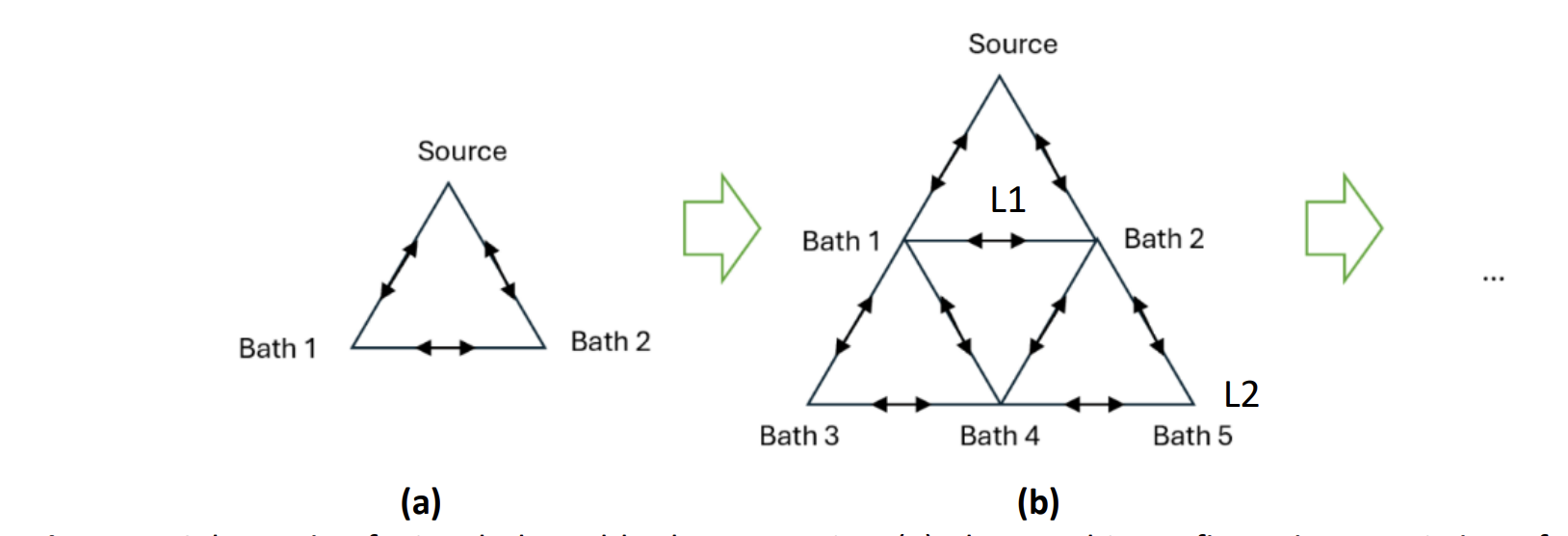
Spectral analysis represents a powerful approach to characterise quantum systems, particularly when considering dynamics beyond the Markovian regime, where memory effects become significant. Rather than treating the environment as a continuous entity, this work focuses on explicitly modelling it as a discrete, structured system. This explicit modelling enables detailed investigation of non-Markovian dynamics and allows for spectral diagnostics via Fast Fourier Transform of system observables. Employing a triangle-based bath motif, and extending this to a six-qubit anisotropic fractal-like architecture, researchers demonstrate how spectral fingerprints encode information about both bath topology and memory depth. Standard machine learning tools, such as Principal Component Analysis and gradient boosting, can then be employed to infer bath parameters and estimate proximity to exceptional points, singularities in quantum systems. The results suggest that spectral analysis can serve as a unifying, quantum-platform agnostic tool across theoretical and experimental investigations.
Simulating Coherence Transfer in a Qubit Bath
Researchers have simulated a six-qubit system, comprising a source qubit interacting with a network of five bath qubits, to explore how coherence, a key quantum property, transfers and dissipates within the environment. The simulation models the interplay between qubits, governed by parameters defining the strength of their interactions and the rate of thermal dissipation. By carefully adjusting these parameters, the team investigates the transition between Markovian and non-Markovian regimes, where the environment retains information about past interactions. This detailed analysis reveals how the bath’s structure influences the retention and loss of quantum information.
The team extracts features from the simulation data using Fast Fourier Transform, a technique that converts time-domain signals into frequency-domain spectra. Before applying the transform, the data undergoes mean removal to eliminate spurious low-frequency components. The resulting spectra are then enhanced and normalized to improve visibility and facilitate comparison. These spectra, derived from multiple observables, are combined into a single, high-dimensional feature vector, capturing a comprehensive picture of the system’s dynamics. To predict key system parameters, the team employs machine learning techniques.
Principal Component Analysis reduces the dimensionality of the feature vectors, simplifying the model and improving its generalization ability. XGBoost, a powerful machine learning algorithm, is then trained to predict parameters such as inter-layer coupling, system-bath coupling, and the non-Markovian backflow rate. The model’s performance is evaluated using metrics like Mean Squared Error and R-squared. The team splits the data into training and testing sets, with 80% used for training and 20% for evaluation. This comprehensive approach demonstrates the power of combining detailed quantum simulations with advanced machine learning techniques.
The FFT-based feature extraction is particularly effective at transforming raw simulation data into a format suitable for machine learning. The ability to predict system parameters from spectral data has several valuable applications, including system characterization, optimal control design, and system design. This work has potential applications in quantum computing, quantum sensing, materials science, and quantum biology.
Simulating Quantum Environments with Layered Qubit Networks
Researchers have developed a compact simulation framework to model open quantum systems, moving beyond traditional approaches that treat environmental noise as a simple disruption. This new method explicitly models the surrounding environment, or “bath,” as a network of interconnected qubits, allowing for detailed investigation of non-Markovian dynamics, situations where the environment retains memory of past interactions. By representing the bath as a discrete, layered structure, the team demonstrates how spectral fingerprints directly encode information about the bath’s topology and its capacity to store and return information. The framework utilizes a triangle-based motif, extending to a six-qubit anisotropic architecture, to simulate complex environmental interactions.
Results show that this structured bath enables controlled memory and delocalized information flow, effectively transforming the environment from a source of noise into a collaborative partner in quantum dynamics. The research reveals the potential to estimate proximity to exceptional points, singularities in quantum systems, using machine learning tools such as Principal Component Analysis and gradient boosting applied to the spectral data. This suggests a pathway for leveraging structured baths not only for understanding coherence loss but also for achieving enhanced quantum control. The framework’s modular design and reproducibility make it a valuable educational tool, allowing students to explore open quantum systems beyond the standard Markovian approximation and extract interpretable signatures of complex dynamics. By connecting the study of exceptional points to a realistic, discrete bath model, this work may provide a pathway for their experimental realization and application within current quantum architectures.
Environment’s Structure Reveals Quantum System Properties
This work introduces a new framework for modeling how quantum systems interact with their environment, representing the environment as a structured network of interconnected qubits rather than an abstract entity. By explicitly modeling the environment’s structure, researchers can directly link its geometry and connectivity to observable phenomena in the quantum system, offering a complementary approach to traditional methods. The results demonstrate that analyzing the frequency spectrum of the system, its “fingerprint”, can reveal detailed information about the environment’s properties, potentially serving as a valuable diagnostic tool for quantum engineers. The framework’s modular design allows for the creation of increasingly complex system-environment configurations, and the method can be used to explore advanced concepts like exceptional points in a realistic and experimentally accessible context. The availability of open-source code further enhances the accessibility and reproducibility of these findings, paving the way for broader exploration of non-Markovian dynamics and structured environments in quantum systems.
🗞 Structured Quantum Baths with Memory: A QuTiP Framework for Spectral Diagnostics and Machine Learning Inference
🧠 ArXiv: https://arxiv.org/abs/2508.17514


