The emerging field of mechanobiology, which investigates how physical forces influence cellular behaviour, receives a significant boost from new research into magnetic nanoparticles. Myriam Reffay, Gilles Tessier, and Jean-François Berret, alongside their colleagues, demonstrate how iron oxide nanoparticles created using the Massart coprecipitation method offer unique capabilities for both applying and measuring forces within living systems. This work expands the established applications of these nanoparticles, previously used in medical imaging and drug delivery, into the realm of fundamental biological investigation. By exploiting both naturally forming nanoparticle assemblies within cells and fabricated magnetic wires, the team accurately quantifies cellular and tissue mechanics, opening new avenues for understanding tissue development, organoid formation, and potentially providing innovative diagnostic tools based on cellular physical properties.
Aqueous Coprecipitation of Magnetic Nanoparticles
Researchers have pioneered a method for creating magnetic nanoparticles (MNPs) using the Massart coprecipitation method, bridging materials science and biological studies. This process involves simultaneously precipitating iron salts in aqueous solution, enabling the creation of stable dispersions without organic stabilizing agents. The simplicity, reproducibility, and scalability of this synthesis rapidly established it as a benchmark for nanoparticle production, allowing for the preparation of well-dispersed particles, typically ranging from 5 to 20 nanometers in size. A key feature is its aqueous nature, enhancing biocompatibility for biological applications and ensuring the particles remain within the paramagnetic domain, advantageous for precise force manipulation.
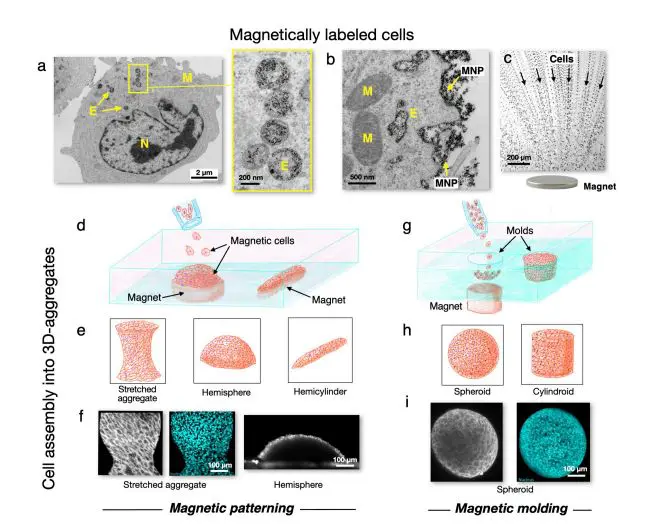
The study leverages these Massart MNPs in two complementary approaches to investigate cellular and tissue mechanics. First, researchers exploit the spontaneous assembly of MNPs within cells, specifically within endosomes, to apply controlled magnetic forces, enabling precise measurements of reconstructed tissues and organoids’ viscoelastic response to external stimuli. By manipulating these intracellular assemblies, scientists can study tissue formation and mechanical properties at a microscopic level. Second, the team fabricated micrometric magnetic wires from the MNPs, employing them in active microrheology to probe the cytoplasm of living cells across a wide frequency range.
This innovative technique allows for detailed mapping of cytoplasmic viscosity and mechanical properties, providing insights into cellular behavior and responses to external forces. The combination of these approaches provides a powerful toolkit for quantifying cellular and tissue mechanics, opening new avenues for mechanobiological studies and the development of novel diagnostic readouts based on cellular mechanical properties. The robustness and scalability of the Massart synthesis ensures a consistent supply of biocompatible nanomaterials, essential for comprehensive biological investigations.
Magnetic Nanoparticles Measure Forces Within Living Systems
Massart coprecipitation consistently produces magnetic nanoparticles with precisely controlled properties, enabling groundbreaking advances at the intersection of materials science and biology. Researchers have demonstrated the ability to generate, transmit, and measure forces within living systems, opening new avenues for mechanobiological studies. Detailed analysis reveals that a single 10 nanometer nanoparticle experiences a force of approximately 10−18 Newtons when placed in a magnetic field of 2×10⁵ Amperes per meter with a gradient of 2×10⁷ Amperes per meter squared. While individually small, these forces accumulate, driving concentration gradients in dispersions, though equilibrium can take several days due to thermal effects at this scale.
To overcome these limitations and achieve faster manipulation, scientists assemble individual nanoparticles into micron-sized aggregates through electrostatic complexation with cationic polymers, dramatically enhancing magnetic responsiveness. Cryo-TEM imaging confirms that nanoparticles also spontaneously assemble into chains hundreds of nanometers long, driven by magnetic dipolar interactions, particularly for particles exceeding 20 nanometers in size. Investigations into cellular interactions demonstrate that Massart nanoparticles are internalized via endocytosis, a natural process where cells engulf extracellular material. This compartmentalization confines the nanoparticles within stable endosomal vesicles, preventing direct contact with the cell’s internal machinery and ensuring biocompatibility.
Researchers have successfully tracked and manipulated magnetically labeled cells for several days, utilizing these stable endosomes. Experiments across a diverse range of cell types, including immune cells, endothelial cells, epithelial cells, connective tissue cells, muscle cells, stem cells, and cancer cells, demonstrate the broad applicability of these nanoparticles for studying cellular and tissue mechanics. These advancements provide new opportunities to quantify cellular and tissue mechanics, with potential diagnostic applications and the development of novel readouts of cellular behavior.
Nanoparticle Mechanics Reveal Cellular Viscoelasticity
This research demonstrates the successful application of magnetic nanoparticles, originally developed through the Massart coprecipitation method, to the emerging field of mechanobiology. Scientists have established that these nanoparticles effectively generate, transmit, and measure forces within living systems, opening new avenues for understanding how mechanical properties govern cellular and tissue behaviour. Crucially, the team highlights the importance of precise interfacial control, achieved through advanced surface chemistry, to ensure both colloidal stability and biocompatibility of the nanoparticles. The work details two complementary approaches.
First, researchers utilized spontaneously forming nanoparticle assemblies within cells to investigate tissue deformation and viscoelastic responses, successfully performing creep experiments on cellular aggregates. Second, they fabricated superparamagnetic wires from the nanoparticles, employing them as probes in active microrheology to quantitatively measure cytoplasmic viscosity across multiple cell lines. These measurements reveal that the intracellular medium behaves as a viscoelastic liquid, with viscosity values typically ranging from 10 to 100 Pascal-seconds. While the Massart coprecipitation method provides a scalable and reproducible means of nanoparticle production, ongoing work focuses on refining surface coatings and optimizing nanoparticle assemblies for specific biological applications. This research provides a foundation for future studies aimed at diagnosing disease states through mechanical biomarkers and developing novel therapies based on manipulating cellular mechanics.
🗞 Massart iron oxide nanoparticles in mechanobiology
🧠 ArXiv: https://arxiv.org/abs/2512.01524