Understanding the atomic structure of disordered materials remains a formidable challenge, yet accurate models are crucial for predicting their behaviour. Tigany Zarrouk and Miguel A. Caro, from Aalto University, now present a significant advance in molecular augmented dynamics, a computational technique that directly incorporates experimental data into simulations. Their work establishes a method for calculating key experimental observables, such as X-ray diffraction patterns and core-electron binding energies, with a computational cost that scales linearly with system size. This breakthrough enables the efficient exploration of vast structural possibilities, allowing researchers to identify stable structures that align with experimental findings and even surpass the accuracy of conventional simulation methods, opening new avenues for materials design and characterisation.
Amorphous Carbon Structure and Machine Learning Potentials
A comprehensive review reveals a vibrant and rapidly evolving field focused on amorphous carbon and related materials, increasingly leveraging the power of machine learning. Investigations into the structure of amorphous carbon, utilizing techniques like neutron scattering and X-ray diffraction, aim to understand the relationship between atomic arrangement and material properties. Research extends to hydrogenated amorphous carbon, nanoporous carbon, graphene oxide, and diamond-like carbon, each offering unique characteristics and applications. A major trend is the growing use of machine learning to accelerate materials discovery and understanding.
Scientists are developing machine learning interatomic potentials, which provide accurate and efficient simulations, overcoming limitations of traditional methods. These potentials employ diverse approaches, including local parametrization of dispersion interactions, graph neural networks to represent atomic environments, and the creation of universal potentials applicable to a wide range of materials and conditions. This work is paving the way for foundation models for materials, analogous to large language models, trained on vast datasets to predict properties and design new materials. Molecular dynamics simulations are extensively used to study material structure and dynamics.
Combining these computational methods with advanced experimental techniques allows for a synergistic approach to materials science. The field is moving towards a data-driven paradigm, focusing on amorphous and disordered materials, and prioritizing the development of accurate and efficient machine learning potentials. This convergence of experiment, theory, and machine learning promises to accelerate materials discovery and innovation.
Molecular Dynamics Aligned with Experimental Data
Scientists have developed molecular augmented dynamics, a refined molecular dynamics method, to generate accurate, low-energy structural models that align with experimental data for disordered systems. Recognizing the limitations of traditional sampling approaches, the team engineered a technique that simultaneously optimizes both the interatomic potential energy and a defined experimental potential. This innovative approach overcomes limitations of standard methods by directly searching for structures compatible with experimental observations. The method involves formulating equations for MAD with linear-scaling calculations for matching X-ray or neutron diffraction patterns and local observables.
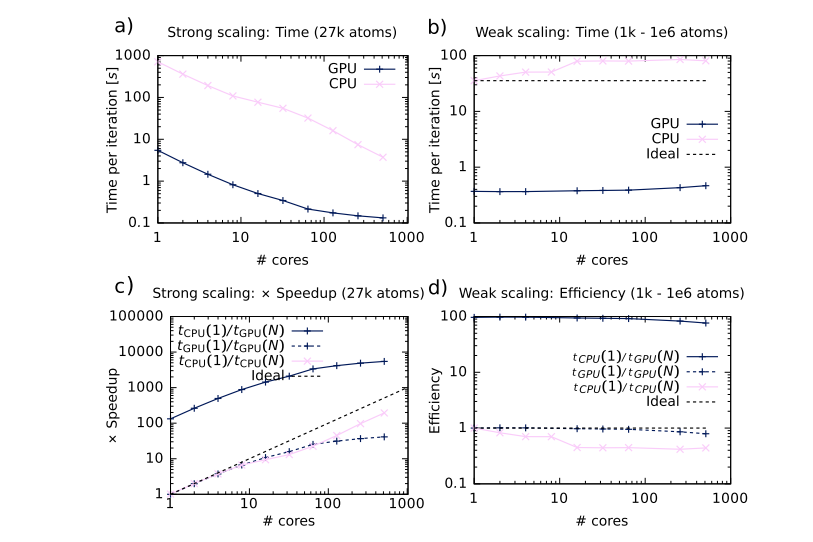
MAD simulations effectively identify both metastable structures consistent with non-equilibrium experimental synthesis conditions and lower-energy structures than those found using alternative computational protocols. Generalizing the virial tensor by incorporating experimental forces allows for precise control of density, enabling the discovery of structures with densities matching experimental observables. The team implemented linear-scaling formulations within the TurboGAP code for both CPU and GPU implementations, achieving a substantial 100-fold speedup on GPU, enabling simulations of larger systems and accelerating structural optimization.
Accurate Disordered Material Structures via Molecular Augmented Dynamics
Researchers have achieved a breakthrough in modeling disordered materials by developing a molecular augmented dynamics method capable of generating accurate, low-energy structures that align with experimental data. This work addresses a significant challenge in simulating amorphous solids, where traditional methods struggle to reproduce realistic structures. The MAD method combines molecular dynamics simulations with a multi-objective optimization that simultaneously minimizes both the interatomic potential energy and the difference between simulated and experimental data. The team successfully implemented linear-scaling formulations for calculating and matching experimental data, including X-ray and neutron diffraction, as well as core-electron binding energies.
Simulations demonstrate that MAD can identify both metastable structures consistent with non-equilibrium experimental synthesis and lower-energy structures than those obtained through conventional melt-quench approaches. Furthermore, generalizing the virial tensor with experimental forces allows for precise control of density, enabling the creation of structures that match experimental densities. Applying this methodology to amorphous carbon, the researchers generated structures for glassy carbon, tetrahedral amorphous carbon, deuterium-rich amorphous carbon, and oxygen-rich amorphous carbon. These simulations utilized experimental data including X-ray diffraction, neutron diffraction, and X-ray photoelectron spectroscopy. The simulations accurately reproduced experimental densities, demonstrating the power of MAD to create realistic models of amorphous materials, opening new avenues for materials design and discovery.
Molecular Structures from Dynamics and Experiment
This work presents a new computational method, molecular augmented dynamics, which efficiently searches for atomistic structures that align with experimental data. The team successfully combined molecular dynamics simulations with an experimental potential, enabling the generation of accurate, low-energy structures for disordered systems. This approach overcomes limitations of traditional methods, such as reverse Monte Carlo, and represents a significant advance in materials modeling. The researchers demonstrate that their method not only finds structures compatible with experimental observations but also identifies lower-energy configurations than those obtained through alternative techniques. While acknowledging that perfect agreement with experimental data is not guaranteed, the team highlights the potential of this approach to bridge the gap between computational and experimental materials science, paving the way for future work focused on applying this method to a wider range of disordered materials.
🗞 Linear-scaling calculation of experimental observables for molecular augmented dynamics simulations
🧠 ArXiv: https://arxiv.org/abs/2509.22388