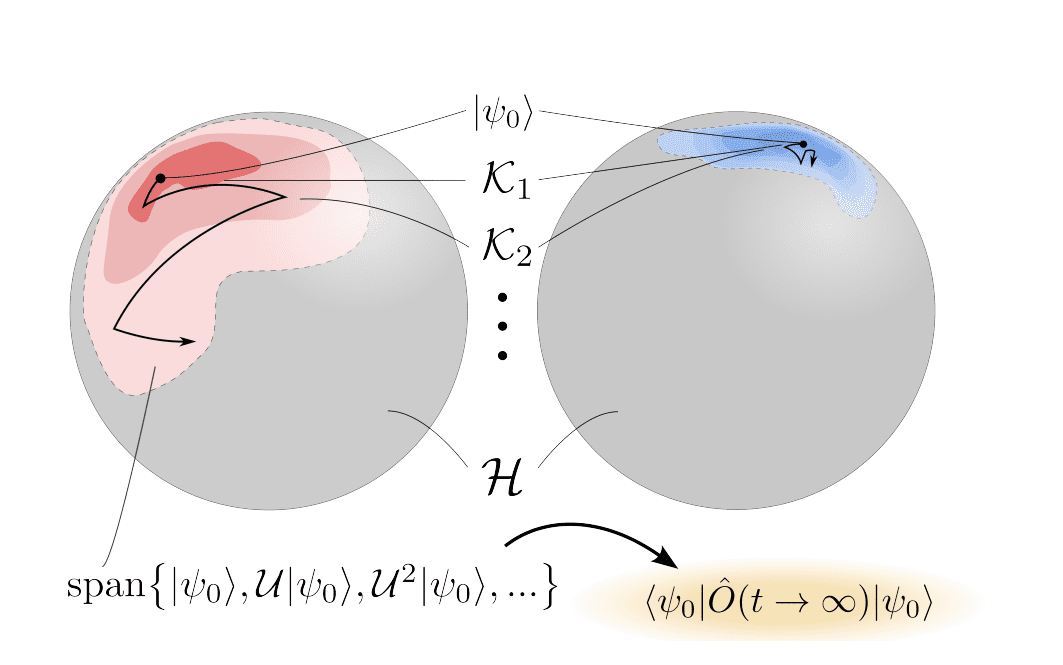
Understanding how systems evolve over time when repeatedly disturbed is a fundamental problem in physics, with implications for diverse areas from quantum computing to materials science. Luke Staszewski, Asmi Haldar, Pieter W. Claeys, and Alexander Wietek from the Max Planck Institute for the Physics of Complex Systems and Laboratoire de Physique Théorique now present a new approach to investigate this behaviour in periodically driven systems. Their work introduces a method based on analysing the dynamics within a ‘Krylov space’, which offers both a way to calculate long-term averages and a means to determine how quickly a system settles into a stable state. By applying this technique to a model magnetic system, the researchers successfully map the transition between chaotic, energy-spreading behaviour and a frozen state where the system remains largely unchanged, revealing crucial insights into the underlying properties of these complex systems and providing a powerful tool for future investigations.
Diagonal Ensemble Average for Disordered Systems
Scientists have developed a powerful numerical method for calculating the Diagonal Ensemble Average (DEA) in complex quantum systems, particularly those exhibiting dynamical freezing and many-body localization. This technique simplifies the calculation of observable properties in systems where interactions and disorder are significant, offering new insights into these phenomena and a way to study their behavior in detail. The core of this achievement lies in the Krylov subspace method, an efficient technique for approximating the time evolution of a quantum state by focusing on a lower-dimensional space. This significantly reduces computational demands, allowing scientists to study larger and more complex systems, and is enhanced by improvements like the isometric Arnoldi iteration.
Careful consideration of eigenvector acquisition and normalization is crucial for reliable results, especially in systems exhibiting dynamical freezing. This algorithm has been successfully applied to systems exhibiting both dynamical freezing and many-body localization, confirming its versatility and effectiveness. The research has implications for a wide range of fields, including condensed matter physics, quantum information, and the study of disordered materials, providing a powerful tool for understanding complex quantum systems and exploring new quantum phenomena.
Krylov Approximation Reveals Floquet Dynamics
Scientists have pioneered a new Krylov space approximation to investigate the long-term dynamics of periodically driven quantum systems, addressing whether these systems reach thermal equilibrium or become trapped in a frozen state. The research introduces an efficient numerical algorithm for calculating infinite-time averages of observable properties using the diagonal ensemble, enabling the analysis of systems with up to 30 spins. The team constructed the Krylov subspace, a lower-dimensional space created by repeatedly applying the Floquet operator to the initial state, effectively capturing the system’s evolution over multiple time steps. By projecting the Floquet operator onto this subspace, scientists created a reduced operator that governs the dynamics within the approximated space, significantly reducing the computational burden while preserving essential features of the long-time behavior.
To evaluate the infinite-time average, the team employed an Arnoldi-based algorithm, constructing an orthonormal basis for the Krylov subspace and efficiently representing the projected Floquet operator. This allows for accurate calculation of the diagonal ensemble average, revealing whether the system converges to a thermal state or remains frozen due to emergent conservation laws. The method was successfully demonstrated using the driven transverse field Ising model, and scientists demonstrated that the localization properties of vectors within the Krylov space, termed Ritz vectors, serve as a reliable diagnostic of ergodicity.
Krylov Space Reveals Long-Time Quantum Dynamics
Scientists have achieved a breakthrough in understanding the complex behavior of periodically driven quantum systems, developing a novel algorithm to calculate long-term averages of observable properties with unprecedented accuracy. This work successfully addresses the challenge of determining how these systems evolve towards steady states, offering a powerful new tool for investigating phenomena like thermalization and dynamical freezing. The team demonstrated the effectiveness of their method by applying it to the mixed-field Ising model, reaching system sizes previously inaccessible with traditional techniques, and accurately capturing both ergodic relaxation and dynamical freezing. The core of this achievement lies in a Krylov space approach, which efficiently approximates the infinite-time dynamics of the system.
Results demonstrate that the algorithm accurately captures both ergodic relaxation, where the system explores all possible states, and dynamical freezing, where it becomes trapped in a limited region of its state space. For a 30-site chain, the algorithm converged to solutions with high precision, confirming its reliability and stability. Detailed analysis of the algorithm’s error revealed distinct behaviors depending on the system’s state; in the frozen regime, the error rapidly decreased, while in the ergodic phase, it followed a predictable scaling. Further investigation revealed a remarkable connection between vectors within the Krylov space, termed Ritz vectors, and the expected fluctuations of the Floquet eigenstates. Scientists found that the Ritz vectors accurately reproduce these fluctuations, indicating that the algorithm effectively captures the essential dynamics of the system. Measurements of the inverse participation ratio provided further insight, demonstrating how the initial state is delocalized over the Ritz vectors, establishing that these vectors not only describe the short-time dynamics but also accurately capture the long-term behavior of the system.
Krylov Space Reveals Ergodic Transitions
This research presents a new approach to understanding thermalization in periodically driven quantum systems, employing a Krylov subspace method to efficiently calculate long-term averages of observable properties. The team successfully applied this method to the driven mixed-field Ising model, reaching system sizes previously inaccessible with traditional techniques, and accurately identified the transition between ergodic and dynamically frozen phases. Importantly, the analysis reveals that the localization properties of vectors within the Krylov space, termed Ritz vectors, serve as a reliable indicator of ergodicity, effectively diagnosing transitions between different dynamical behaviours. The findings demonstrate that this Krylov-based approach offers a powerful diagnostic tool for characterizing ergodicity-breaking transitions and provides a reduced Hilbert space for accurately describing system dynamics across various timescales. The method’s efficiency stems from the physics of each regime; it performs well in dynamically frozen phases because the system remains close to its initial state, and it benefits from ergodicity in ergodic regimes where the initial state explores a large portion of the Krylov subspace. This work opens avenues for exploring quantum chaos through studies of entanglement and fidelity susceptibility, and for investigating the effects of conservation laws and kinetic constraints, potentially offering a complementary approach to methods based on matrix product states.
👉 More information
🗞 Krylov space dynamics of ergodic and dynamically frozen Floquet systems
🧠 ArXiv: https://arxiv.org/abs/2510.19824