

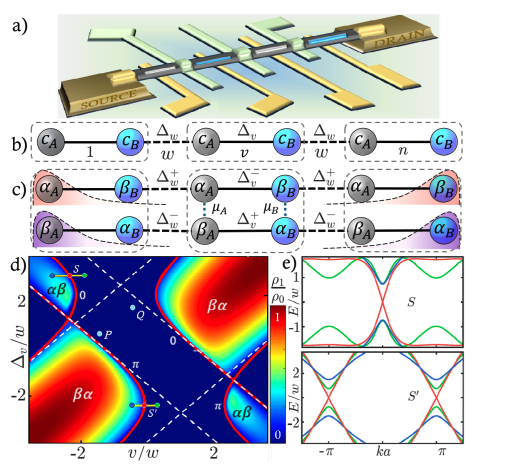
The pursuit of topological superconductivity, materials hosting exotic states of matter with potential applications in quantum computing, receives a significant boost from new research into engineered quantum systems. Rafael Pineda Medina, Pablo Burset, and William J. Herrera, from universities in Colombia and Spain, investigate artificial Kitaev chains, structures designed to mimic the behaviour of theoretical models predicting these unusual superconducting properties. Their work demonstrates that interference between edge states within these chains produces measurable signals in electrical transport, offering a novel way to detect and study the elusive Majorana bound states that underpin topological superconductivity. This discovery provides experimentally accessible methods for probing the behaviour of these states in nanoscale superconducting devices, paving the way for more robust and controllable quantum technologies.
Artificial Kitaev chains, engineered from semiconducting quantum dots coupled by superconducting segments, offer a promising route to realize and control Majorana bound states for topological quantum computation. This research investigates dimerized Kitaev chains, equivalent to superconducting Su-Schrieffer-Heeger models, and analyses the behaviour of the resulting coupled chains. The team demonstrates that interference between Majorana edge modes from each chain gives rise to observable signatures in nonlocal conductance. Furthermore, the scientists identify a parity effect in the system length that governs the coupling of edge states, supported by detailed analytical modelling. The results provide experimental insight into the behaviour of these complex quantum systems and advance the field of topological quantum computation.
Dimerized Kitaev Chain Calculations and Methods
This research focuses on determining the charge parity of finite chains, crucial for understanding the topological properties of the system. This involves transforming the system into a Majorana basis and calculating determinants to establish the parity. The team also calculated the differential conductance, representing the current through the chain when connected to electrodes, using Keldysh formalism and analysing transmission probabilities for various processes. These calculations ensure the validity and reproducibility of the results. Key concepts underpinning this work include the Kitaev chain, a model system exhibiting topological superconductivity, and dimerization, the introduction of variations in hopping amplitude. Topological superconductivity itself is a state of matter exhibiting robust edge states, and Majorana fermions are particles that are their own antiparticles, predicted to exist as these edge states. The research utilizes Green’s functions to describe electron propagation and Keldysh formalism to model non-equilibrium systems.
Dimerized Kitaev Chains Reveal Tunable Majorana Coupling
This work presents a theoretical investigation of dimerized Kitaev chains, engineered as a tunable platform to explore coupled Majorana physics and their potential for topological quantum computation. Researchers demonstrate that these chains, equivalent to superconducting Su-Schrieffer-Heeger models, exhibit unique properties arising from the interference of Majorana bound states between coupled chains. The team decomposed the dimerized chain into two independent Majorana chains, revealing that the coupling between them is governed by local onsite energies. Experiments show that the system’s topological behaviour is highly sensitive to chain parity and inter-chain coupling.
Specifically, the chains exhibit a topologically nontrivial phase when certain conditions relating to hopping amplitudes are met. Analysis of the system’s Z2 invariant confirms this behaviour and provides a quantitative measure of the system’s topological properties. Crucially, the team discovered that nonlocal conductance measurements provide experimentally accessible probes of Majorana hybridization. For chains with a length of eight units, the zero-bias nonlocal conductance displays characteristic features indicative of topological phase transitions. Further investigation with nine-unit chains revealed voltage-dependent Majorana nonlocal correlators, providing detailed information about the coupling between Majorana modes. These measurements demonstrate the potential to identify and characterize Majorana states through transport measurements, paving the way for their utilization in quantum computing architectures.
Majorana Hybridization Probed by Conductance Signatures
Researchers have demonstrated that interference between Majorana modes within dimerized Kitaev chains produces measurable signatures in nonlocal conductance, offering new avenues for exploring topological superconductivity. By studying these engineered chains, constructed from semiconducting dots and superconducting segments, the team revealed that the coupling between effective chains is controlled by onsite energy, and can be fully decoupled under specific conditions. Finite length chains exhibit hybridization of edge states, resulting in interference effects that depend on the chain’s length and fermion parity, manifesting as multiple conductance peaks. This work provides experimentally accessible probes for characterizing Majorana hybridization in mesoscopic topological superconductors. The researchers also observed that Majorana modes can exhibit slow decay and spatial oscillations along the chain under certain conditions, adding to the understanding of their behaviour within these systems. The findings represent a significant step towards harnessing Majorana modes for potential applications in quantum computation and metrology.
🗞 Topological superconductivity in a dimerized Kitaev chain revealed by nonlocal transport
🧠 ArXiv: https://arxiv.org/abs/2509.10412


