Controlling unwanted noise represents a significant challenge in advanced optical technologies, particularly as systems increasingly utilise multiple modes of light to enhance performance. Jamison Sloan, Michael Horodynski, and Shiekh Zia Uddin, alongside colleagues at their respective institutions, now demonstrate a method for actively suppressing this noise in complex optical systems. The team achieves this by precisely shaping the input wavefront of light, effectively focusing intensity while simultaneously minimising noise at the output. This programmable control reduces noise by a substantial 12 dB, pushing performance closer to the fundamental limits imposed by quantum mechanics, and opens new possibilities for developing robust and efficient nonlinear multimode technologies.
Optoelectronic systems based on multiple modes of light can often exceed the performance of their single-mode counterparts. However, multimode nonlinear interactions often introduce considerable noise, limiting the ultimate performance of these systems. It is therefore crucial to develop ways to simultaneously control complex nonlinear interactions while also gaining control over their noise.
Controlling Nonlinearity in Multimode Optical Fibers
This research investigates the challenges and opportunities presented by using multimode fibers for nonlinear optical applications. Multimode fibers, unlike single-mode fibers, allow many light modes to propagate simultaneously. While this can increase the efficiency of nonlinear processes, it also introduces complexities like modal dispersion and interference between modes. The central problem addressed is how to control these nonlinear effects to achieve desired outcomes, such as generating squeezed light or shaping pulses, and to mitigate unwanted effects like instability. Traditional methods for controlling nonlinearity in single-mode fibers do not directly translate to multimode fibers.
The researchers demonstrate techniques to manipulate the spatial distribution of light across the modes of the multimode fiber through careful input coupling and potentially through elements placed within the fiber. By controlling which modes are excited and how they interact, they can enhance desired nonlinear effects and suppress unwanted ones. They also address the problem of nonlinear instabilities, proposing and demonstrating methods to suppress these instabilities through modal control and optimization of input parameters. A key achievement is the ability to achieve broadband squeezed light generation in multimode fibers, crucial for many practical applications as it allows for wider bandwidths and more versatile operation.
The research combines rigorous theoretical modeling with extensive experimental validation, ensuring that the proposed techniques are not only theoretically sound but also practically feasible. The team optimizes input coupling to excite specific modal combinations that enhance the desired nonlinear process, and explores techniques to selectively filter or suppress certain modes to improve stability and performance. They highlight the importance of phase matching between different modes, and discuss methods to achieve it, while also demonstrating effective strategies to suppress stimulated Brillouin scattering, a major limitation in high-power fiber optics. This research represents a significant step forward in quantum optics, particularly in the area of squeezed light generation, and opens up new possibilities for using multimode fibers in a wide range of applications, including quantum communication, precision sensing, and optical signal processing.
Multimode fibers offer the potential to create more compact and efficient quantum devices compared to traditional bulk optics setups, and can be more easily integrated into complex systems, paving the way for scalable quantum technologies. The demonstrated techniques could lead to the development of practical quantum devices for various applications, including gravitational wave detection, medical imaging, and secure communication. The research confirms that multimode fibers are a viable platform for advanced nonlinear optics and quantum technologies, and that the challenges associated with modal dispersion and intermodal interference can be overcome through careful design and control. Further research is needed to explore the full potential of multimode fibers, including developing more sophisticated modal control techniques, investigating new nonlinear processes, integrating devices into complex systems, and exploring other quantum applications.
Wavefront Control Suppresses Multimode Fiber Noise
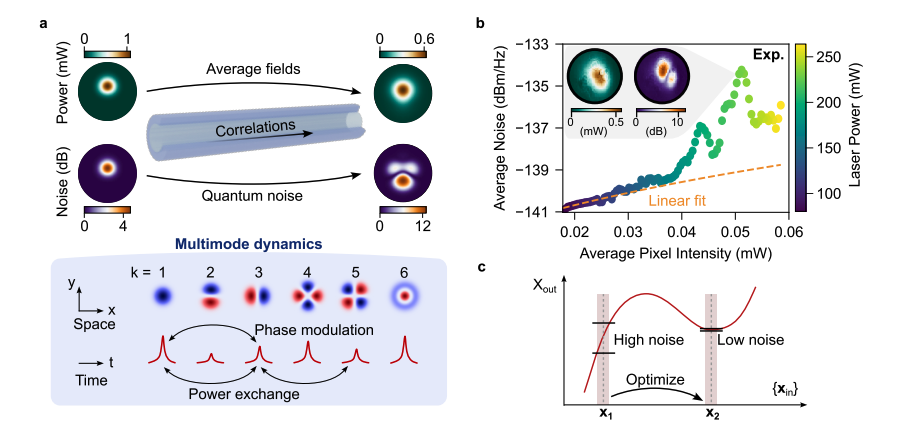
Researchers have demonstrated a groundbreaking method for suppressing noise in multimode optical systems, achieving a significant reduction in fluctuations and bringing performance closer to the fundamental quantum limit. The team discovered that by precisely controlling the input wavefront of light, they could dramatically reduce noise buildup within a multimode fiber, surpassing the performance achievable with simple signal attenuation. Experiments reveal a noise reduction exceeding 12 decibels, a substantial improvement that pushes the system’s performance closer to the shot-noise limit, the minimum level of noise dictated by quantum mechanics. This breakthrough addresses a critical challenge in nonlinear optics, where complex interactions between multiple modes of light often introduce considerable noise, limiting the potential of these systems.
The team’s approach involves actively shaping the wavefront to focus high-intensity, low-noise light at the output, effectively decoupling output fluctuations from input noise. Data confirms that this optimized wavefront shaping steers the system to a state where output noise is minimized, even when starting with highly noisy light sources. Furthermore, the researchers developed a new theoretical and simulation framework to understand the complex spatiotemporal quantum noise dynamics within these highly multimode systems. This framework revealed that cross-phase modulation generally drives noise buildup, but that careful wavefront shaping can counteract this effect. The results demonstrate that, through precise control, the system can be steered to produce low-noise light with fluctuations approaching the shot-noise level, opening new possibilities for applications requiring high precision and sensitivity. This advancement promises to unlock the full potential of multimode nonlinear technologies, enabling them to overcome noise limitations and operate at the quantum-noise limit.
Wavefront Shaping Suppresses Optical System Noise
Researchers have demonstrated a method for significantly reducing noise in multimode nonlinear optical systems by carefully controlling the input wavefront of light. They successfully suppressed noise buildup in a multimode fiber using an active wavefront-shaping protocol, achieving a 12 dB reduction in noise beyond what simple signal attenuation could accomplish. This level of noise reduction brings performance close to the fundamental shot-noise limit, a key benchmark in optics. This improvement stems from the ability to decouple fluctuations in the output intensity from those present in the input laser, effectively minimizing the impact of initial noise.
The team developed a theoretical framework to explain these findings, deriving an equation that shows how optimized input conditions suppress excess noise contribution to the overall output noise. Furthermore, by combining input wavefront shaping with spatial filtering of the output beam, they identified subsets of the beam exhibiting both high power and low noise, exceeding the performance of individual focused points. Future work could explore the impact of random mode coupling and extend the method to more complex pulsed wave scenarios, potentially unlocking even greater control over noise in multimode optical systems and paving the way for high-performance nonlinear technologies.
🗞 Programmable control of the spatiotemporal quantum noise of light
🧠 ArXiv: https://arxiv.org/abs/2509.03482