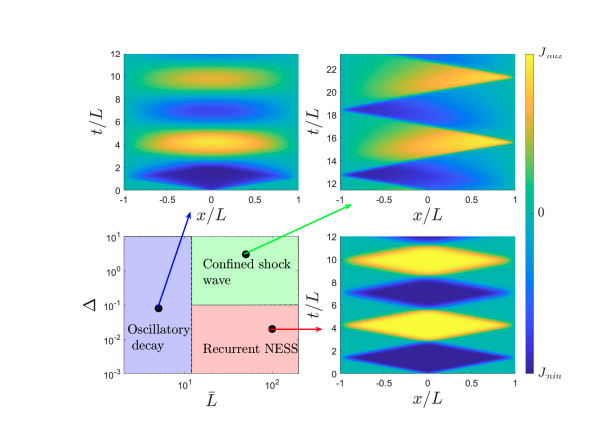
The behaviour of systems undergoing rapid change, known as thermalization, presents a fundamental challenge in physics, and understanding this process is crucial for fields ranging from condensed matter physics to cosmology. Li Li, Yan Liu from Beihang University, and Hao-Tian Sun, along with their colleagues, investigate thermalization in small, critical systems, those poised at the brink of a phase transition, using a sophisticated approach that connects gravity and quantum mechanics. Their work reveals that the way these systems exchange energy depends dramatically on both the temperature difference between them and their overall size, leading to three distinct patterns of behaviour. This research demonstrates that energy transfer in these systems isn’t simply a process of diffusion, but involves waves propagating energy and reflecting off boundaries, enabling nearly complete energy swapping and offering new insights into how complex systems reach equilibrium.
Finite Size Impacts Quantum Thermalization Dynamics
Thermalization dynamics in finite-size quantum critical systems represent a fundamental problem in condensed matter physics, with implications extending to areas such as quantum information and many-body physics. Understanding how isolated quantum systems evolve from initial states to thermal equilibrium remains a central challenge, particularly when considering systems exhibiting quantum criticality. These systems, characterised by long-range entanglement and diverging correlation lengths, display unique behaviour during thermalization, differing significantly from those governed by conventional ergodic theory. The dynamics are further complicated by the finite size of realistic experimental systems, introducing both quantitative and qualitative deviations from the infinite-size limit.
Current theoretical frameworks often struggle to accurately describe the interplay between quantum criticality, finite size effects, and thermalization dynamics, often relying on approximations valid only in specific regimes. Consequently, a comprehensive understanding of thermalization in these systems remains elusive. This work focuses on elucidating the thermalization dynamics of finite-size quantum critical systems, specifically examining the influence of system size and critical exponents on the relaxation process. By employing a combination of analytical techniques and numerical simulations, the study seeks to provide insights into the behaviour of these complex systems and establish a quantitative understanding of the interplay between quantum criticality, finite size effects, and thermalization dynamics.
The research investigates the thermalisation process when two finite-size quantum critical systems are brought into thermal contact along a perfectly transmitting interface, utilising holographic duality. This method involves simulating gravitational dynamics to model the interaction and subsequent equilibration of the quantum systems. These simulations allow observation of how energy distributes and entropy increases as the systems reach thermal equilibrium, providing insights into the fundamental principles governing thermalisation in strongly interacting systems. The approach effectively translates a complex quantum many-body problem into a classical gravitational problem, simplifying the computational challenges while retaining the essential physics of the quantum system.
Late-time Quasi-normal Mode Perturbation Analysis
This document provides supplemental information for a research paper focusing on holographic thermalization. It details the numerical methods, error analysis, and results presented in the main paper, offering a comprehensive overview of the research process. The document is structured into several sections, each addressing a specific aspect of the simulations and analysis. One section delves into the late-time behaviour of the system, analysing the quasi-normal modes (QNMs) and how they govern the decay of oscillations during thermalization. This connects the numerical results to theoretical expectations about QNMs, validating the simulations and providing insights into the physical processes occurring during thermalization.
A substantial section focuses on numerical accuracy, presenting two distinct error metrics to ensure the reliability of the simulations. The document also details the initial and boundary conditions used for the simulations, as well as the specific numerical techniques employed to solve the equations of motion. The research demonstrates a strong commitment to numerical accuracy and provides detailed explanations of the methods used, connecting the results to theoretical expectations.
Quantum Energy Transfer via Wave Propagation
This research investigates how energy distributes itself when two interacting quantum systems reach thermal equilibrium, using holographic duality and numerical simulations. The study reveals that the size of the systems and the initial temperature difference between them dramatically influence the thermalization process, leading to three distinct patterns: oscillating energy exchange, prolonged shock waves, and rapid dissipation. Importantly, the findings demonstrate that energy transfer in these quantum systems occurs primarily through wave propagation and boundary reflections, enabling nearly complete energy swapping between the subsystems, a behaviour notably different from traditional diffusive systems. The research highlights a striking connection between system size and dynamics; larger systems exhibit reflected energy currents, while smaller systems are dominated by internal dissipation. The team observed that, under certain conditions, the systems can even undergo a near “temperature swap” after contact, redistributing energy in a way that does not violate thermodynamic principles. While the simulations focused on two spatial dimensions, the authors suggest the approach can be extended to other dimensions and adapted to study more complex systems.
🗞 Thermalization dynamics of finite-size quantum critical systems
🧠 ArXiv: https://arxiv.org/abs/2509.06523