

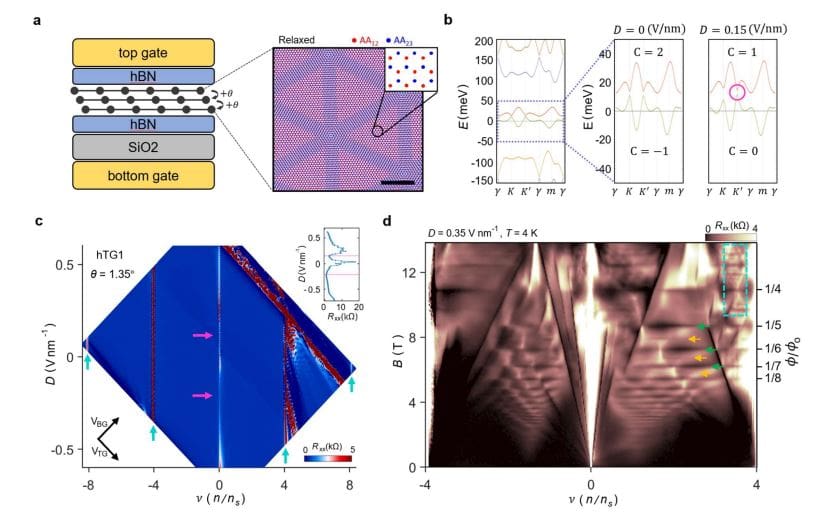
The behaviour of electrons within crystalline structures fundamentally determines the properties of materials, and understanding how these electrons respond to imperfections is a central challenge in condensed matter physics. Hangyeol Park, Junhyeok Oh, Rasoul Ghadimi, and colleagues now present compelling evidence for electron localisation within a uniquely structured material, helical trilayer graphene. Their work demonstrates how the interplay of two moiré patterns creates a ‘moiré-of-moiré’ superlattice, a complex landscape of periodic and aperiodic potentials that significantly alters electron behaviour. By observing distinct electronic signatures, including double moiré-induced bands and high-order Brown-Zak oscillations alongside an anomalous hysteretic signal, the team reveals that electrons become partially trapped, or localised, due to the loss of a perfectly repeating lattice structure. This achievement offers new insight into controlling electron behaviour in low-dimensional materials and opens promising avenues for designing advanced solid-state devices.
Twisted Graphene, Moiré Patterns, and Correlated Phenomena
This extensive research details a rapidly evolving field focused on twisted two-dimensional materials, particularly graphene and related structures, and the remarkable properties that emerge from their unique arrangement. Investigations reveal how precise control over stacking and twisting unlocks a wealth of novel electronic phenomena and potential device applications. The interplay between theoretical modelling and experimental characterization is essential for advancing our understanding and harnessing the full potential of these materials, with the emergence of ferroelectricity and memory-like behaviour adding exciting new dimensions to the field. Scientists are discovering that twisting graphene layers creates “magic angles” where the material’s electronic band structure flattens, leading to correlated electron phenomena like superconductivity and insulating states.
In trilayer graphene, complex patterns emerge due to the interaction of multiple moiré patterns, significantly impacting the material’s electronic properties. Precise control over twist angle and stacking order is achievable through advanced fabrication techniques, allowing researchers to tailor the material’s properties. These twisted structures exhibit unconventional superconductivity and correlated insulating states, often coexisting within the same material. Interfacial and intrinsic ferroelectricity, the ability to possess a spontaneous electric polarization, are emerging as important phenomena, potentially enabling novel devices.
Some systems demonstrate “sliding ferroelectricity,” where the polarization can be switched by applying an in-plane force. Hysteresis in electronic transport and memory-like behaviour suggest potential for non-volatile memory applications, while the possibility of an electronic “ratchet effect,” creating directional current flow, is also being explored. These materials hold promise for neuromorphic computing, brain-inspired computing, and the development of non-volatile memory devices. The ability to control electronic properties through twist angle and stacking opens possibilities for novel transistors and logic devices, and charge trapping dynamics can be harnessed to emulate synaptic behaviour. The ferroelectric properties could be used for sensors and other applications.
Twist Angle Controls Moiré Relaxation in Graphene
Scientists engineered van der Waals heterostructures using helical trilayer graphene to investigate how electrons behave in twisted materials. By fabricating devices with dual gates, allowing precise control over both electronic density and displacement field, and varying the twist angle between graphene layers, they observed a fascinating interplay between moiré patterns. Simulations and measurements revealed that moderate twist angles induce lattice relaxation, forming triangular domains with periodic arrangements of moiré sites separated by aperiodic boundaries. Characterizing the electronic structure, scientists computed the band structure, revealing energy gaps and accommodating four electrons per moiré unit cell.
Calculations demonstrated that as the displacement field increased, the energy gap closed and reopened, corresponding to topological band inversions. Transport measurements corroborated these theoretical predictions, showing high-resistance lines corresponding to specific moiré fillings. Detailed examination of the resistance at the charge neutrality point revealed two local minima, consistent with the presence of two band inversion points. Magnetotransport measurements further validated the high quality of the devices, exhibiting well-developed features and oscillations persisting up to the fifth order.
The team reproducibly observed high-resistance states and oscillations across multiple devices, confirming the intrinsic nature of the observed phenomena. Furthermore, scientists observed a peculiar hysteretic behaviour in the resistance, where measured values changed depending on the sweep direction of the gate voltages, indicating a significant influence of the aperiodic regions on electron transport. This was demonstrated by comparing resistance maps obtained with opposing sweep directions, revealing striking contrasts in the resistance values of insulating states.
Moiré Superlattices Localise Electrons in Graphene
Scientists have discovered strong evidence of electron localisation within helical trilayer graphene, a material formed by stacking layers of graphene with a specific rotational alignment. This work demonstrates how the interplay of two moiré patterns creates a “moiré-of-moiré” superlattice, influencing electron behaviour. Experiments reveal the presence of distinct regions within this superlattice exhibiting both periodic and aperiodic potentials, fundamentally altering how electrons move through the material. Measurements of the electronic band structure show that energy gaps separate energy bands near the charge neutrality point, accommodating four electrons per moiré unit cell.
As an applied displacement field is varied, these energy gaps close and reopen, indicating topological band inversions. Transport measurements corroborate these theoretical predictions, with high-resistance features observed at specific moiré fillings, aligning with the calculated band structure. Detailed analysis of resistance maps reveals two local minima at the charge neutrality point, consistent with the presence of two band inversion points. Further magnetotransport measurements exhibit well-developed features and oscillations persisting up to the fifth order, confirming the high quality of the graphene device and the underlying moiré periodicity within the periodic domains.
Importantly, these features, high-resistance states and oscillations, were consistently observed across multiple devices, indicating that the phenomena are intrinsic to the material. Remarkably, the team observed a distinct hysteretic behaviour in the resistance, where measured values changed depending on the direction of gate voltage sweeps. Resistance maps reveal striking contrasts in insulating state resistance values depending on the sweep direction, particularly near specific moiré fillings. Analysis of resistance values demonstrates that the material can exhibit both metallic and insulating behaviour depending on the applied displacement field. This behaviour is interpreted through a model involving parallel-connected circuits representing the resistance of the periodic domains and the aperiodic domain boundaries, providing insight into the mechanisms driving the observed hysteresis. Line cuts of resistance values extracted from the maps confirm the influence of the displacement field on the material’s electronic properties, with the envelope of resistance values reflecting the resistance of the domains.
Electron Localisation in Twisted Graphene Layers
This research demonstrates strong evidence for electron localisation within helical trilayer graphene, a phenomenon arising from the interplay of two moiré patterns. The team observed double moiré-induced bands and high-order oscillations, confirming the presence of periodic regions within the material, alongside a distinct hysteretic signal indicative of aperiodic regions. These findings strongly suggest that electrons are partially localised due to the loss of a strictly periodic lattice potential, a result supported by observed gate asymmetry and stable multiple resistance states. The study establishes a clear link between the structural characteristics of the material and the resulting electronic behaviour, offering insight into how spatially inhomogeneous lattice potentials influence low-dimensional electronic states. The researchers acknowledge that the precise location of these localised electrons within the domain boundaries remains an open question, proposing that future studies employing techniques such as scanning capacitance or scanning single-electron transistor microscopy could map their spatial distribution. While the current work cannot definitively distinguish between structural disorder and quasicrystalline order as the origin of localisation, it highlights the potential for engineered aperiodic systems in advanced electronic devices.
👉 More information
🗞 Evidence for electron localisation in a moiré-of-moiré superlattice
🧠 ArXiv: https://arxiv.org/abs/2511.22115

