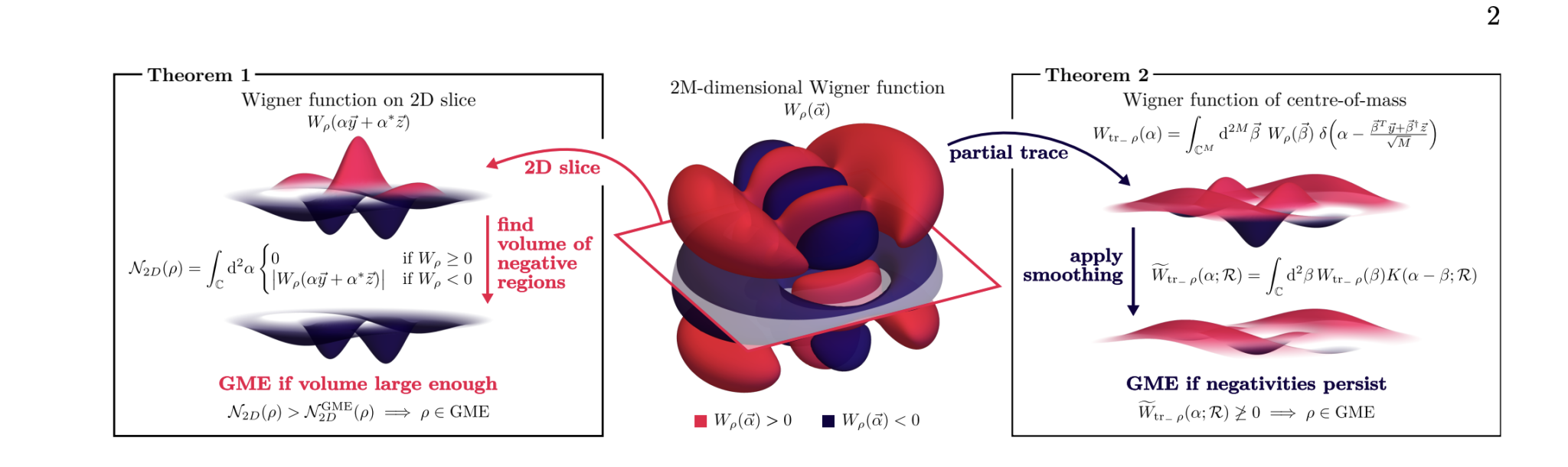
Genuine multipartite entanglement, a powerful form of quantum correlation, underpins many potential advantages in quantum technologies, and researchers continually seek ways to reliably detect and quantify it. Lin Htoo Zaw from the Centre for Quantum Technologies, National University of Singapore, Jiajie Guo from the State Key Laboratory for Mesoscopic Physics, Peking University, and Qiongyi He, alongside Matteo Fadel and Shuheng Liu, now demonstrate a clear link between a measurable quantum property, known as Wigner negativity, and the presence of this complex entanglement. The team proves that a sufficient amount of Wigner negativity, assessed through relatively simple measurements, definitively confirms genuine multipartite entanglement in continuous-variable systems. This achievement is significant because it provides readily implementable criteria for detecting entanglement, using techniques already common in several leading quantum computing platforms, and offers a pathway to certify entanglement without needing to fully characterise a quantum state.
They demonstrate that a sufficient amount of Wigner negativity, a measure of non-classical behaviour in quantum mechanics, guarantees the presence of genuine multipartite entanglement, extending beyond the simpler case of two entangled particles. This research establishes a quantifiable link crucial for advanced quantum technologies like quantum computation and quantum communication, offering a new perspective on the connection between non-classicality and entanglement, potentially simplifying the characterisation and experimental verification of complex quantum states.
Wigner negativity and genuine multipartite entanglement are key resources enabling computational advantages and broader quantum-information tasks. In this work, the researchers prove two theorems for multimode continuous-variable systems connecting these nonclassical resources. Both theorems demonstrate that sufficient Wigner negativity, assessed either through its volume along a two-dimensional slice or through the negativity of the system’s centre-of-mass, confirms the presence of genuine multipartite entanglement. Violations of the latter inequality also provide quantifiable lower bounds on the distance between a detected state and states lacking entanglement.
Wigner Function Proves Gaussian-Mean-Entanglement Criterion
This research presents criteria for determining whether a quantum state exhibits Gaussian-mean entanglement, a specific type of entanglement important in quantum information and quantum optics. The core idea leverages the Wigner function, a quasi-probability distribution representing the quantum state, and its properties. The authors explore ways to detect entanglement, including direct measurement of the Wigner function, analysis of its characteristic function, and integration of the Wigner function over specific regions. The document provides rigorous mathematical proofs for each criterion, building on concepts from quantum mechanics, functional analysis, and matrix theory.
The resulting corollaries offer practical ways to apply these criteria in experimental settings. The Wigner function represents a quantum state in phase space and can be negative, indicating non-classical behaviour. A non-negative Wigner function is a sufficient, though not always necessary, condition for a state to be Gaussian. The characteristic function is the Fourier transform of the Wigner function and encodes information about the state’s probability distribution. One corollary provides a practical criterion based on integrating the Wigner function over a finite region, avoiding the need to measure the entire function. Another offers a sampling-based criterion that uses a finite number of points to estimate the characteristic function, making it suitable for experimental implementations. The strength of this work lies in its mathematical rigor, practicality, and clear explanations.
Wigner Negativity Certifies Genuine Multipartite Entanglement
This work establishes fundamental connections between Wigner negativity and genuine multipartite entanglement in multimode continuous-variable systems. Researchers proved two theorems demonstrating that sufficient Wigner negativity, assessed either through its volume along a specific two-dimensional slice or through the negativity of the system’s centre-of-mass, confirms the presence of genuine multipartite entanglement. Importantly, violations of the latter inequality also provide quantifiable lower bounds on the distance between a detected state and states lacking entanglement. These findings not only link distinct concepts of nonclassicality, quasiprobabilities and correlations, but also provide sufficient conditions for generating genuine multipartite entanglement through interference with the vacuum using multimode interferometers, complementing existing knowledge in the field.
The team developed criteria for detecting genuine multipartite entanglement particularly well-suited for experimental implementation in platforms such as cavity/circuit electrodynamics, circuit acoustodynamics, and trapped ions and atoms. These criteria require measurements of the Wigner function only over a finite region of phase space, or measurements of a limited number of characteristic function points, simplifying experimental procedures. The authors acknowledge that further investigation, detailed in a companion paper, explores the impact of practical effects like losses and extends these criteria using controlled-unitary operations and qubit measurements. These advancements offer readily implementable methods for identifying and generating genuine multipartite entanglement in various quantum systems.
🗞 “Enough” Wigner negativity implies genuine multipartite entanglement
🧠 ArXiv: https://arxiv.org/abs/2510.26761