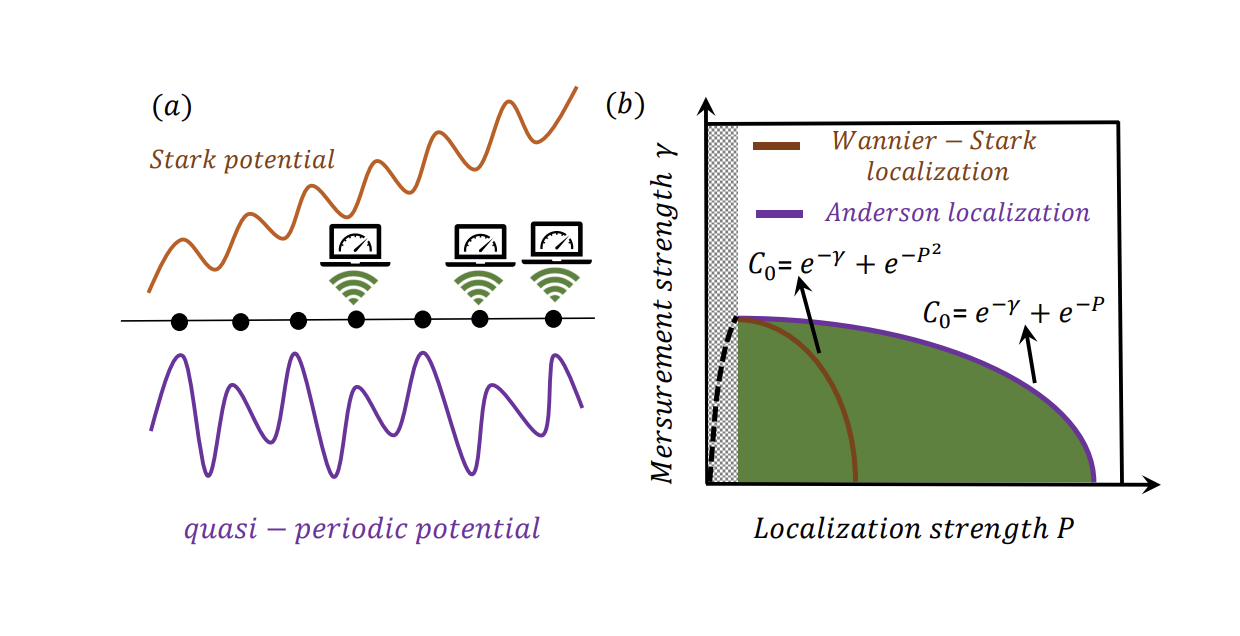
The interplay between quantum entanglement and environmental monitoring represents a frontier in quantum physics, and recent research explores how introducing imperfections into these systems affects their fundamental properties. Yu-Jun Zhao from Xiangtan University and Shanghai University, alongside Xuyang Huang and Yi-Rui Zhang from Shanghai University, and colleagues, investigate this phenomenon by modelling the behaviour of electrons within a monitored system containing localized imperfections. Their work demonstrates that these imperfections do not fundamentally alter the way entanglement behaves under measurement, but instead create a boundary jointly determined by both the monitoring process and the degree of localization. This finding offers a new understanding of entanglement boundaries arising from combined effects, and importantly, provides a pathway to detect these novel states in a range of experimental platforms, including cold atom systems and trapped ions.
Monitoring Drives Novel Entanglement Phases
Recent research reveals that introducing local variations in energy significantly complicates the study of many-body localization, a state where quantum systems resist thermal equilibrium. This investigation explores how continuous monitoring affects entanglement, a key quantum connection, in a free fermion system subject to these local energy fluctuations. The team discovered that monitoring alters the system’s behaviour, leading to distinct entanglement phases and transitions between them. By analysing the entanglement structure under varying monitoring strengths and energy fluctuations, the study reveals a rich landscape of quantum states.
The results demonstrate that continuous monitoring induces a novel entanglement phase characterized by a unique scaling of entanglement, differing from the standard localized phase with limited entanglement. Furthermore, the research identifies a critical monitoring strength beyond which the system undergoes a phase transition from a state with limited entanglement to this new, uniquely entangled phase. This transition coincides with changes in the system’s energy levels, indicating a fundamental shift in its quantum dynamics. The analysis reveals that the monitoring process effectively creates long-range connections, suppressing entanglement growth and leading to the emergence of this unique phase.
This work deepens our understanding of how measurement, disorder, and entanglement interact in quantum systems, with implications for developing robust quantum memories and error correction schemes. The approach employs computer simulations to model a one-dimensional system of spinless fermions under continuous measurement and local energy variations. By averaging the steady-state entanglement over many quantum simulations, the investigation explores its dependence on measurement and localization parameters. A theoretical model interprets the simulation results, demonstrating that introducing local energy variations does not destroy the fundamental behaviour of the entanglement phase transition. The boundary defining this transition is jointly determined by the measurement process and the strength of localization.
Localization, Measurement, and Quantum Phase Transitions
This collection of research explores several interconnected areas of quantum physics, including many-body localization, measurement-induced phase transitions, and the behaviour of quantum systems in disordered environments. Many-body localization describes a phase of matter where interactions prevent the system from reaching thermal equilibrium, leading to a localization of quantum states. Research in this area investigates the conditions required for this localization, its characteristic signatures, such as limited entanglement, and how it breaks down. Measurement-induced phase transitions explore how continuous quantum measurements can drive transitions between different phases of matter.
Crucially, these transitions are not caused by changes in external conditions like temperature, but by the very act of measurement itself. This often leads to the emergence of different entanglement structures. Many papers explore the behaviour of quantum particles in disordered environments, which is a key ingredient for both many-body localization and some measurement-induced transitions. This includes studies of Anderson localization, the localization of non-interacting particles in disorder, and its extension to interacting systems. Research also investigates quantum systems coupled to an environment or subjected to time-dependent forces, relevant because measurements inherently involve interaction with an environment.
Quasiperiodic systems, those with patterns that are not perfectly repeating, are also a focus, exhibiting unique properties and localization phenomena. A central theme is understanding how entanglement grows, or fails to grow, in these different phases of matter, with limited entanglement being a key signature of many-body localization and certain measurement-induced phases. Several papers mention experimental realizations of these phenomena using trapped ions, cold atoms, and superconducting circuits, highlighting the growing interest in translating theoretical predictions into experimental observations. Quasiperiodic systems provide a unique setting to study localization, often exhibiting complex behaviour and the emergence of energy levels where localization breaks down.
The study of driven and open quantum systems is crucial for understanding the effects of measurements and environmental interactions on quantum dynamics. Some research explores the connection between quantum measurement and machine learning, suggesting that measurement-induced phase transitions can be viewed as transitions in a system’s ability to learn. Researchers are using analog quantum simulators to mimic the behaviour of these complex quantum systems. They are also developing new theoretical tools to understand the dynamics of these systems, including nonlinear models and advanced mathematical formalisms.
The influence of specific energy level arrangements on localization and entanglement in monitored systems is also explored. In summary, this body of work paints a picture of a vibrant and rapidly evolving field at the intersection of many-body physics, quantum information theory, and experimental quantum simulation. The interplay between disorder, interactions, measurements, and driving forces is leading to new insights into the fundamental nature of quantum matter and the emergence of novel quantum phases.
Entanglement, Measurement, and Local Potential Effects
This research investigates how entanglement behaves in monitored free fermion systems, specifically exploring the influence of both continuous measurement and local energy variations. The study demonstrates that introducing local energy variations does not fundamentally alter the underlying behaviour of entanglement, but instead reshapes the boundary between different entanglement phases in conjunction with the measurement process and the localization mechanism. Results reveal that increasing either the strength of continuous measurement or the local energy variation can drive a phase transition, moving the system from a phase exhibiting unique entanglement scaling to one governed by limited entanglement. The findings highlight a key equivalence between energy variations induced by an applied field and those caused by random potential in driving these entanglement phase transitions. Importantly, the research establishes that the boundary defining this phase transition is jointly determined by both the measurement strength and the type of localization induced by the energy variation, offering a new perspective on characterizing entanglement under combined influences. While acknowledging limitations inherent in the theoretical model used, the authors suggest future work could further explore the distinctive behaviour of monitored systems and refine our understanding of how systems relax to equilibrium within these systems.
🗞 Entanglement phases and phase transitions in monitored free fermion system due to localizations
🧠 ArXiv: https://arxiv.org/abs/2509.09538