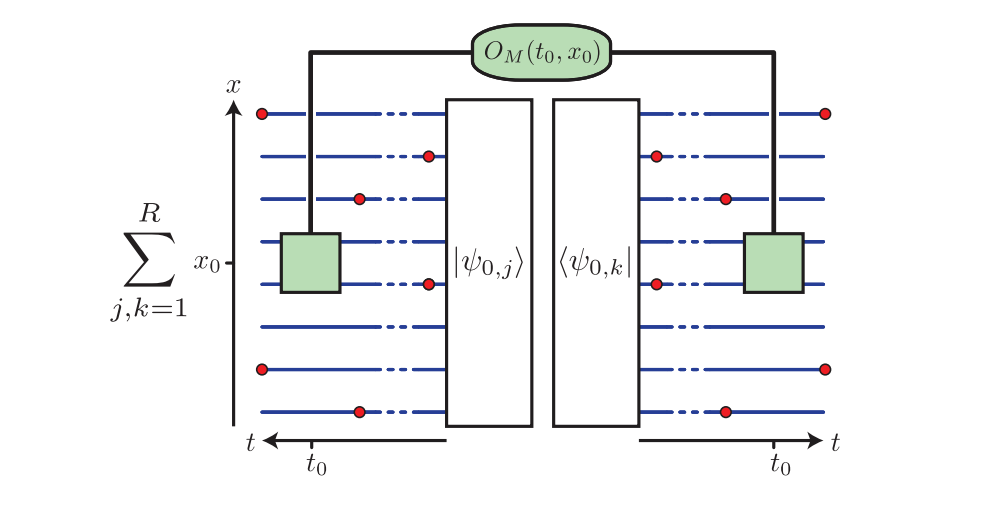
The behaviour of entangled particles represents a fundamental challenge in modern physics, and recent research investigates the precise point at which entanglement transitions from scaling with the volume of a system to its area. Matthew S. Foster from Rice University, Haoyu Guo and Chao-Ming Jian from Cornell University, along with Andreas W. W. Ludwig from the University of California, Santa Barbara, explore this transition in systems of interacting fermions, particles that obey the Pauli exclusion principle. Their work demonstrates that this volume-to-area law entanglement transition halts chaotic behaviour, suggesting the disappearance of a specific component within the underlying theoretical framework describing the transition. By focusing on interacting fermions, the team proposes a pathway to identify a critical point and numerically verify their predictions, offering new insights into the nature of entanglement and its connection to fundamental physical laws.
Weak Interactions Drive Entanglement Transition Changes
This research investigates how even weak interactions influence the transition between different types of entanglement in free fermion systems. Entanglement, a key quantum phenomenon, can scale with either the volume or the area of a subsystem. The team demonstrates that interactions fundamentally alter this transition, modifying the way entanglement scales and changing the system’s overall behaviour. Specifically, interactions introduce a subtle logarithmic correction to the expected area-scaling entanglement, indicating a departure from simpler, non-interacting systems. The researchers analysed entanglement using a sophisticated mathematical technique involving the calculation of Rényi entropy and analytical continuation. This analysis revealed that interactions effectively modify the critical exponent governing entanglement scaling, signifying a change in the system’s fundamental properties at the transition point. These findings deepen our understanding of entanglement transitions in complex systems and have implications for developing quantum technologies reliant on entangled states.
Fermion Dynamics and Monitoring Calculations
This document provides a detailed theoretical framework supporting the research on monitored, interacting fermion dynamics. It expands on the methods and calculations used to describe how constant measurement affects the behaviour of fermions, particles like electrons. The core focus is understanding how these measurements influence the system’s properties, particularly its ability to conduct electricity and exhibit exotic quantum phases. The study utilizes the Keldysh formalism to describe systems that are not in equilibrium, constantly interacting and being measured. Quantum field theory serves as the primary tool, describing the system in terms of fields like electron density and calculating their interactions.
Conformal field theory, a specialized form of quantum field theory, simplifies calculations by exploiting symmetries and analysing critical behaviour. Non-Abelian bosonization maps interacting fermions into bosons, simplifying calculations, while the WZNW model describes the system’s low-energy behaviour. Scaling and renormalization techniques reveal how the system behaves at different length scales, identifying relevant parameters and understanding critical behaviour. The document details calculations of operator content and the one-loop renormalization group, which determine how system parameters change with length scale.
It explains how the system of interacting fermions is mapped into a system of bosons using non-Abelian bosonization and the WZNW model. Scaling dimensions, crucial for understanding how operators behave at different length scales, are calculated throughout the analysis. This work has implications for quantum computing, condensed matter physics, and quantum metrology, offering insights into systems undergoing continuous monitoring.
Entanglement Volume Scaling Signals Field Theory Simplification
This research demonstrates that a transition to a specific phase in monitored quantum systems, characterized by entanglement scaling with system volume rather than area, coincides with the vanishing of a key parameter within the system’s underlying field theory. The team investigated this phenomenon in monitored, interacting Majorana fermions, proposing that the critical theory governing this transition is, surprisingly, identical to that of a non-interacting system. This suggests that interactions, while present, become effectively irrelevant at the critical point, allowing for a simplified description of the transition. The findings establish a connection between the behaviour of entanglement and the underlying field theory, offering insights into the nature of measurement-induced phase transitions.
Specifically, the research indicates that the observed transition can be understood through the lens of a non-interacting system, despite the presence of interactions within the model. The authors propose that this simplification arises because the “mass” term, responsible for entanglement generation, effectively vanishes at the transition point. This work provides a foundation for understanding complex quantum systems undergoing measurement-induced phase transitions.
🗞 Free-Fermion Measurement-Induced Volume- to Area-Law Entanglement Transition in the Presence of Fermion Interactions
🧠 ArXiv: https://arxiv.org/abs/2510.23706