Understanding how symmetries break down within complex systems represents a fundamental challenge in physics, and researchers are now developing new tools to investigate this phenomenon. Francesco Benini, Pasquale Calabrese, Michele Fossati, and Amartya H. Singh, all from SISSA, alongside Marco Venuti, introduce a novel approach using ‘entanglement asymmetry’ to detect symmetry breaking, even in states that are not at equilibrium. This method extends the analysis to include more complex, generalized symmetries, including those that are noninvertible, which are increasingly recognised as important in modern theoretical physics. By developing a way to quantify asymmetry through entanglement, the team reveals how different states can exhibit distinct physical properties when symmetry breaks, and applies this technique to analyse excited states in conformal field theories, offering new insights into the behaviour of these fundamental systems.
Entanglement asymmetry is an observable in quantum systems, constructed using quantum-information methods, suited to detecting symmetry breaking in states, possibly out of equilibrium, relative to a subsystem. In this paper, researchers investigate entanglement asymmetry for higher and noninvertible symmetries, quantifying symmetry breaking in quantum states by examining imbalances in entanglement patterns. This approach allows for the detection of subtle symmetry violations, particularly in complex, many-body systems and those far from equilibrium, and demonstrates applicability to a broad range of physical scenarios, including those with non-unitary symmetries relevant in modern condensed matter physics and quantum field theory. The work provides a novel tool for characterizing quantum phases of matter and understanding the effects of symmetry breaking in complex quantum systems.
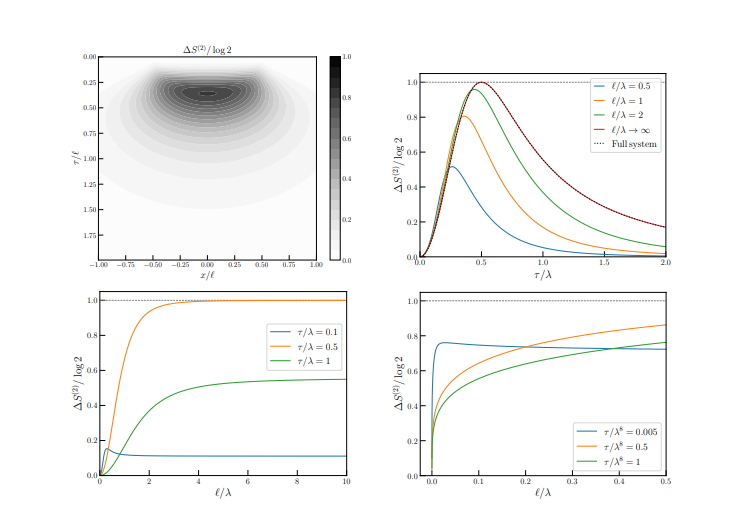
Researchers define the asymmetry for generalized finite symmetries, including higher-form and noninvertible ones, introducing a ‘symmetrizer’ of density matrices with respect to the symmetry operators acting on the subsystem. They study applications to two-dimensional systems, analysing spontaneous symmetry breaking of noninvertible symmetries and confirming that distinct vacua can exhibit different physical properties. They also compute the asymmetry of certain excited states in conformal field theories, including the Ising CFT, when the subsystem is either the full circle or an interval therein.
Conformal Field Theory And Operator Algebras
This collection of references represents a deep dive into advanced mathematical and physics concepts, particularly related to conformal field theory, operator algebras, category theory, and topological phases of matter. The work encompasses several core themes and broad areas, revealing current research directions, and highlights the importance of conformal field theory with many papers detailing the mathematical structure of these theories, including operator algebras and correlation functions. Operator algebras, such as Von Neumann and C*-algebras, are heavily featured as the mathematical tools used to rigorously define and study observables in quantum field theory. Category theory provides a powerful abstract framework for organizing and understanding mathematical structures, with concepts like fusion categories, braided tensor categories, and modular tensor categories crucial for classifying and studying topological phases of matter and the symmetries of conformal field theories.
A significant portion of the references relate to the mathematical description of topological phases, such as the fractional quantum Hall effect, using concepts from category theory and operator algebras, including Levin-Wen models and related constructions. Increasingly, research focuses on non-invertible symmetries and generalized global symmetries, linked to 2-group symmetries and their anomalies. The references can be categorized into several areas: mathematical foundations, including operator algebras and category theory; mathematical aspects of conformal field theory; research on topological phases of matter; and symmetry and anomalies. Emerging areas, such as categorical symmetry, transparent Haagerup-Izumi categories, and fusion category symmetry, are also represented.
Several key observations emerge from this collection: a clear trend towards increasing abstraction with more abstract mathematical tools being used to study physical systems; a growing number of papers on non-invertible symmetries suggesting this is a rapidly developing area of research; and the deep connections between mathematics and physics. Research on topological phases of matter is motivated by the potential for building fault-tolerant quantum computers, and recent work on Haagerup algebras and conformal field theory suggests new and unexpected connections between these two areas. In conclusion, this is a comprehensive list of references that reflects the cutting edge of research in conformal field theory, operator algebras, category theory, and topological phases of matter.
Subsystem Asymmetry Reveals Broken Symmetry Properties
This work introduces a refined method for detecting symmetry breaking in physical systems, extending the concept of entanglement asymmetry to encompass generalized symmetries, including those that are noninvertible. Researchers developed a ‘symmetrizer’, a mathematical tool to quantify symmetry within a subsystem, and applied this to investigate symmetry breaking in both gapped and gapless two-dimensional systems. The team demonstrated that distinct vacua, arising from the spontaneous breaking of noninvertible symmetries, can indeed exhibit differing physical properties, a result confirmed through calculations using topological quantum field theory. Investigations into conformal field theories, such as the Ising model, revealed that the asymmetry of subsystems varies depending on their size and the specific symmetry algebra considered, with the tube algebra proving a more sensitive detector of symmetry breaking than the fusion algebra.
Importantly, the study highlights the crucial role of boundary conditions when dealing with noninvertible symmetries; accurately defining these conditions is essential for correctly calculating asymmetry. While the choice of boundary conditions does not affect asymmetry calculations for conventional, group-like symmetries, it becomes unavoidable when considering noninvertible symmetries. The authors acknowledge that alternative formulations of the symmetrizer may exist depending on the specific algebraic structure of the symmetry, such as in the case of Hopf algebras, and future research may explore these alternative formulations and apply this refined method to a broader range of physical systems and symmetry types.
🗞 Entanglement Asymmetry for Higher and Noninvertible Symmetries
🧠 ArXiv: https://arxiv.org/abs/2509.16311