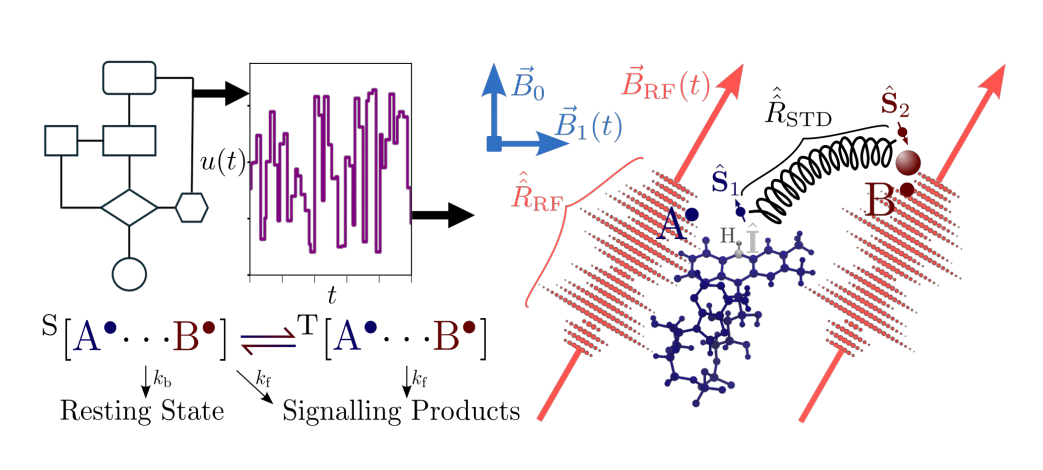
The manipulation of spin-correlated radical pairs presents a significant challenge with potential benefits for technologies ranging from robust information processing to novel biological applications. Farhan T. Chowdhury, Luke D. Smith, and Daniel R. Kattnig, from the University of Exeter, now demonstrate a new method for precisely controlling these complex systems. Their work overcomes limitations in existing computational approaches, which struggle with the intricacies of both coherent electron spin dynamics and the disruptive effects of incoherent relaxation. By applying control engineering principles, the team successfully steers the spin dynamics of radical pairs, achieving robust control even in the presence of realistic noise, and opening new avenues for manipulating these fundamental quantum processes.
Singlet exciton radical pairs (SCRPs) hold promise for targeted manipulation of magnetic field effects, with potential applications ranging from noise-resilient quantum information processors to genetically encodable quantum sensors. Achieving precise control over the interplay between coherent electron spin dynamics and incoherent relaxation processes in photoexcited radical-pair reactions requires tractable approaches for numerically obtaining controls for large, complex open quantum systems. Research centres on understanding how these mechanisms underpin biological processes, such as avian navigation, and whether quantum coherence plays a functional role within living systems. A significant focus lies on developing techniques to control quantum systems, like radical pairs, using optimal control theory, a mathematical framework for determining the best way to steer a system towards a desired outcome. Studies also examine the influence of magnetic fields on biological processes beyond navigation, including embryogenesis and cytoskeletal dynamics.
Some research explores the possibility of harnessing biological molecules as qubits, the fundamental building blocks of quantum computers, addressing the impact of noise and environmental interactions on quantum systems with stochastic modelling techniques. Investigations consistently address the coupling between quantum systems and their surroundings, crucial for understanding how coherence is maintained or lost in biological environments. This research encompasses a broad range of topics, from the fundamental physics of radical pair dynamics to the potential for exploiting quantum phenomena in biological systems. This work introduces a control engineering method, based on the Pontryagin Maximum Principle, to steer the evolution of these radical pairs, offering a viable alternative to computationally intensive methods used for larger systems. The team successfully implemented this control scheme to influence both coherent and incoherent spin dynamics, paving the way for manipulating reaction outcomes. The method involves introducing a tunable parameter that alters the system’s evolution over time, allowing scientists to influence the rate at which radical pairs convert between singlet and triplet states.
Measurements confirm that this control is robust, maintaining
Measurements confirm that this control is robust, maintaining effectiveness even in the presence of noise arising from fluctuations in inter-radical interactions and magnetic fields. The research demonstrates the ability to maximize or minimize the recombination yield of radical pairs, effectively controlling the efficiency of the chemical reaction. This method offers a viable alternative to traditional computational techniques for larger systems, enabling precise control over both coherent and incoherent aspects of spin dynamics. The team demonstrated the ability to design controls that are robust against common sources of noise, paving the way for manipulating radical-pair spin dynamics in a reliable manner. Furthermore, the ability to precisely control these dynamics could potentially unlock new approaches to mastering metabolic functions through magnetoresponsive pathways. The authors acknowledge that their current models represent simplified representations of complex biological systems, and future work will focus on applying these control strategies to more intricate scenarios, and investigating the scalability of the method for even larger spin systems.
🗞 Engineering the uncontrollable: Steering noisy spin-correlated radical-pairs with coherent and incoherent control
🧠 ArXiv: https://arxiv.org/abs/2510.05074