

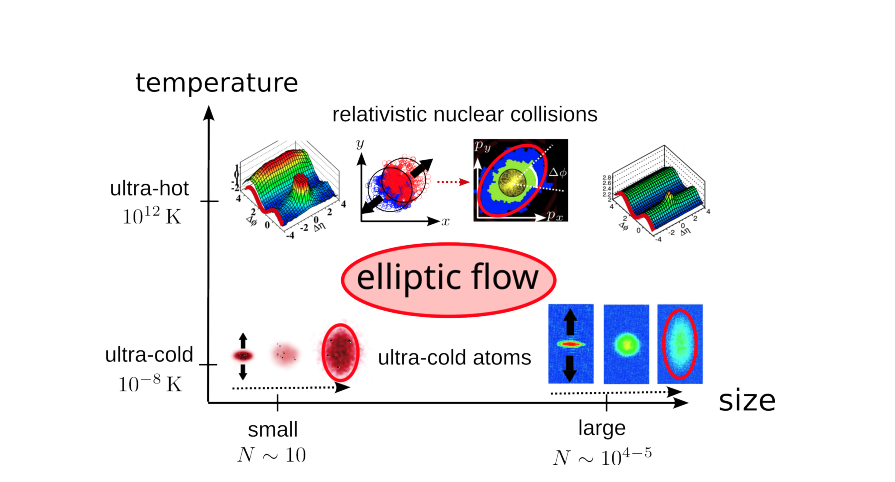
The behaviour of matter at the collective level, typically described by frameworks like hydrodynamics, faces increasing scrutiny as scientists observe complex phenomena in systems with surprisingly few interacting particles. Juergen Berges, Sandra Brandstetter, and Jasmine Brewer, alongside Georg Bruun, Tilman Enss, and Stefan Floerchinger, investigate these ‘mesoscopic’ systems, ranging from high-energy particle collisions to ultra-cold gases, where traditional descriptions break down. Their work challenges the fundamental assumption that collective behaviour always emerges from a clear separation between microscopic and macroscopic dynamics, and explores whether established theories still hold true when dealing with only a handful of interacting particles. By examining these systems across varying sizes, degrees of equilibrium, and interaction strengths, the researchers aim to redefine our understanding of how collective behaviour arises and to establish the limits of current theoretical frameworks.
Ultracold Gases Probe Extreme Matter Physics
Scientists are investigating the properties of strongly interacting ultracold atomic gases to understand fundamental aspects of many-body physics, offering a controllable environment to explore phenomena typically found in nuclear and condensed matter systems. This research addresses the behaviour of matter under extreme conditions, where traditional theoretical approaches often struggle, aiming to characterise the spectral function and determine how it evolves with varying interaction strengths and temperatures, ultimately providing insights into the underlying quantum dynamics of the system.
Hydrodynamic Evolution of Quark-Gluon Plasma
Research into quark-gluon plasma reveals a complex interplay between nuclear physics, quantum physics, and mathematics, describing the plasma as a fluid using hydrodynamics to understand its equation of state, viscosity, and evolution over time. Investigations explore how this plasma forms so quickly after collisions, examining initial conditions and the role of energy deposition, while kinetic theory offers a more detailed description of particle interactions within the plasma. Scientists also study how the plasma affects the propagation of high-energy particles, providing a way to probe its properties, and are increasingly connecting quantum physics with high-energy physics, exploring the use of entanglement and quantum correlations to enhance measurements. Advanced mathematical techniques, such as resurgent transseries, are used to understand the behaviour of the plasma and other complex systems, with many studies focusing on systems far from equilibrium, relevant to the early stages of heavy-ion collisions, and insights from string theory and holography used to model the plasma. Future facilities, like the Electron-Ion Collider, are expected to significantly advance our understanding of the structure of nuclei and the quark-gluon plasma, with research also exploring ultraperipheral collisions to study the properties of nuclei and the plasma.
Collective Flow Emerges at Microscopic Scales
Scientists are fundamentally reassessing understandings of how collective behaviour emerges in matter, spurred by observations across diverse physical systems, revealing that systems previously considered too small to exhibit fluid-like dynamics demonstrably display collective flow, a behaviour characteristic of macroscopic systems. This challenges the conventional requirement for a clear separation of scales between microscopic and macroscopic dynamics for effective theories to apply, with investigations into high-energy collisions demonstrating that even in proton-proton or proton-heavy ion collisions, pairs of particles exhibit correlated behavior over large distances, forming “ridges” in correlation functions. Remarkably, these findings indicate emergent collective behavior consistent with hydrodynamic expectations in conditions where such a description should not hold, with analysis revealing that the applicability of hydrodynamics hinges on the Knudsen number, a ratio comparing the mean free path of particles to the system size. In large nuclei collisions, the Knudsen number is approximately 0. 2, indicating a reasonable, though not strong, separation of scales, while in smaller systems, this separation vanishes as the system size becomes comparable to the time needed for local equilibrium. Conversely, experiments with ultra-cold atomic gases demonstrate elliptic flow in systems containing as few as 10 fermions, with tunable initial geometry and interaction strength, paralleling observations in high-temperature quark-gluon plasma.
Emergent Behaviour in Controlled Quantum Systems
Recent advances in understanding emergent collective behaviour in complex physical systems are being synthesised through technological developments that allow researchers to systematically investigate this principle, controlling the complexity and interactions within quantum systems. The work focuses on three key frontiers: the size frontier, examining systems with few constituents; the equilibrium frontier, investigating short timescales and the onset of collective behaviour; and the interaction frontier, exploring the role of strong coupling and many-body correlations. Findings from mesoscopic systems, such as those created in high-energy collisions and ultra-cold gases, are challenging conventional understandings of established theories. The research emphasises a shift towards data-driven inquiry, aiming to define the boundaries of validity for effective theories and to understand the transition from microscopic chaos to macroscopic order, acknowledging that current research is pushing the limits of existing theoretical frameworks and that a complete understanding of emergent phenomena remains a significant challenge. Future research will likely focus on refining theoretical models and developing new experimental techniques to probe the behaviour of increasingly complex systems, representing a move towards a deeper understanding of how collective behaviour arises in nature and the conditions under which established physical descriptions break down.
🗞 Few is different: deciphering many-body dynamics in mesoscopic quantum gases
🧠 ArXiv: https://arxiv.org/abs/2509.05049


