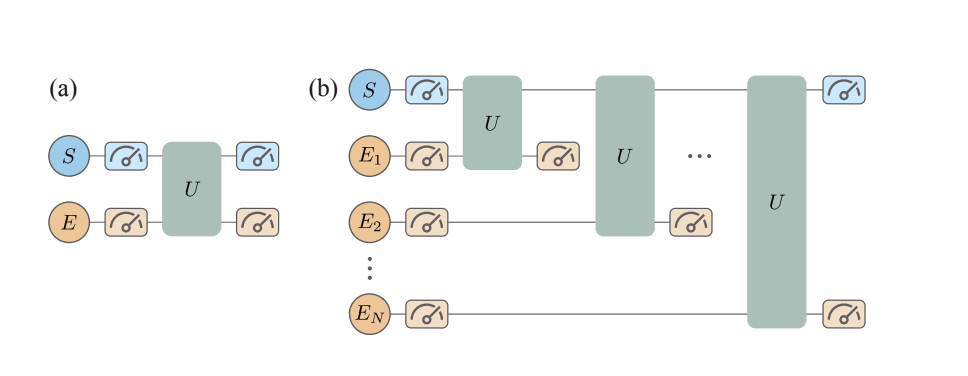
The fundamental limits of measurement precision in complex systems receive increasing scrutiny, and new research from Tan Van Vu, Ryotaro Honma, and Keiji Saito, all at Kyoto University, addresses a critical gap in our understanding. The team investigates how accurately we can measure properties in ‘open’ quantum systems, those interacting with their surroundings, particularly when those interactions are complex and not easily predictable. Their work establishes universal boundaries on measurement precision, revealing that the accuracy of any measurement is fundamentally linked to both the energy dissipated into the environment and the degree of imbalance between processes occurring forwards and backwards in time. This framework provides a comprehensive understanding of precision limits, extending beyond simpler systems and offering insights relevant to diverse fields including quantum technologies and biological systems.
They demonstrate that achievable precision when measuring a property is fundamentally constrained by thermodynamic costs, specifically the rate of energy dissipation and the cost of maintaining the system away from equilibrium. This work relaxes previous restrictive assumptions, seeking bounds applicable to a wider range of quantum systems. The research focuses on identifying the minimal energetic cost required to achieve a specific level of precision when estimating an unknown parameter, considering both standard and complex dynamics.
This exploration has implications for quantum metrology and information processing, aiming to establish a fundamental limit on the performance of quantum measurements in realistic, noisy environments, acknowledging the inherent trade-off between precision and energetic cost. The study builds upon existing concepts of dynamic and kinetic uncertainty relations, extending these ideas to systems where cause and effect are not straightforward. While previous work largely focused on systems in equilibrium, this research explores constraints in systems undergoing complex, non-equilibrium dynamics, deriving universal bounds on measurement precision for systems coupled to environments of varying strength, measured using two-point measurements. Researchers introduce a concept of asymmetry, quantifying the difference between processes moving forward and backward in time, demonstrating that this asymmetry, alongside entropy production, limits precision.
Tighter Bounds on Entropy Production Fluctuations
This document presents detailed mathematical derivations refining our understanding of entropy production, fluctuations, and the thermodynamic uncertainty relation in systems driven away from equilibrium. It expands upon existing research, applying to systems with arbitrary initial conditions, rather than requiring them to be in a steady state, establishing more precise limits on the probability of observing unusual fluctuations in thermodynamic quantities. The research addresses limitations of previous work, which often assumed systems started in equilibrium, a significant extension because real-world systems rarely begin in perfect balance. Researchers express entropy production in terms of the likelihood of specific sequences of events and relate it to the forward and backward evolution of the system, leading to a generalized thermodynamic uncertainty relation incorporating a boundary term accounting for the initial state, expected to become negligible over time.
The analysis relies on the concept of path probabilities, representing the likelihood of specific sequences of events, distinguishing between forward and time-reversed trajectories, recognizing that the difference between them is directly related to entropy production. Researchers utilize relative entropy, a measure of the difference between probability distributions, to quantify the irreversibility of the process, building upon existing research and generalizing it to more complex scenarios, providing tighter bounds on fluctuations in thermodynamic quantities like heat or work. In simpler terms, this research helps understand the limits of the second law of thermodynamics and the possibility of seemingly impossible events, with potential implications for designing and optimizing thermodynamic devices, such as heat engines and refrigerators.
Dissipation and Asymmetry Limit Quantum Precision
This research establishes fundamental limits on the precision of measurements in open quantum systems, demonstrating that both dissipation and asymmetry in the system’s dynamics play crucial roles. Researchers show that the precision with which a property can be measured is fundamentally limited by the rate at which energy is lost to the environment and by the difference between processes moving forward and backward in time, particularly for properties resembling currents. The team proves that a generalized activity term imposes a fundamental constraint on the precision of any measurable property, reflecting the underlying dynamics of the quantum system, offering a comprehensive framework for understanding the limits of precision in a broad range of open quantum systems, regardless of the strength of their interaction with the environment. The results apply to systems undergoing general dissipative dynamics, providing a valuable tool for interpreting experimental observations and designing more precise measurements. Researchers acknowledge that their work focuses on theoretical bounds and does not address the practical challenges of implementing such measurements in real-world scenarios, suggesting that future research could explore the implications of these bounds for specific physical systems and investigate how they might be overcome through optimized measurement protocols or system design.
🗞 Universal Precision Limits in General Open Quantum Systems
🧠 ArXiv: https://arxiv.org/abs/2508.21567