

The behaviour of electrons in heavy-fermion materials presents a long-standing puzzle in condensed matter physics, and understanding their response to external stimuli remains a key challenge. Francisco Meirinhos, Michael Turaev, and Michael Kajan, all from Universität Bonn, alongside Tim Bode from Forschungszentrum Jülich and Johann Kroha from the University of St. Andrews, now provide a theoretical explanation for how these materials evolve following a pulse of terahertz light. Their work reveals two crucial mechanisms governing this evolution: a rapid shift in the material’s electronic state and a slow return to its original heavy-fermion characteristics, dictated by the material’s inherent Kondo coherence time. This research not only clarifies recent experimental observations from time-resolved terahertz spectroscopy, but also establishes this technique as a powerful tool for directly probing the fundamental properties of heavy-fermion materials and classifying their unique electronic behaviour.
Terahertz Excitation of Heavy Fermion Dynamics
This research investigates the dynamic behaviour of heavy fermion systems following excitation with terahertz radiation. Heavy fermion materials, characterized by strong interactions between electrons, exhibit unusual properties like unconventional superconductivity and quantum criticality. Understanding how these materials respond to extremely fast pulses of terahertz light is crucial for revealing the underlying mechanisms governing their behaviour and disentangling the interplay between different energy scales. The study focuses on the emergence of a distinctive echo-like signal, originating from the coherent coupling between localized and conduction electrons via the Kondo effect, which describes how conduction electrons interact with localized magnetic moments.
When a terahertz pulse excites the system, it creates a non-equilibrium distribution of electrons, initiating coherent oscillations between localized and conduction electrons. These oscillations, coupled with the Kondo effect, give rise to the observed echo-like signal, providing a sensitive probe of the underlying Kondo physics. The characteristics of this echo depend sensitively on the system’s parameters, such as the Kondo temperature and the strength of interactions with vibrations in the material. This research develops a theoretical framework to accurately describe the non-equilibrium dynamics of terahertz-pumped heavy fermions and interpret experimental observations of the Kondo echo.
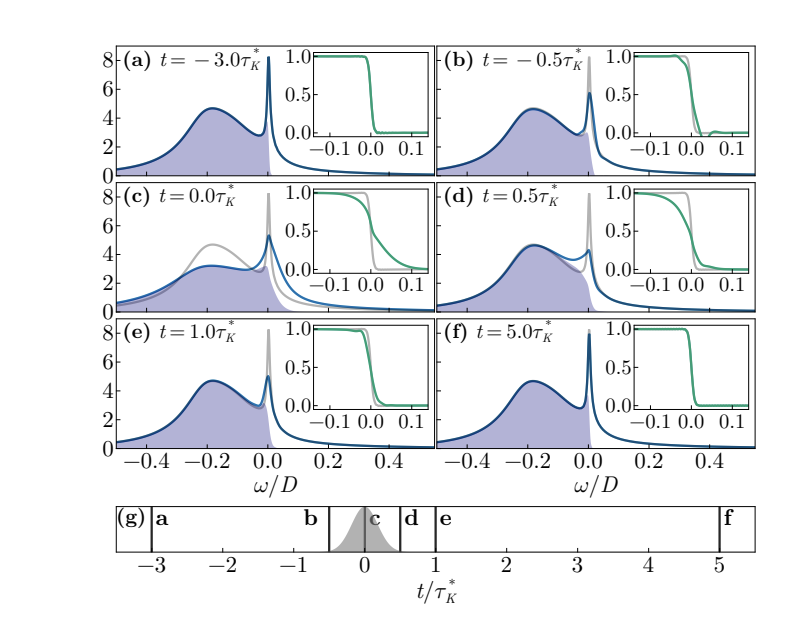
The research presents a framework to describe the temporal dynamics of correlated electron systems for realistic parameters and timescales. It is based on an integro-differential formulation of time-dependent dynamical mean-field theory and a quantum representation of the driving electromagnetic field. For heavy-fermion systems, the study identifies two key mechanisms governing their time evolution after terahertz excitation: a rapid shift from the Kondo to a mixed-valence state via enhanced photoassisted hybridization, and a slow recovery of the heavy-fermion state.
DMFT Simulations of Kondo Photoexcitation Dynamics
This appendix provides a detailed description of the mathematical and computational methods used in the research, focusing on the simulation of Kondo physics and photoexcitation. The core of the approach is dynamical mean-field theory, a method for solving strongly correlated electron systems where electron-electron interactions are significant. This theory maps the complex lattice problem onto an effective single-impurity problem embedded in a self-consistent environment, allowing for a more manageable calculation. A crucial approximation within this framework is the non-crossing approximation, used to solve the impurity problem self-consistently.
The researchers also employed an auxiliary particle representation to handle strong correlations by introducing auxiliary particles to represent the occupation of the local orbital. The Keldysh formalism, utilizing greater and lesser Green’s functions, is essential for describing nonequilibrium dynamics, crucial for modeling the time-dependent response of the system to the photoexcitation. The appendix details the equations used, including the core DMFT self-consistency equations, and the equations defining how the auxiliary particle Green’s functions are calculated. The Luttinger-Ward functional represents the energy of the system and is minimized to find the optimal solution. The equations are solved numerically to simulate the time evolution of the system after the photoexcitation, with the DMFT equations solved iteratively until self-consistency is reached at each time step.
Terahertz Pulses Reveal Heavy-Fermion Dynamics
This research presents a theoretical framework for understanding the behaviour of strongly correlated electron systems when excited by ultrashort terahertz light pulses. The team developed a method to model how these systems respond to light, revealing two key processes in heavy-fermion materials: a rapid shift from the Kondo to a mixed-valence state, and a slower recovery of the heavy-fermion state governed by the Kondo coherence time. These findings provide a microscopic explanation for recent time-resolved terahertz spectroscopy experiments, establishing the technique as a means to directly measure both the Kondo coherence time and the quasiparticle weight of heavy-fermion materials. The study highlights the importance of using the Anderson lattice model, which accurately captures the physics of these materials. While the research demonstrates that superradiance is unlikely in typical heavy-fermion compounds due to limitations in quantum coherence, the developed method is broadly applicable to other optically driven, correlated systems. Future work could explore the conditions under which superradiance might be achieved in different many-body systems.
🗞 Kondo echo dynamics of terahertz-pumped heavy fermions
🧠 ArXiv: https://arxiv.org/abs/2509.07117


