

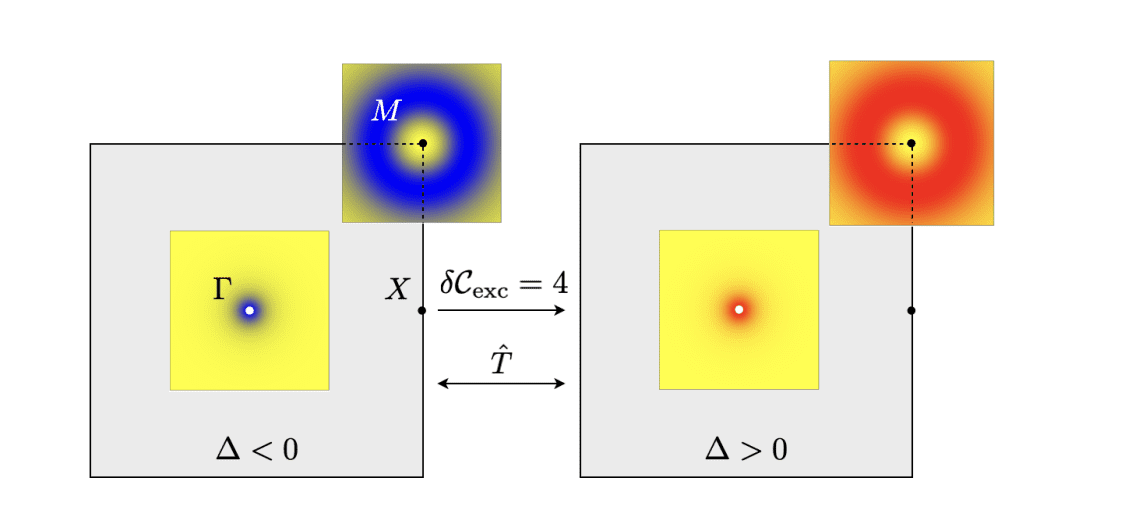
The behaviour of excitons, quasiparticles crucial to optoelectronic properties, undergoes dramatic changes during topological phase transitions in quasi-two-dimensional materials. Xiaochan Cai from ShanghaiTech University, Armando Consiglio and Domenico Di Sante from the University of Bologna, along with Ronny Thomale and Werner Hanke from the Universität Würzburg, now present a new continuum theory that simplifies the understanding of these transitions. Their work demonstrates that the essential physics governing these topological changes localises near specific points in the exciton band structure, significantly reducing the computational complexity needed to model these systems. This breakthrough allows researchers to efficiently investigate complex materials, including twisted bilayer systems and even potentially room-temperature spin Hall systems like Bismuthene, opening new avenues for designing advanced optoelectronic devices.
Topological Exciton Condensate, Continuum Field Theory Approach
An effective continuum theory describes the topological phase transition of excitons in quasi-two-dimensional systems, crucial for determining their optoelectronic properties due to larger binding energies and enhanced excitation characteristics. The methodology employs a field-theoretic approach, utilising a Ginzburg-Landau free energy functional to describe the exciton condensate, incorporating exciton density, topological order, and their coupling to investigate phase boundaries and critical phenomena. Numerical simulations, utilising a finite-difference method on a square lattice, solve the resulting equations of motion to determine stable configurations and the transition pathway, mapping the phase diagram and characterising the topological phase transition by analysing the evolution of the order parameter and the emergence of topological defects.
Excitons, Topology, and Valleytronics in 2D Materials
This work presents detailed theoretical work on excitons, topological insulators, and valleytronics in two-dimensional materials like transition metal dichalcogenides, focusing on linking exciton topology to valley physics for potential applications. The authors demonstrate that excitons can exhibit topological properties, similar to those found in topological insulators, leading to robust phenomena intimately connected to the valley degree of freedom, allowing for control and manipulation of valley polarization. Symmetry, particularly time-reversal symmetry, plays a crucial role in protecting these topological states, while electron-hole interactions, specifically the Coulomb interaction, are essential for understanding exciton behaviour and affect their dispersion and topology. The research explores the potential of the quantum spin Hall regime to influence exciton behaviour and create unique optical properties, proposing that exciton topology can give rise to new optical selection rules, controlling exciton emission and absorption, and that the valley degree of freedom could be used to create new exciton qubits for quantum information processing. The theoretical framework is applied to specific materials, such as transition metal dichalcogenides and boron nitride, to calculate exciton properties and compare predictions with experimental results.
Exciton Topology From Band-Crossing Points
This research establishes a continuum theory to effectively describe the behaviour of topological excitons in quasi-two-dimensional materials, demonstrating that their essential topological properties are determined by band-crossing points within the exciton band structure, simplifying calculations. This approach accurately predicts topological invariants using only the exciton states forming these specific band-crossing points, applicable to both spin-conserving and non-spin-conserving systems. The theory was successfully applied to two distinct model systems, twisted bilayer metal dichalcogenides and the Bernevig-Hughes-Zhang model, validating its predictive power. In the twisted bilayer system, a Moiré potential creates a specific band-crossing point which, when subjected to a magnetic field, results in a lowest exciton band with a defined Chern number, while in the Bernevig-Hughes-Zhang model, the researchers investigated both trivial and quantum spin Hall insulating phases, demonstrating the theory’s versatility in describing different material behaviours. Future research could focus on extending the theory to incorporate additional interactions and exploring its applicability to a wider range of quasi-two-dimensional systems to further refine understanding of topological exciton behaviour and potentially unlock new optoelectronic functionalities.
👉 More information
🗞 Continuum theory for topological phase transitions in exciton systems
🧠 ArXiv: https://arxiv.org/abs/2509.22274

