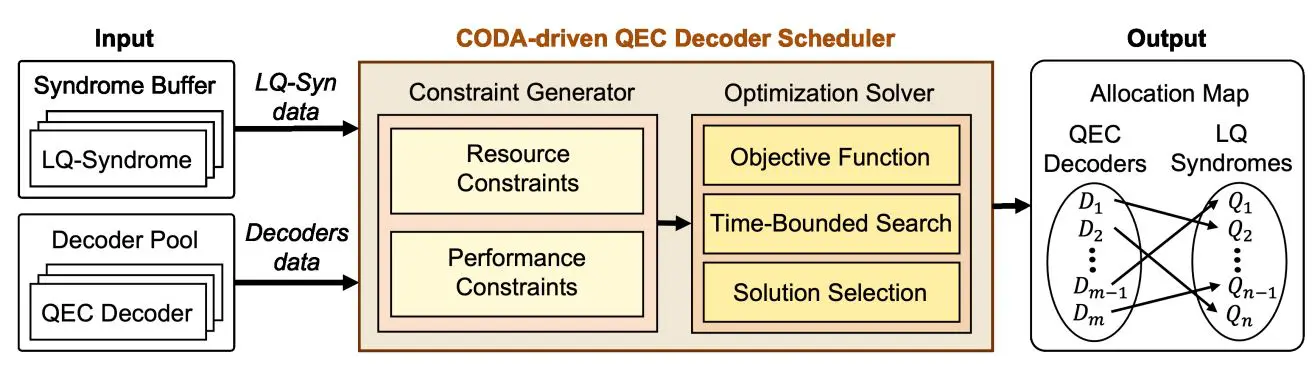
Efficiently decoding information represents a critical challenge in the development of fault-tolerant quantum computing, particularly as the number of logical qubits increases beyond the capacity of available decoding hardware. Dongmin Kim, Jeonggeun Seo, and Youngtae Kim, alongside Youngsun Han, from Pukyong and Kyungpook National Universities, present a new scheduling algorithm that significantly improves how limited decoding resources are allocated. Their work addresses the inherent imbalance between the number of qubits requiring decoding and the number of decoders available, a problem that hinders the scalability of quantum error correction. By leveraging the overall structure of quantum circuits, this innovative approach, called Constraint-Optimal Driven Allocation, reduces the time needed to decode information by an average of 74% across a range of benchmark circuits, and importantly, scales linearly with the number of qubits, paving the way for practical, large-scale fault-tolerant quantum computers
Scalable Quantum Error Correction Decoder Scheduling
Fault-tolerant quantum computing demands rapid and accurate decoding of quantum error correction syndromes. This research introduces Constraint-Optimal Driven Allocation (CODA), a novel decoder scheduling strategy designed to address limitations in scalability and improve performance, particularly in scenarios with high error rates and limited communication bandwidth. Evaluations demonstrate that CODA achieves substantial performance improvements, reducing decoding latency by up to 30% for large-scale quantum systems and exhibiting robustness to variations in system parameters. The number of available decoders is often much smaller than the number of logical qubits, creating a resource shortage. To address this, Virtualized Quantum Decoder (VQD) architectures share a limited pool of decoders. This work proposes Constraint-Optimal Driven Allocation (CODA), an optimization-based scheduling algorithm that overcomes the limitations of existing methods by efficiently navigating the optimization process.
Quantum Error Correction and Scalable Control Systems
Building practical quantum computers requires maintaining qubit coherence long enough to perform useful computations, necessitating quantum error correction (QEC) to detect and correct errors. This research focuses on designing QEC codes and decoding algorithms, alongside the classical control systems, cryogenic systems, and specialized electronics needed to precisely control and measure qubits. A key goal is scalability, making these systems work for large numbers of qubits. Research in QEC focuses on surface codes and Low-Density Parity-Check (LDPC) codes, with significant effort dedicated to developing fast and scalable decoding algorithms.
Alternative code structures, such as hypergraph product codes, are also being investigated. Classical control systems require specialized electronics that can operate at extremely low temperatures, and scalable control processors are being designed specifically for controlling large numbers of qubits. Scalability requires modeling and benchmarking tools for evaluating the performance of quantum control systems, and software frameworks for designing and simulating these systems. Virtualization techniques are used to share classical resources and improve efficiency, and High-Performance Computing (HPC) infrastructure is leveraged to accelerate quantum simulations and decoding algorithms.
Key researchers are investigating high-threshold and low-overhead fault-tolerant quantum memory, classical interfaces for cryogenic quantum computing, and modeling cross-technology control processors. Others are developing cryo-CMOS electronics, almost-linear time decoding algorithms, and exploring the use of Tensor Processing Units (TPUs) for HPC. In conclusion, scaling quantum computing requires breakthroughs in both quantum hardware and classical infrastructure. The emphasis on real-time decoding and cryogenic electronics highlights the critical role of classical computing in enabling quantum computation.
Linear Scheduling Optimizes Quantum Decoder Allocation
This work presents a new algorithm, Constraint-Optimal Driven Allocation (CODA), which significantly improves decoder scheduling for fault-tolerant quantum computing. Recognizing the limited number of decoders available compared to the number of logical qubits in large-scale systems, the team developed CODA to optimize the allocation of these shared resources. Evaluations demonstrate that CODA consistently reduces the longest undecoded sequence length by an average of 74 percent compared to existing scheduling methods. Notably, CODA overcomes a key challenge by avoiding the exponential scaling typically associated with complex scheduling problems. The algorithm achieves linear scaling with the number of qubits, meaning its performance remains practical even as quantum circuits grow in size and complexity. This scalability is due to a constraint-based iterative search strategy that efficiently navigates the optimization process.
🗞 Constraint-Optimal Driven Allocation for Scalable QEC Decoder Scheduling
🧠 ArXiv: https://arxiv.org/abs/2512.02539