

The increasing demand for sophisticated robotic systems drives exploration into cloud-based control, yet reliably connecting robots to the cloud presents significant hurdles. Achilleas Santi Seisa, Viswa Narayanan Sankaranarayanan, Gerasimos Damigos, and colleagues at Luleå University of Technology and Ericsson Research address this challenge by presenting a new framework for testing cloud and edge robotic systems. Their work demonstrates a scalable solution for remotely controlling aerial robots via the cloud, even under realistic and often unpredictable network conditions. By combining containerized cloud clusters with simulated robotic environments and introducing artificial network delays, the team provides a robust platform for developing and validating cloud-assisted robotic applications, paving the way for more responsive and reliable remote control systems.
The system addresses the challenges of enabling robust, scalable, and reliable remote drone control, particularly when complex computations and real-time responsiveness are required. The proposed solution combines cloud computing for centralized management and data storage, edge computing to reduce latency and improve control, and containerization to facilitate portable and scalable software deployment. The Robot Operating System (ROS) serves as the core robotics middleware for communication and control, and the team explored the potential of advanced communication technologies like 5G and Paced-5G to further enhance performance.
The framework utilizes a layered architecture, distributing tasks between the cloud, edge, and the drone itself. Kubernetes orchestrates containerized applications, enabling scalability and fault tolerance, while edge computing minimizes latency for responsive control. Cloud infrastructure enables remote monitoring and control of drones, and the system supports advanced control algorithms, such as Model Predictive Control (MPC), which require significant computational resources. This work highlights the importance of combining these technologies to overcome challenges related to latency, scalability, and reliability in remote robotic control.
Cloud-Edge Testing for Remote Robotic Control
Scientists engineered a novel framework for rigorously testing cloud and edge robotic systems, addressing challenges posed by network latency and resource management. The core of this system comprises containerized cloud clusters and robotic simulation environments, enabling scalable and intuitive testing procedures. Communication between these components occurs via a User Datagram Protocol (UDP) tunnel, simulating realistic network conditions and facilitating bidirectional data exchange. To replicate the variable delays encountered in real-world deployments, the team harnessed Linux-based traffic control, introducing artificial delay and jitter into the communication stream.
The methodology centers on a three-step process for cloud-assisted remote control of aerial robots: a position predictor, a teleoperation module, and a controller. Recognizing that network delays impact control precision, the team developed a position predictor that estimates the drone’s current and future states based on delayed data, refining state estimates to compensate for uplink and downlink delays. Human operators input waypoints via the teleoperation module, which then feeds commands to the controller. The controller employs a dual-loop design, separating attitude and position dynamics for optimized performance.
An inner loop, responsible for attitude control, operates onboard the drone at a high frequency, while the outer loop, managing position dynamics, executes on the cloud cluster. A Proportional, Integral, Derivative (PID) controller governs waypoint tracking, receiving state estimates from the position predictor and teleoperation commands to generate velocity-based control actions. This system delivers a robust platform for evaluating cloud-robot interactions under realistic conditions, enabling researchers to assess performance and refine control strategies.
Cloud-Robot System Testing with Network Emulation
Scientists have developed a framework for testing cloud and edge robotic systems, offering a scalable and intuitive solution. The system utilizes containerized technology, creating both a containerized cloud cluster and a containerized robot simulation environment, enabling researchers to emulate realistic cloud-robot collaborations. A key innovation lies in the incorporation of a User Datagram Protocol (UDP) tunnel, facilitating bidirectional communication between the cloud and the simulated robot, and allowing for the simulation of variable network conditions. The framework accurately replicates real-world challenges by introducing artificial delay and jitter, mimicking the unpredictable network conditions encountered in practical cloud-robot deployments.
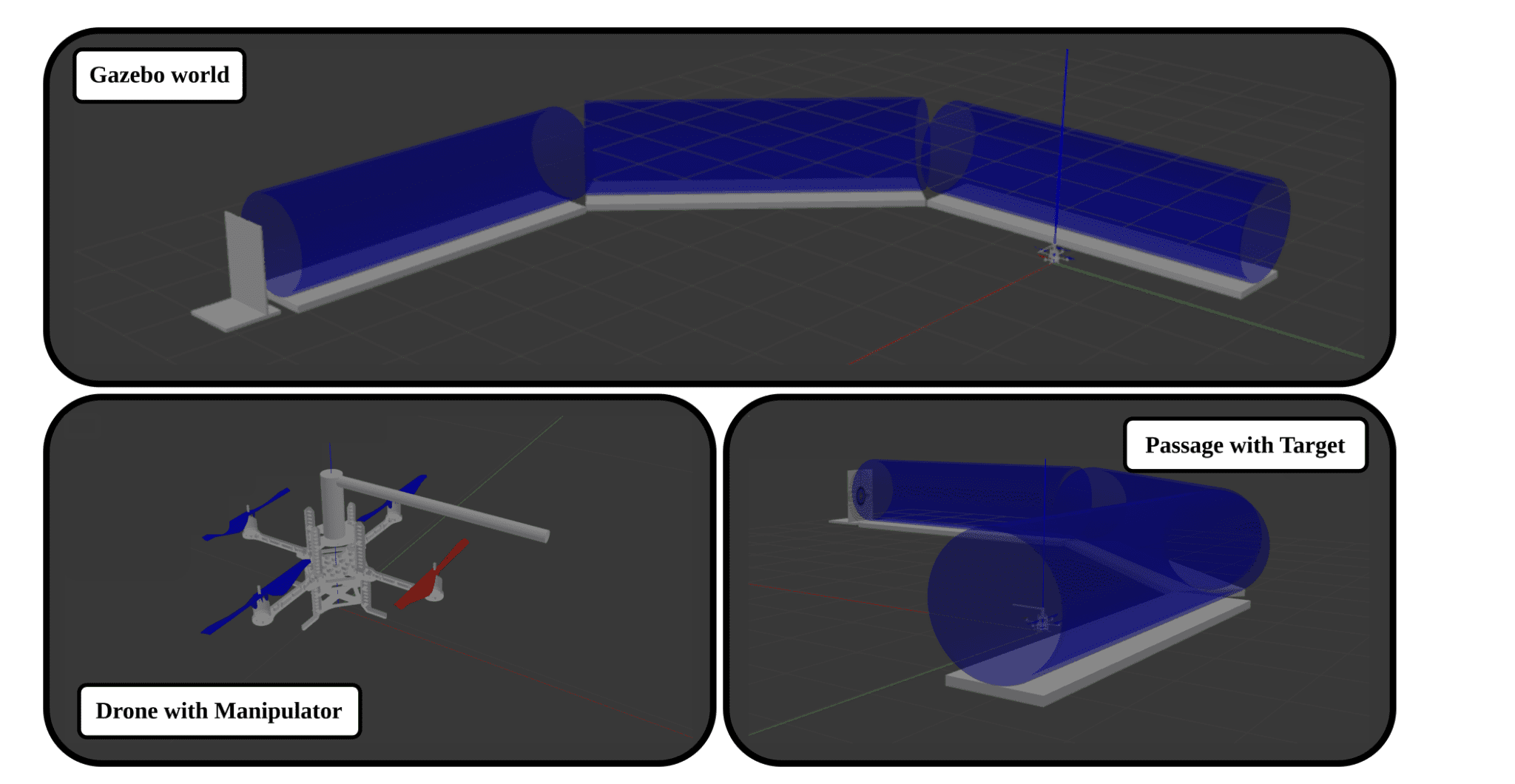
The simulation environment incorporates a Gazebo simulator, representing a virtual robotic system with a pre-defined environment designed for evaluating cloud-assisted aerial manipulation. This detailed simulation generates the current state of the aerial robot and utilizes a Low Level Controller (LLC) to translate control actions from the cloud into motor speeds. The cloud cluster container houses a velocity controller, a teleoperation module for human input, and a position predictor designed to estimate the drone’s current and future states, accounting for communication delays. Researchers implemented a Proportional, Integral, Derivative (PID) controller for cloud-assisted control, dividing the solution into three steps: position prediction, teleoperation, and control. The code for both the simulated world and the containerized cloud cluster are publicly available, fostering collaboration and accelerating innovation in cloud robotics.
Cloud Robotics Testing With Network Emulation
This research presents a cloud-emulated framework designed for testing aerial robotics applications, specifically focusing on cloud-assisted remote control. The system integrates containerized technologies, a robotics simulation environment, and network emulation to realistically assess interactions between cloud services and robots, even under challenging network conditions. By introducing artificial delays and jitter, the framework replicates the variable network conditions often encountered in real-world cloud-robot deployments. The team demonstrated precise trajectory tracking using a PID-based velocity controller, effectively compensating for network-induced delays with a position predictor, maintaining positional errors below 0.1 cm. This emulated environment offers a controlled and adaptable platform for validating cloud robotics applications and promoting further research in the field. The authors acknowledge that the framework currently focuses on aerial robots and further work could explore its applicability to other robotic platforms and more complex scenarios. Future research directions could also investigate the scalability of the system and its performance with a larger number of robots operating simultaneously.
👉 More information
🗞 Cloud-Assisted Remote Control for Aerial Robots: From Theory to Proof-of-Concept Implementation
🧠 ArXiv: https://arxiv.org/abs/2509.04095


