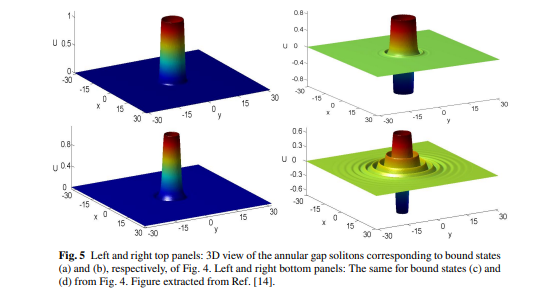
The challenge of creating stable, multidimensional structures within quantum systems drives ongoing research in nonlinear physics, and scientists are now exploring ways to overcome the inherent instability of higher-dimensional solitons. Fatkhulla Abdullaev of the Physical-Technical Institute of Uzbekistan Academy of Sciences, alongside Mario Salerno from the University of Salerno, and their colleagues, investigate the theoretical conditions necessary for sustaining these delicate formations. Their work focuses on systems like Bose-Einstein condensates, where attractive interactions typically lead to collapse, and explores mechanisms to counteract this tendency. By reviewing key theoretical advances in areas such as external potential control and competing nonlinearities, the team demonstrates pathways towards achieving long-lived or fully stable multidimensional solitons, representing a significant step towards manipulating quantum matter with greater precision and control.
Localized structures, such as two- and three-dimensional solitons, are central to understanding nonlinear wave phenomena, with research focusing on optical lattices, manipulation of nonlinearity via Feshbach resonance, and Rabi coupling between hyperfine states. Scientists also investigate competing nonlinearities and quantum corrections, with an emphasis on conditions that enable long-lived or fully stable solitons. Despite experimental feasibility, achieving robust stabilization remains challenging due to the complex interplay of nonlinearities and external controls. This chapter surveys collapse dynamics, stabilization strategies, and soliton existence based on key theoretical contributions.
Temporal Modulation Stabilizes Multidimensional Solitons
Researchers pioneered a sophisticated approach to stabilizing multidimensional solitons within nonlinear systems, specifically focusing on atomic Bose-Einstein condensates. Recognizing the inherent instability of two- and three-dimensional solitons, the study developed techniques to counteract the attractive forces causing collapse, achieving long-lived or fully stable soliton formations. A central innovation involved the precise temporal modulation of the atomic scattering length using Feshbach resonance techniques, effectively averaging the nonlinear interaction to suppress collapse. This involved applying a time-varying magnetic field to control the strength of interactions between atoms, inducing a periodic variation in the nonlinearity.
To simplify the analysis, a transformation removed rapidly varying terms, leading to an effective equation governing the soliton’s behavior. This transformation, coupled with a perturbative expansion, revealed a correction to the system’s energy, demonstrating the existence of a minimum energy state indicative of stable solitons. Further validation came from a variational approach, incorporating the rapid phase modulations induced by the nonlinearity management, yielding the same averaged energy expression. The analysis yielded a characteristic soliton size, providing a theoretical prediction for stability conditions.
Complementing this approach, scientists explored stabilization via Rabi management, leveraging the coupling between components of a two-component Bose-Einstein condensate. By applying an external electromagnetic field, they induced periodic transitions between hyperfine states, modulating the mean-field interactions and effectively changing the sign of the interactions from repulsive to attractive. A mathematical transformation simplified the coupled equations, reducing the system to a single nonlinear equation with a time-periodic nonlinearity. Similar to the nonlinearity management technique, this analysis demonstrated the possibility of achieving stabilization for sufficiently large frequencies, aligning with results from direct numerical simulations. This innovative combination of theoretical modeling and numerical validation provides a robust framework for controlling and stabilizing multidimensional solitons in complex quantum systems.
Soliton Stability and Bose-Einstein Condensates
This extensive compilation details research into solitons, Bose-Einstein condensates, nonlinear optics, and related areas of physics. The references cover fundamental soliton theory, including the stability criterion and the properties of Townes solitons relevant to Bose-Einstein condensates, with a particular focus on multidimensional solitons. Many references address the stability of different soliton types and the dynamics of Bose-Einstein condensates, often utilizing the equation as a foundational framework. Researchers investigate solitons within trapped Bose-Einstein condensates and external potentials, as well as spinor and dipolar Bose-Einstein condensates. The references also cover Raman scattering and related phenomena, and the creation of novel solitons with topological properties using artificial gauge fields. The compilation highlights experimental realizations of Bose-Einstein condensates and the observation of related phenomena, alongside optical experiments involving nonlinear optics and soliton creation.
Stabilizing Higher-Dimensional Soliton Localisation
This research comprehensively examines the formation and stabilization of multidimensional solitons within nonlinear systems, with particular relevance to atomic Bose-Einstein condensates and nonlinear optics. The study demonstrates that while one-dimensional solitons are generally stable, their higher-dimensional counterparts are susceptible to collapse due to attractive interactions. However, the work identifies several theoretical mechanisms to counteract this instability, including the use of lattices, precise control of nonlinearity through Feshbach resonance management, and the application of Rabi coupling between hyperfine states. Importantly, the findings reveal that periodic modulation of linear coupling can enable the prolonged localization of two-dimensional solitons, even in free space, and that the addition of a weak external trapping potential can fully stabilize them.
The research builds upon established theoretical frameworks and confirms analytical predictions through numerical simulations, while also aligning with experimental observations of matter-wave soliton trains and related phenomena. The authors acknowledge that achieving robust stabilization of fully three-dimensional solitons remains a significant challenge, particularly due to the influence of quantum fluctuations, thermal effects, and corrections beyond the mean-field approximation. Future research directions include a deeper understanding of how these effects interact with modulational instability and soliton formation, as well as exploring the potential of synthetic gauge fields and spin-orbit coupling to further enhance soliton stability and dynamics in both Bose-Einstein condensates and nonlinear optics.
👉 More information
🗞 Attractive Multidimensional Solitons in Trapping Potentials
🧠 ArXiv: https://arxiv.org/abs/2509.15994