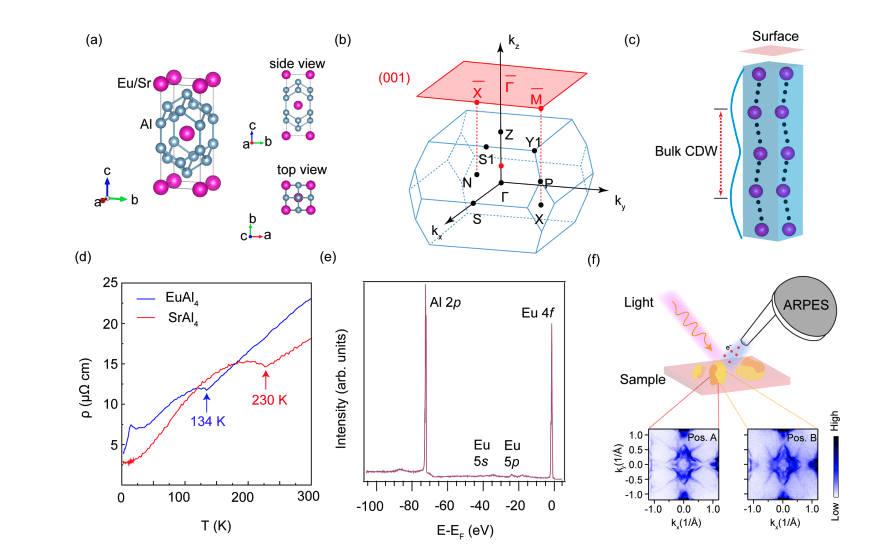
The surfaces of certain materials can behave dramatically differently from their interiors, potentially hosting entirely new electronic states, but observing these states directly proves challenging. Tongrui Li, Leiyuan Chen, and Jian Yuan, along with their colleagues, investigate this phenomenon in the layered compounds strontium aluminium alloy and europium aluminium alloy, materials known to undergo charge-density-wave transitions. Their work reveals that the surface of these alloys reconstructs into a distinct order, breaking the symmetry present in the bulk material and creating unique electronic states that run perpendicular to the original charge waves. This decoupling of surface and bulk orders, traced to the arrangement of missing atoms on the surface, establishes these alloys as ideal systems for studying emergent low-dimensional electronic phases and surface-confined nematicity.
Surface-induced symmetry breaking in quantum materials can stabilize exotic electronic phases and emergent phenomena, crucial for developing novel quantum devices and deepening our understanding of fundamental physics. Observing and controlling these surface effects remains a significant challenge, particularly in complex materials where surface and bulk properties are intertwined. This research investigates the interplay between surface symmetry breaking and the emergence of topological electronic states in bismuth selenide (Bi₂Se₃), a prototypical three-dimensional topological insulator, aiming to demonstrate how controlled surface modification can induce and manipulate these states for advanced spintronic and quantum computing applications.
Charge Density Waves and Topological Materials
This research details a comprehensive effort focused on materials science, specifically exploring charge density waves (CDWs) and topological materials. The study centers on understanding the formation, properties, and characterization of CDWs, including the mechanisms driving their formation and structural characteristics. A significant focus lies on how CDWs interact with and modify the topological electronic states in materials possessing non-trivial electronic structures. Researchers employ advanced computational methods, such as ab initio calculations, and experimental techniques like angle-resolved photoemission spectroscopy (ARPES) to directly observe changes in electronic band structure.
The research covers a wide range of materials, including transition metal dichalcogenides and europium-based compounds, with titanium diselenide being frequently studied. Researchers utilize computational tools like VASP and Quantum ESPRESSO, alongside techniques like Wannier function analysis and Green’s function methods. Synchrotron radiation and Raman spectroscopy are also employed to characterize lattice vibrations and CDW modulations, aiming to understand the fundamental mechanisms driving CDW formation, explore their impact on material properties, and potentially harness CDW behavior for technological applications.
Surface Reconstruction Decouples From Bulk Order
Scientists have uncovered a surprising decoupling between surface and bulk electronic order in the intermetallic compounds strontium aluminide (SrAl₄) and europium aluminide (EuAl₄). These materials exhibit charge-density-wave (CDW) transitions in their bulk structure, consistent with previous observations. However, detailed angle-resolved photoemission spectroscopy (ARPES) and scanning tunneling microscopy (STM) reveal a distinct symmetry breaking at the surface that does not mirror the bulk behavior. Experiments demonstrate that the surface of both compounds undergoes a reconstruction, forming a patterned arrangement with quasi-one-dimensional modulations and step-like features.
This reconstruction is attributed to an ordered arrangement of vacancies in the strontium or europium atoms, which surprisingly vanish irreversibly upon thermal cycling, further highlighting its independence from the bulk CDW state. ARPES measurements reveal linearly dispersing electronic states and pronounced replica bands, indicating the emergence of an in-plane symmetry-breaking electronic order at the surface. These findings establish SrAl₄ and EuAl₄ as model systems for exploring surface-confined electronic orders and offer new avenues for understanding and manipulating electronic order at material surfaces.
Surface Symmetry Breaking in Layered Materials
The research presents a detailed investigation of SrAl₄ and EuAl₄, layered materials exhibiting charge-density-wave (CDW) transitions, and reveals a previously unrecognized form of electronic symmetry breaking confined to their surfaces. Through a combination of angle-resolved photoemission spectroscopy and scanning tunneling microscopy, scientists discovered linearly dispersing electronic states and replica bands on the surface, indicating a breaking of four-fold rotational symmetry. These surface-level changes are distinct from the bulk CDW order, propagating in a different direction and demonstrating a decoupling between the surface and interior electronic structures. Further analysis using scanning tunneling microscopy revealed a reconstruction of the surface layer, characterized by an ordered arrangement of vacancies in the strontium or europium atoms.
Calculations corroborate this finding, supporting the idea that this vacancy ordering drives the observed surface reconstruction and symmetry breaking. Importantly, the replica bands and surface reconstruction are metastable and disappear with thermal cycling, confirming the surface order is independent of the bulk phase. These findings establish SrAl₄ and EuAl₄ as valuable model systems for exploring surface-confined electronic orders and offer potential for engineering novel low-dimensional quantum phases through surface modification.
👉 More information
🗞 Surface reconstruction and orthogonal decoupling in SrAl4 and EuAl4
🧠 ArXiv: https://arxiv.org/abs/2509.04742