The conventional wisdom suggests that disrupting symmetry weakens light confinement within artificial materials known as metasurfaces, but a new investigation challenges this assumption. Thanh Xuan Hoang, Ayan Nussupbekov, and colleagues from the Institute of High Performance Computing, alongside collaborators at Singapore University of Technology and Design, Eindhoven University of Technology, and the Australian National University, demonstrate that breaking symmetry actually enhances light trapping by strengthening interactions between the tiny structures composing these materials. Their work reveals that diffractive effects and specific light-trapping modes, termed Mie-tronic supermodes, both originate from the same fundamental properties of these structures, yet represent distinct physical phenomena. This research establishes a unified understanding of how light interacts with these complex materials and provides design principles for creating advanced metasurfaces capable of manipulating and controlling light in unprecedented ways, potentially leading to breakthroughs in areas like optical devices and light emission technologies.
Nonlocal Metasurfaces and Symmetry-Broken Supermodes
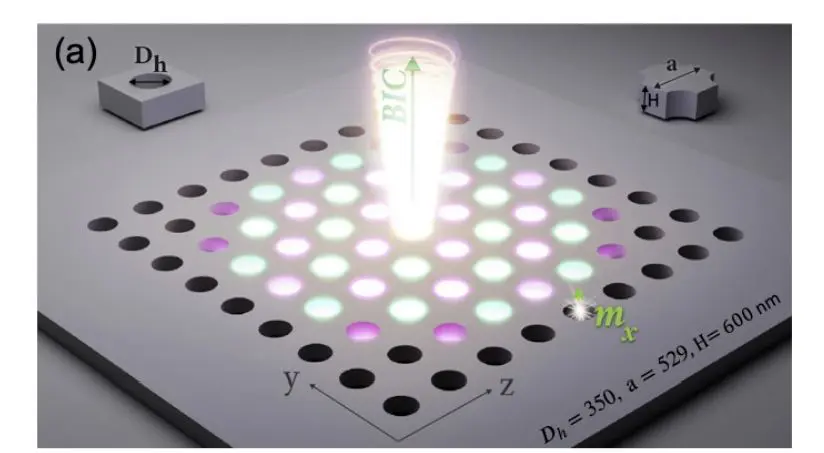
Researchers investigate symmetry breaking and the emergence of Mie-tronic supermodes within nonlocal metasurfaces, structures differing from conventional metamaterials due to their extended spatial responses. The team explores how symmetry in the metasurface design influences light confinement and enhancement, building upon established Mie-tronic resonances involving high-order multipolar excitations in dielectric structures. This work utilises theoretical investigation and advanced computational techniques to model the electromagnetic response of the designed metasurfaces. By carefully controlling the geometry and material properties, the team demonstrates the ability to break symmetry and induce the formation of specific Mie-tronic supermodes, characterised by enhanced electromagnetic fields and unique radiation patterns. The key contribution lies in demonstrating symmetry-controlled Mie-tronic supermodes in nonlocal metasurfaces, where introducing asymmetry manipulates the excitation and coupling of Mie-tronic resonances, forming supermodes with tailored properties. These supermodes exhibit significantly enhanced field confinement and increased radiation intensity compared to conventional Mie-tronic resonances, opening possibilities for advanced optical devices such as high-resolution imaging and efficient light harvesting.
Researchers have fundamentally challenged conventional understanding of symmetry in metasurfaces, demonstrating that breaking symmetry can actually enhance light trapping. Within the framework of Mie-tronics, symmetry breaking strengthens coupling pathways between elements, leading to improved performance. Detailed analysis of diffraction and multiple scattering establishes that both diffractive bands and Mie-tronic supermodes originate from the same underlying resonances, representing distinct physical phenomena. Finite metasurface arrays exhibit enhanced quality factors, a result of redistributed radiation channels that reverses predictions based on infinite lattice theory.
Mie Resonances and Topological Photonics Design
A comprehensive review of existing research reveals a strong focus on Mie resonances, bound states in the continuum (BICs), and topological photonics, with significant attention given to nonlocal metamaterials and their potential applications in quantum computing and integrated photonics. The research encompasses fundamental theory of light scattering, the design and fabrication of nanophotonic structures, and the development of advanced sensing and imaging technologies, with a central theme exploring high-quality factor resonances and the ability to control them. Bound states in the continuum, states localized within the radiation continuum, are a key area of investigation, with researchers exploring methods for creating and controlling BICs in metamaterials and nanostructures for applications in sensing, lasing, and nonlinear optics. The connection to nonlocal metamaterials, where the response is not purely local, is also highlighted, alongside a growing interest in topological photonics, which uses concepts from topological insulators to create robust and unidirectional light propagation.
The research indicates an interest in metamaterials enabling more complex and tunable optical properties. The review also reveals a strong thread related to using photonic structures for quantum information processing, including implementing quantum gates, simulating quantum systems, and building quantum sensors. The use of BICs and high-quality factor resonances to enhance nonlinear optical effects is a recurring theme, alongside applications in sensing and imaging leveraging enhanced light-matter interactions. The research encompasses a wide range of theoretical modeling and simulation techniques, including Mie theory, rigorous analytical modeling, and computational electromagnetics.
Symmetry Breaking Enhances Light Trapping in Metasurfaces
Researchers have fundamentally challenged conventional understanding of symmetry in metasurfaces, demonstrating that breaking symmetry can actually enhance light trapping. Within the framework of Mie-tronics, symmetry breaking strengthens coupling pathways between elements, leading to improved performance. Detailed analysis of diffraction and multiple scattering establishes that both diffractive bands and Mie-tronic supermodes originate from the same underlying resonances, representing distinct physical phenomena. Finite metasurface arrays exhibit enhanced quality factors, a result of redistributed radiation channels that reverses predictions based on infinite lattice theory.
Crucially, controlled symmetry breaking opens new channels for electromagnetic coupling, enabling polarization conversion with efficiencies reaching up to 30%. These findings establish a unified understanding linking scattering and diffraction theories, and provide design principles for multifunctional metasurfaces capable of advanced light manipulation and emission control. The authors acknowledge that extending the Mie-tronics framework to more complex regimes, such as nonlinear or quantum systems, represents a future research direction, and highlight the need for continued advances in computational power to model large ensembles of Mie scatterers accurately, ultimately laying the foundation for multifunctional integrated photonic circuits.
🗞 Symmetry Breaking and Mie-tronic Supermodes in Nonlocal Metasurfaces
🧠 ArXiv: https://arxiv.org/abs/2511.03560