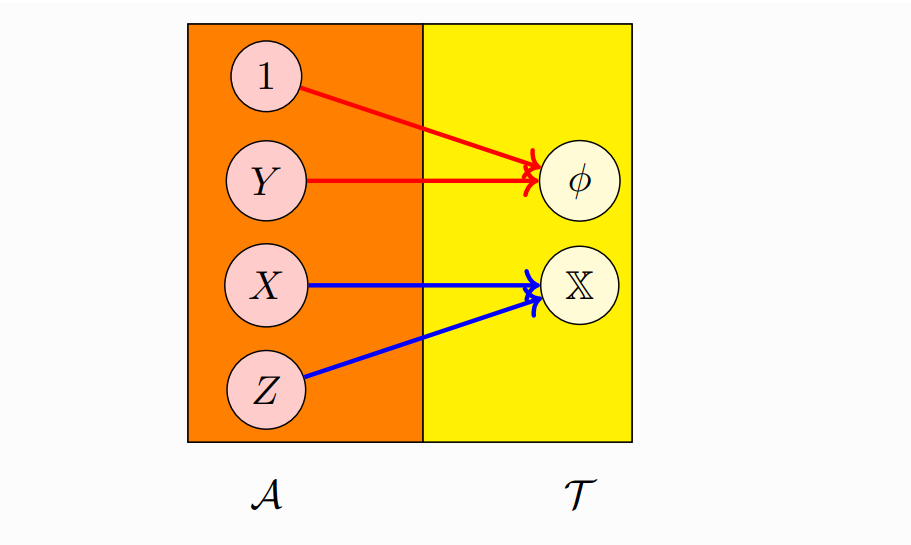
The subtle loss of information accompanying symmetry breaking represents a fundamental challenge in physics, and researchers are now applying new mathematical tools to understand this process in complex systems. Javier Molina-Vilaplana from Universidad Politécnica de Cartagena, Germán Sierra from Instituto de Física Teórica, UAM-CSIC, and H. C. Zhang develop a powerful algebraic framework to characterise how symmetry breaks down in two-dimensional systems exhibiting generalized, non-invertible symmetries. Their work connects the mathematical concept of subfactors with the physical phenomenon of anyon condensation, which occurs in exotic states of matter, and introduces a way to quantify the information lost when symmetry breaks using a measure called relative entropy. By establishing a universal bound on this information loss, linked to the underlying structure of the condensate, the team provides new insights into the behaviour of these systems and forges connections between operator algebras, tensor categories, and the study of generalized symmetries.
Our work focuses on groups within a categorical framework, a perspective that naturally connects to the description of anyon condensation in topological phases of matter. Central to our approach are coarse-graining maps, functioning as quantum channels that project observables from a phase with higher symmetry onto one where the symmetry is partially or completely broken by condensation. By employing relative entropy as an entropic order parameter, we quantify the information loss induced by condensation and establish a universal bound governed by the Jones index, which is equal to the quantum dimension of the condensate. We illustrate this framework through explicit examples, including the toric code.
Non-Invertible Symmetries and Topological Quantum Computation
Recent research extensively explores non-invertible symmetries, topological quantum computation, subfactors, entanglement, and related mathematical structures. This work investigates symmetries that are not invertible, challenging standard assumptions in quantum field theory and condensed matter physics. A significant portion of the research delves into the mathematical foundations of subfactors and operator algebras, providing a rigorous framework for understanding and classifying these symmetries. Many papers connect non-invertible symmetries to topological quantum computation, where anyons, particles with exotic exchange statistics, are crucial.
These symmetries offer new ways to realize and manipulate anyonic systems. Entanglement, a key resource for quantum information processing, is deeply connected to topological order, and researchers explore how to use entanglement measures, like relative entropy, to characterize different phases of matter and detect topological order. The mathematical language of category theory, particularly tensor categories, is essential for describing the algebraic structure of non-invertible symmetries and anyonic systems. A more recent development, SymTFTs, aims to provide a framework for describing topological phases of matter with non-invertible symmetries.
Current research focuses on developing a robust framework for SymTFTs, understanding their properties, and constructing examples. Researchers are also investigating how to consistently incorporate non-invertible symmetries into gauge theories and exploring the deep connection between modular invariance, a key property of topological phases, and the structure of entanglement. There is increasing interest in applying these ideas to understand and classify different phases of matter, particularly those with topological order. This is a highly active and interdisciplinary field, bringing together ideas from mathematics, physics, and computer science. The exploration of non-invertible symmetries challenges our understanding of fundamental concepts and has the potential to lead to new discoveries in both fields.
Entropic Order Parameter Quantifies Symmetry Breaking
Scientists have developed a novel algebraic and theoretical framework to characterize symmetry breaking in two-dimensional systems exhibiting generalized, non-invertible symmetries. The work models symmetry reduction within subfactor theory, utilizing condensable Frobenius algebras to represent generalized subgroups in a categorical setting, connecting directly to anyon condensation in topological phases of matter. Central to this approach are coarse-graining maps, functioning as quantum channels that project observables from a phase with higher symmetry onto one with reduced symmetry due to condensation. Experiments reveal that relative entropy serves as an effective entropic order parameter, quantifying the information loss induced by condensation.
Measurements establish a universal bound on this loss, governed by the Jones index, which is equal to the quantum dimension of the condensate. The team illustrated this framework through explicit examples, including the toric code, abelian groups ZN, and the representation category Rep(S3), demonstrating how dualities give rise to equivalence classes of condensation patterns. Results demonstrate that conditional expectations and coarse-grainings function as quantum channels, effectively projecting observables between different symmetry states. The research confirms that both gauging and anyon condensation are governed by the same algebraic structure, specifically condensable algebras, which simultaneously implement projection onto invariant observables and symmetry reduction. Measurements show that relative entropy accurately quantifies the information lost during condensation, with the magnitude of this loss directly linked to the quantum dimension of the condensate via the Jones index. This framework provides a comprehensive treatment combining concepts from condensed matter physics, operator algebras, tensor category theory, and quantum information in the study of non-invertible symmetries.
Symmetry Breaking and Topological Order Quantified
This work presents a new algebraic and information-theoretic framework for understanding how generalized symmetries break down in two-dimensional systems. Researchers developed a method using subfactor theory and condensable algebras to model symmetry breaking, effectively generalizing the concept of subgroups to non-invertible symmetries, which are common in systems exhibiting topological order. The approach connects symmetry breaking to the mathematical tools of tensor categories, providing a novel way to analyze phases of matter with these complex symmetries. The team quantified the loss of symmetry during condensation, a process where symmetries are partially or completely broken, using a concept called relative entropy.
They established a universal bound on this loss, linked to the dimension of the condensate, offering a fundamental constraint on symmetry-breaking patterns. This framework was successfully demonstrated through examples including the toric code and abelian groups. The authors acknowledge that their current framework primarily focuses on two-dimensional systems. Future research directions include exploring the application of this framework to gapless phases of matter and investigating the connection between their approach and the SymTFT framework, which characterizes symmetry in terms of topological quantum field theories. They also suggest that further investigation into the relationship between their results and existing classifications of phases with topological order would be valuable.
🗞 Information Loss and Cost in Symmetry Breaking
🧠 ArXiv: https://arxiv.org/abs/2509.24625