

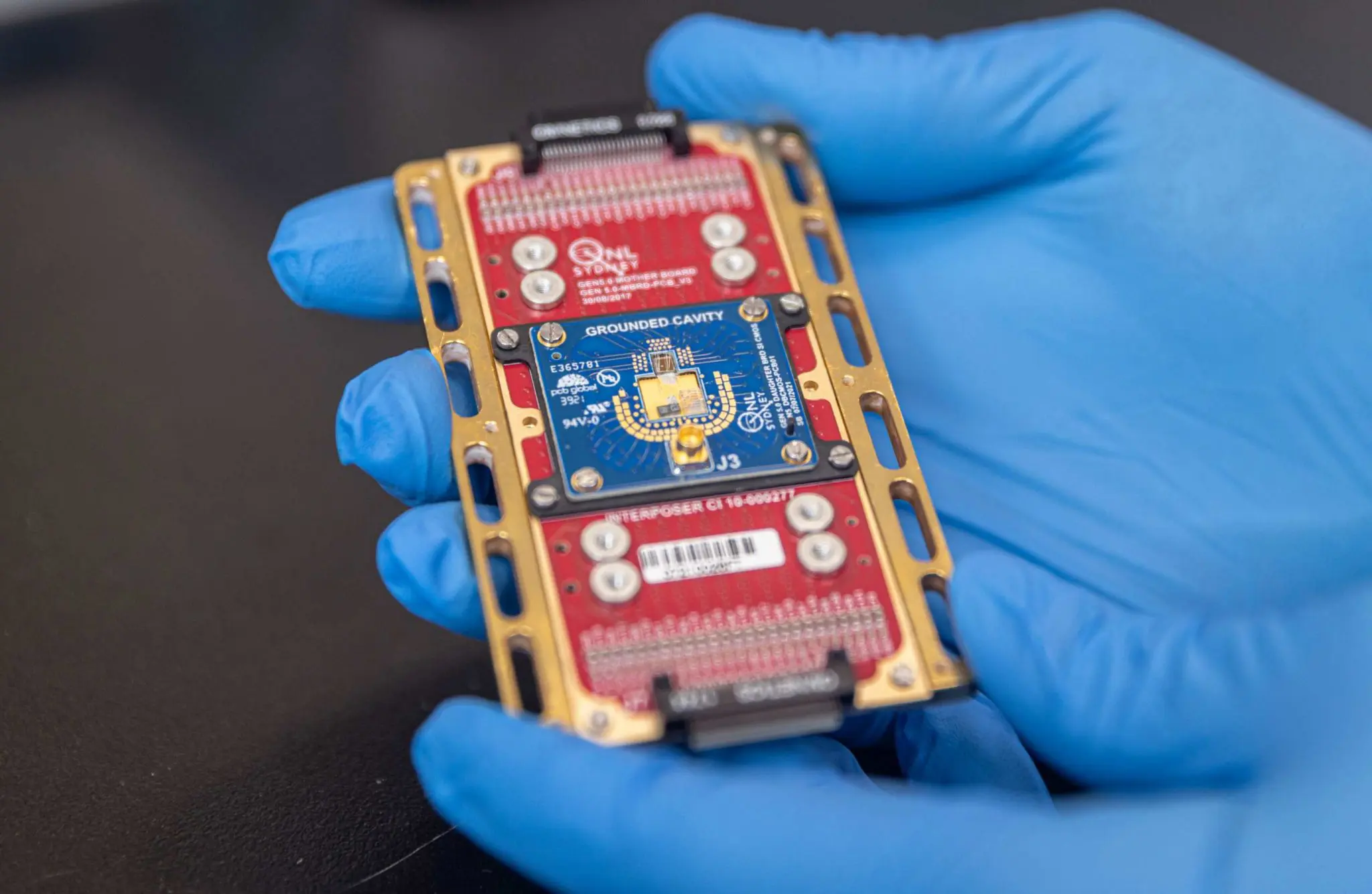
Researchers at the University of Sydney and UNSW have demonstrated a silicon chip controlling spin qubits – quantum bits leveraging electron magnetic direction – at temperatures just above absolute zero, a development poised to accelerate quantum computer scalability. Published in Nature, the work details a cryogenic control system achieving negligible fidelity loss for qubit operations despite operating with a power consumption of just 10 microwatts. The advance, backed by Microsoft and the Australian Research Council, underpins the commercial strategy of Emergence Quantum, a spin-out aiming to deliver practical quantum computing solutions within the next five years.
The development of cryogenic control electronics capable of operating at temperatures just above absolute zero represents a significant step towards addressing a critical impediment to practical quantum computation: scalability. Researchers at the University of Sydney, in collaboration with the University of New South Wales and their affiliated companies Emergence Quantum and Diraq, have demonstrated a silicon chip capable of controlling spin qubits – utilising the magnetic orientation of single electrons to encode information – with minimal performance degradation. This is particularly noteworthy given the compatibility of spin qubits with existing CMOS manufacturing processes, potentially easing the transition from research prototypes to commercially viable systems.
A key achievement detailed in the Nature publication concerns the mitigation of signal fidelity loss typically associated with placing control electronics in close proximity to qubits. The team demonstrated negligible impact on single-qubit operations, coherence times, and qubit interactions, despite the switching transistors being less than a millimetre away. This represents a substantial improvement over previous designs where signal interference and thermal noise often limited the number of reliably controllable qubits. Crucially, the chip operates with a remarkably low power consumption of 10 microwatts, with analogue components dissipating only 20 nanowatts per megahertz, a factor vital for managing the energy demands of large-scale quantum processors.
The implications for quantum computing scalability are considerable. Maintaining the delicate quantum states of qubits requires extremely low temperatures, and the ability to control a large number of qubits without introducing significant noise or energy overhead is paramount. This advance, coupled with the use of silicon-based qubits, positions the technology as a viable pathway towards building quantum processors with the millions of qubits necessary for tackling complex computational problems. The research, supported by Microsoft and the Australian Research Council, underscores the growing investment in silicon-based quantum technologies as a pragmatic approach to achieving practical quantum computation.
Scaling Qubit Systems
The demonstrated fidelity of qubit control is further reinforced by the chip’s minimal impact on key quantum characteristics. The research team observed no measurable reduction in qubit coherence time – the duration for which a qubit maintains its quantum state – and comparable qubit interactions, despite the close proximity of the control electronics. This is a critical factor in achieving quantum computing scalability, as maintaining coherence is essential for performing complex calculations. Previous designs often suffered from signal degradation and increased noise, hindering efforts to build processors with the requisite millions of qubits for practical applications.
Beyond simply increasing qubit count, this advance facilitates the development of more complex quantum architectures. The ability to precisely control individual qubits, coupled with minimal impact on coherence times and interactions, is essential for implementing sophisticated quantum algorithms and error correction schemes. These features are crucial for realising the full potential of quantum computation and tackling problems intractable for classical computers.
The collaborative nature of this research, involving both academic institutions and spin-out companies – Emergence Quantum and Diraq – highlights a growing trend in the quantum computing industry. This synergy between fundamental research and commercial development is accelerating the translation of scientific breakthroughs into tangible technologies. Diraq’s focus on integrating silicon qubits with classical control electronics, underpinned by the University of Sydney’s control chip, represents a pragmatic approach to achieving quantum computing scalability and building commercially viable quantum processors.
Implications for Quantum Technology
The demonstrated performance characteristics of this control chip directly address a central challenge to quantum computing scalability: the trade-off between qubit control fidelity and system complexity. Previous cryogenic control systems often imposed limitations on qubit density due to signal attenuation and increased noise, hindering efforts to build processors with the requisite millions of qubits for practical applications. This research demonstrates that high-fidelity control can be maintained even with closely integrated electronics, paving the way for denser qubit arrays and more powerful quantum processors.
Beyond simply increasing qubit count, this advance facilitates the development of more complex quantum architectures. The ability to precisely control individual qubits, coupled with minimal impact on coherence times and interactions, is essential for implementing sophisticated quantum algorithms and error correction schemes. These features are crucial for realising the full potential of quantum computation and tackling problems intractable for classical computers.
The commercial implications of this technology are significant. Diraq’s stated goal of integrating these silicon qubits with classical control electronics in a compact, energy-efficient package positions them to address a key barrier to widespread adoption of quantum computing. The scalability and energy efficiency demonstrated by this research are essential for transitioning from laboratory prototypes to commercially viable quantum systems, potentially accelerating the development of quantum-based solutions across various industries.
Furthermore, the potential applications extend beyond conventional computation. Professor Reilly’s vision of near-term sensing systems and future data centres highlights the versatility of this technology. The precise control and low-noise characteristics of the chip could enable the development of highly sensitive quantum sensors for applications in medical imaging, materials science, and environmental monitoring, while also offering potential benefits for energy-efficient data processing.
More information
External Link: Click Here For More


