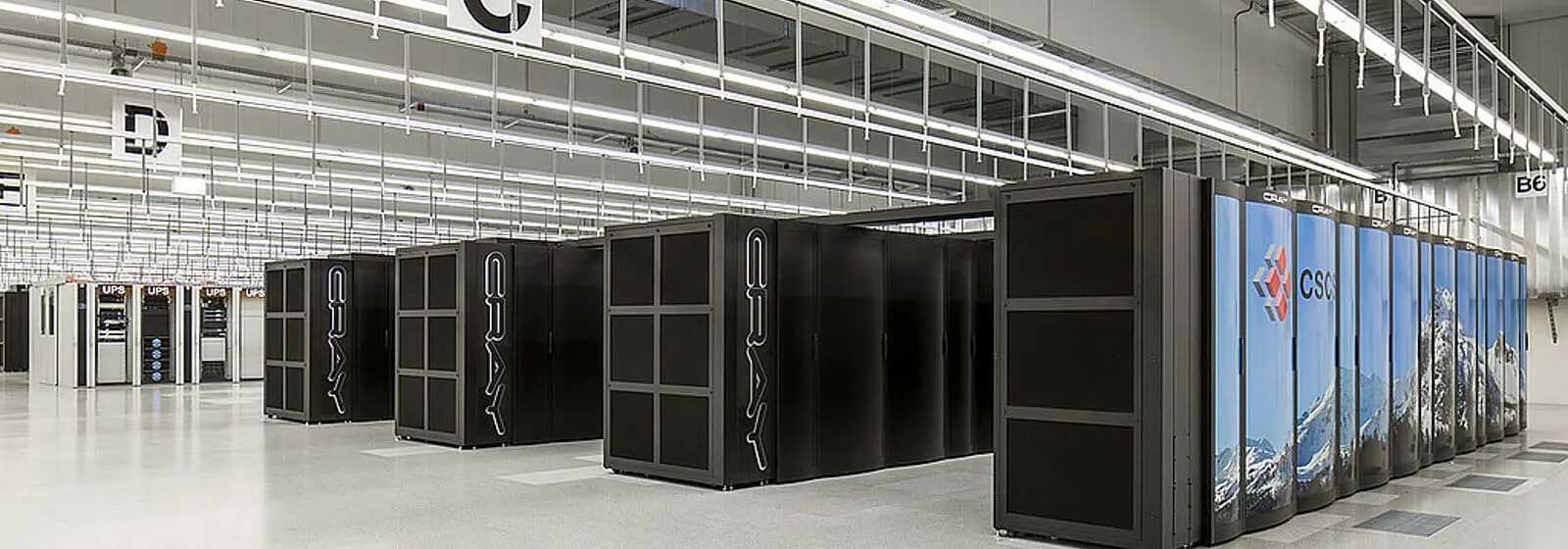
As the curtains draw on the illustrious career of Piz Daint, Europe’s most potent GPU-accelerated supercomputer, the scientific community is reminded of the profound impact of high-performance computing (HPC) on advancing our understanding of the world.
For over a decade, this Swiss National Supercomputing Centre (CSCS) flagship system has been at the forefront of computational science, driving breakthroughs in fields as diverse as climate modeling, astrophysics, materials science, and life sciences.
With its legacy of innovation and technological evolution, Piz Daint’s retirement marks not only the end of an era but also a significant milestone in the ongoing quest for scientific discovery, underscoring the critical role that supercomputing plays in pushing the boundaries of human knowledge and driving progress in an increasingly complex and interconnected world.
As researchers transition to next-generation systems like the HPE Cray EX Supercomputer “Alps”, they carry forward the lessons and methodologies honed on Piz Daint, poised to tackle the most pressing challenges of our time with unprecedented computational power and efficiency.
The End of an Era: Farewell to Piz Daint, a Pioneer in Supercomputing
For over a decade, Piz Daint, the Cray XC50/XC40 supercomputer at the Swiss National Supercomputing Centre (CSCS), has been a driving force behind advancements in computational science across Switzerland, Europe, and beyond. With its GPU-accelerated hardware, Piz Daint has pushed the boundaries of high-performance computing (HPC) and revolutionized research in diverse scientific fields. As the supercomputer reaches the end of its life, it leaves behind a legacy of innovation, scientific breakthroughs, and technological evolution.
The Birth of a Hybrid Supercomputer
Commissioned in 2012, Piz Daint began as a Cray XC30 multicore system. However, it was the addition of NVIDIA K20x GPUs in 2013 that marked the beginning of its transformation into a hybrid supercomputer. A significant upgrade in 2016 combined Intel Xeon E5-2690 v3 (Haswell) CPUs with NVIDIA Tesla P100 GPUs, making Piz Daint one of the earliest large-scale GPU-accelerated supercomputers in the world. The Aries interconnect provided ultra-fast communication between nodes, ensuring exceptional computational efficiency.
With a peak performance of 27 petaflops, Piz Daint became Europe’s most powerful GPU-accelerated supercomputer, consistently ranking among the top 10 supercomputers worldwide. Its hybrid architecture enabled large-scale CPU-GPU computing, making it an ideal platform for a wide range of scientific applications.
A New Era for Swiss Science
Piz Daint was designed to support various scientific disciplines, enabling groundbreaking discoveries across fields such as Earth and Environmental Science, Astrophysics and Cosmology, Materials Science, Quantum Chemistry, and Life Sciences. In Earth and Environmental Science, Piz Daint enabled high-resolution climate modeling, significantly improving the accuracy of weather predictions and long-term climate projections.
In Astrophysics and Cosmology, scientists leveraged its computing power to model the evolution of the universe, providing insights into the origins of galaxies and dark matter. The supercomputer also played a crucial role in Materials Science and Quantum Chemistry, helping develop new materials and contributing to the discovery of next-generation semiconductors, batteries, and superconductors.
In the field of Life Sciences, Piz Daint enabled advanced molecular simulations essential for biomedical research, such as protein folding, drug interactions, and genome sequencing. These simulations ultimately accelerated the development of potential treatments for various diseases.
The Legacy of Piz Daint
Piz Daint was more than just a supercomputer – it was a catalyst for scientific discovery, a symbol of European HPC excellence, and a testament to Switzerland’s commitment to innovation. As researchers transition to “Alps,” the new HPE Cray EX Supercomputer, they carry forward the lessons, methodologies, and breakthroughs made possible by this flagship system.
The legacy of Piz Daint extends beyond its technical specifications and scientific achievements. It represents a decade of collaboration, innovation, and progress in the field of supercomputing. The supercomputer’s impact will be felt for years to come, as researchers continue to build upon the discoveries and advancements made possible by Piz Daint.
The Future of Supercomputing
As Piz Daint is decommissioned, the Swiss National Supercomputing Centre (CSCS) is preparing for a new era of supercomputing with “Alps,” the new HPE Cray EX Supercomputer. With a peak performance of over 200 petaflops, “Alps” is more than ten times as powerful as Piz Daint and features a water-cooled design, making it completely silent.
The transition to “Alps” marks an exciting new chapter in the history of supercomputing at CSCS. As researchers begin to explore the capabilities of the new system, they will be able to tackle even more complex scientific challenges and make new breakthroughs in various fields.
Curtains Close on Piz Daint
As the curtains close on Piz Daint’s remarkable career, it is clear that its legacy will endure. The supercomputer’s impact on scientific research and innovation has been profound, and its contributions will continue to shape the future of various fields. As the world of supercomputing continues to evolve, one thing is sure – Piz Daint will be remembered as a pioneer in the field, a testament to human ingenuity and the boundless potential of technological innovation.
The decommissioning of Piz Daint serves as a reminder that progress is often marked by the end of one era and the beginning of another. As researchers embark on new journeys with “Alps” and other next-generation supercomputers, they will continue to push the boundaries of human knowledge and understanding, driven by the same spirit of innovation and discovery that defined Piz Daint’s remarkable career.
In the words of CSCS Director Thomas Schulthess, “Piz Daint was an extraordinary system that enabled us to tackle complex scientific challenges and make new breakthroughs in various fields. We are grateful for its service and look forward to the exciting possibilities that ‘Alps’ and future supercomputers will bring.” As the world bids farewell to Piz Daint, it is clear that its legacy will continue to inspire and drive innovation in the years to come.
External Link: Click Here For More