Researchers from the Institute of Physics and the Center for Quantum Science and Engineering at Ecole Polytechnique Fédérale de Lausanne have developed a new method, the LowRank Variational Quantum Algorithm, to simulate the real-time evolution of the density matrix in quantum systems. The algorithm, which requires fewer qubits than other methods, encodes each pure state of the statistical mixture as a parametrized quantum circuit. The team’s research could lead to more efficient simulations of quantum systems, aiding in the development of quantum technologies and our understanding of quantum systems. Future research will focus on optimizing the algorithm and exploring its applicability to a wider range of quantum systems.
What is the LowRank Variational Quantum Algorithm for the Dynamics of Open Quantum Systems?
The LowRank Variational Quantum Algorithm is a new method developed by researchers Sara Santos, Xinyu Song, and Vincenzo Savona from the Institute of Physics and the Center for Quantum Science and Engineering at Ecole Polytechnique Fédérale de Lausanne in Switzerland. This algorithm is designed to simulate the real-time evolution of the density matrix, which is a mathematical representation of the quantum state of a system. The algorithm operates under the assumption that the quantum state has a bounded entropy, which allows for a low-rank representation of its density matrix.
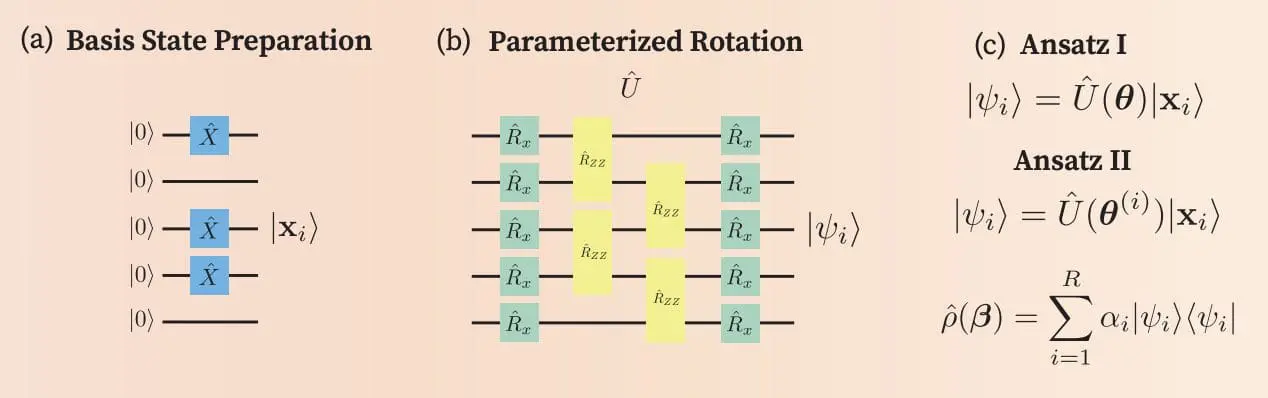
The algorithm encodes each pure state of the statistical mixture as a parametrized quantum circuit and the associated probabilities as additional variational parameters stored classically. This approach requires a significantly lower number of qubits than algorithms where the full density matrix is encoded in the quantum memory. The researchers proposed two variational Ansätze (trial solutions) and assessed their effectiveness in the simulation of the dynamics of a 2D dissipative transverse field Ising model. The results underscore the algorithm’s efficiency in simulating the dynamics of open quantum systems in the low-rank regime with limited quantum resources on a near-term quantum device.
Why is the Simulation of Open Quantum Systems Important?
The simulation of open quantum systems is crucial for solving numerous outstanding problems in physics, chemistry, material science, and the development of quantum technologies. Quantum systems are invariably influenced by their environment, an interaction that often has detrimental effects such as decoherence, thereby limiting the efficacy of quantum technological platforms. The ability to efficiently simulate open quantum systems is thus of paramount importance, providing essential insights into their fundamental properties and aiding in the development of quantum technologies.
The statistical properties of an open quantum system are fully described by the density matrix, which gives direct access to statistical ensemble averages of physical quantities. The time evolution of the density matrix is governed by a master equation, which within the general assumption of a Markovian environment takes the celebrated Lindblad form. Alternatively, open quantum systems admit a stochastic description in terms of quantum trajectories, which simulate their dynamics by unraveling the evolution of the system’s density matrix into an ensemble of stochastically evolving pure states.
How Does the LowRank Variational Quantum Algorithm Work?
The LowRank Variational Quantum Algorithm works by simulating the real-time evolution of the density matrix governed by the Lindblad master equation. The Lindblad master equation is a mathematical description of how the quantum state of a system changes over time due to interactions with its environment. The algorithm operates under the assumption that the quantum state has a bounded entropy, which allows for a low-rank representation of its density matrix.
The algorithm encodes each pure state of the statistical mixture as a parametrized quantum circuit and the associated probabilities as additional variational parameters stored classically. This approach requires a significantly lower number of qubits than algorithms where the full density matrix is encoded in the quantum memory. The researchers proposed two variational Ansätze (trial solutions) and assessed their effectiveness in the simulation of the dynamics of a 2D dissipative transverse field Ising model.
What are the Implications of this Research?
The development of the LowRank Variational Quantum Algorithm has significant implications for the field of quantum computing and the simulation of open quantum systems. The algorithm’s efficiency in simulating the dynamics of open quantum systems in the low-rank regime with limited quantum resources on a near-term quantum device is a significant advancement. This could potentially lead to more accurate and efficient simulations of quantum systems, which is key to solving numerous outstanding problems in physics, chemistry, material science, and the development of quantum technologies.
Furthermore, the algorithm’s approach of encoding each pure state of the statistical mixture as a parametrized quantum circuit and the associated probabilities as additional variational parameters stored classically could potentially lead to a reduction in the number of qubits required for quantum simulations. This could make quantum simulations more accessible and feasible with current quantum computing technology.
What are the Future Directions for this Research?
The LowRank Variational Quantum Algorithm represents a significant step forward in the simulation of open quantum systems. However, there is still much work to be done in this field. Future research could focus on further optimizing the algorithm and exploring its applicability to a wider range of quantum systems. Further research could also focus on exploring other methods of reducing the number of qubits required for quantum simulations.
The researchers’ work also opens up the possibility of exploring other low-entropy quantum states and their potential applications in quantum computing. Furthermore, the development of more efficient and accurate quantum simulation algorithms could also have significant implications for the development of quantum technologies and our understanding of quantum systems.
Publication details: “Low-Rank Variational Quantum Algorithm for the Dynamics of Open Quantum
Systems”
Publication Date: 2024-03-09
Authors: Sara Santos, Xinyu Song and Vincenzo Savona
Source: arXiv (Cornell University)
DOI: https://doi.org/10.48550/arxiv.2403.05908