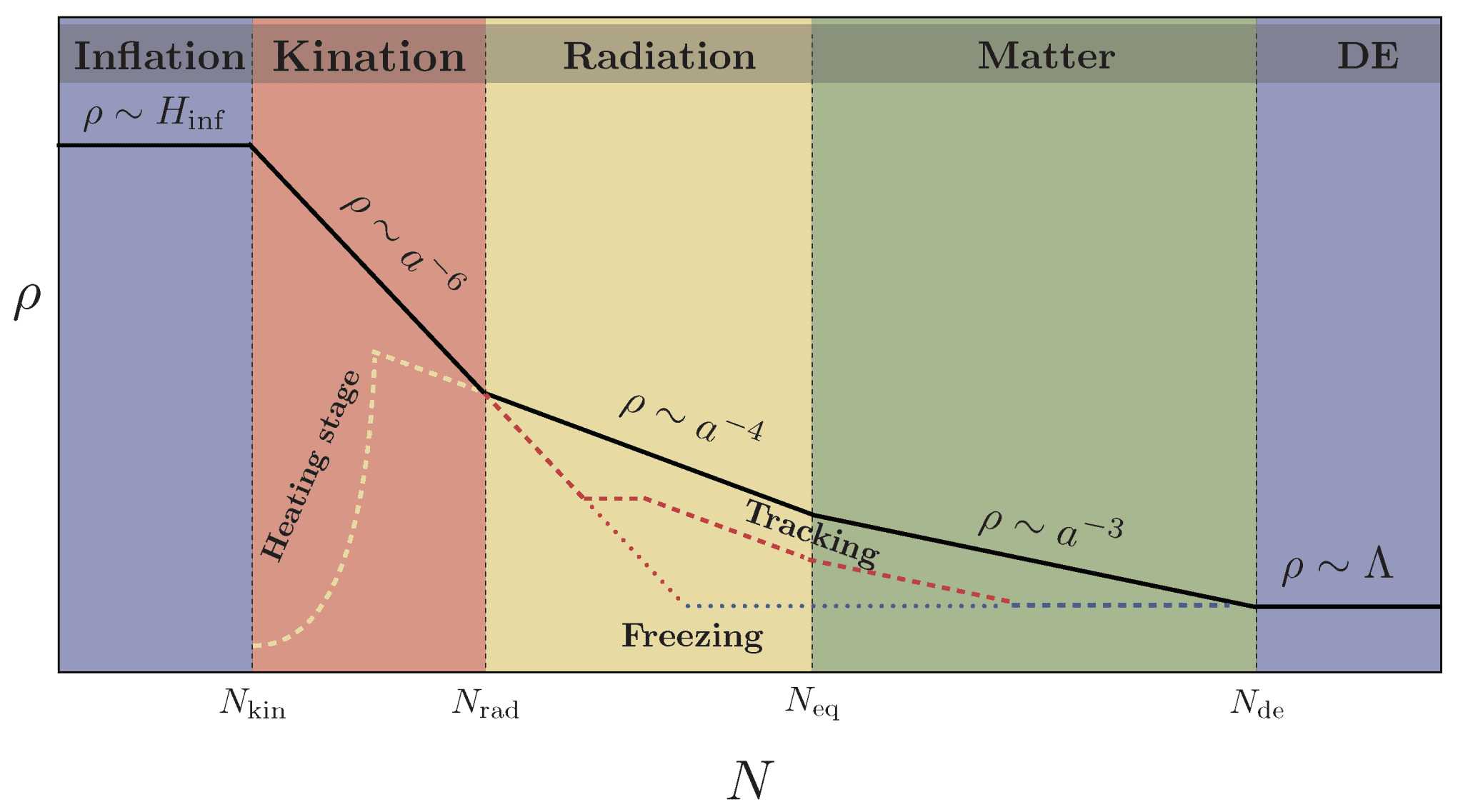
The enduring mystery of the Universe’s earliest moments and its accelerating expansion drives ongoing research into models that connect inflation with dark energy, and a recent study by S. Saoud, M. A. Rbah, and R. Sammani, alongside E. H. Saidi and R. Ahl Laamara from Mohammed V University, investigates this connection within a specific theoretical framework. The team explores a scenario combining quintessential inflation, driven by a field linked to the Inert Doublet Model, with a universe exhibiting late-time acceleration, and they demonstrate how this approach generates a modified form of inflationary potential resembling the well-known Starobinsky model. Their analysis of the resulting cosmological predictions reveals a critical tension, however, as current observational data demands a very weak coupling between the inflationary field and the universe’s expansion, while theoretical consistency, specifically the swampland dS conjecture, suggests a stronger coupling is necessary, potentially challenging the viability of this model and highlighting a fundamental conflict between gravity and cosmological observations. This work therefore advances our understanding of the early universe and the constraints imposed by theoretical consistency, paving the way for further investigation into models that reconcile inflationary predictions with the broader landscape of theoretical physics.
Scientists explore whether seemingly viable models of the universe, describing its rapid early expansion and current accelerated expansion, actually align with the fundamental principles of string theory. The swampland conjecture suggests that not all effective field theories are fully realized within a consistent string theory framework, imposing specific criteria that valid theories must satisfy. They investigate whether the IDM’s potential energy landscape, required to explain both inflation and dark energy, is consistent with the constraints imposed by the swampland. The results suggest that certain configurations within the IDM might require fine-tuning or modifications to avoid inconsistencies with the swampland criteria. Furthermore, the research explores the connection between the IDM, potential instability in the Higgs boson, and the swampland, suggesting the IDM might offer a way to stabilize the Higgs potential while still adhering to the swampland’s requirements. By applying swampland criteria to the IDM, scientists constrain effective field theory models, ultimately assessing whether models attempting to explain both dark matter/dark energy and the early universe’s expansion are truly consistent with the underlying principles of string theory. They transformed equations, resulting in an effective potential resembling a well-known model of inflation, modulated by an exponential factor, aiming to unify the early inflationary epoch with the current accelerated expansion. By analyzing the dynamics of the two interacting fields, researchers calculated parameters characterizing the inflationary period and predicted observable signatures in the cosmic microwave background. The team meticulously calculated key inflationary observables, specifically the spectral index and tensor-to-scalar ratio, to compare their predictions with the latest data from cosmological observations.
This revealed that the coupling between the quintessence and inflaton fields must remain extremely weak, on the order of 10⁻¹². Furthermore, the study examined the compatibility of the model with the swampland dS conjecture, finding a tension between gravity consistency and cosmological viability, indicating the model favors a specific type of potential. The team detailed the Higgs potential associated with the IDM, incorporating the coupling to the quintessence field, and derived the masses of the resulting scalar particles. The research team analyzed the resulting dynamics of the two interacting fields, calculating parameters characterizing the inflationary period and predicting observable signatures in the cosmic microwave background. Measurements reveal a critical constraint on the coupling between the quintessence and inflationary fields; the coupling must be exceedingly weak, on the order of 10⁻³, to align with current observational data. Experiments demonstrate that a stronger coupling leads to significant suppression of primordial fluctuations, creating tension with expectations from the swampland de Sitter conjecture, which favors a specific type of potential.
Data shows that simultaneously satisfying both cosmological observations and quantum gravity constraints proves challenging within this framework. Measurements of these masses, derived from the potential, are crucial for collider searches and dark matter investigations. By employing a mathematical transformation, scientists derived an effective potential that unifies these two epochs, offering a potential framework for understanding the universe’s evolution from its earliest moments to the present day. Analysis of the resulting dynamics and parameters allowed for predictions regarding the primordial perturbation spectrum and key inflationary observables, which were then compared with the latest data from cosmic microwave background observations. The findings indicate that the coupling between the quintessence and inflationary fields must be exceptionally weak to align with current observational constraints. However, the research also highlights a tension with the de Sitter Swampland Conjecture, which favors a different type of potential, suggesting a potential challenge to the model’s consistency with broader theoretical frameworks of quantum gravity. The authors acknowledge this discrepancy and propose that further investigation into extensions and stabilization mechanisms may be necessary to reconcile the inflationary predictions with these more fundamental constraints.
👉 More information
🗞 Swampland bound on quintessential inflation in IDM
🧠 ArXiv: https://arxiv.org/abs/2512.14651